
AI Visibility Tracking13 min read
AI Visibility for Canadian Trucking Companies
Published · RankMonks
AI visibility for a Canadian trucking company is how often, and how accurately, AI tools name your carrier when people ask questions about freight, lanes and driving jobs. It covers ChatGPT, Claude, Perplexity, Gemini and Grok, along with the AI Overviews and AI Mode answers that Google shows in search.
The people asking are the same people who have always looked for carriers: shippers and 3PLs who need capacity, brokers who need a reliable partner on a lane, and drivers who want a seat with a company that gets them home. What has changed is the first step. A logistics coordinator in Mississauga can now ask "which carriers run temperature-controlled freight from the GTA to Chicago and handle their own customs paperwork?" and get a written answer with three or four names in it. If yours is not one of them, you were not in the running.
This guide explains what AI visibility means for a Canadian carrier, who is asking and what they ask, what makes tracking different in Canada, what to measure, how the work fits with SEO, AEO and GEO, and what to watch for if you hire help. It is the hub for four shorter guides on why it matters, how to set it up, how it works for local map answers and how it improves the rest of your search work.
Key takeaways
- AI visibility measures whether AI tools name your carrier, cite your pages and describe you correctly for the questions shippers, brokers and drivers ask.
- Canadian carriers need a prompt set that covers both audiences, both official languages where relevant, each province and terminal you operate from, and your cross-border lanes.
- Accuracy matters as much as presence, because a wrong answer about your authority, terminals or border programs can cost a load before anyone calls you.
- One answer proves little. The same prompts, run on a schedule and read as a trend, give a number you can manage.
- Tracking only pays when each report turns into SEO, AEO and GEO work, so treat it as the measurement layer for everything else you do in search.
What is AI visibility for a Canadian trucking company?
AI visibility is the degree to which AI tools mention, cite and correctly describe your trucking company when people ask questions about the freight you haul and the jobs you offer. It is a rate across many answers, not a position on a list.
Three things make it up:
- Mentions. The answer names your company in its text.
- Citations. The answer links to a page on your site, or lists it as a source.
- Accuracy. What the answer says about you is true and current: your terminals, your equipment, your lanes, your authority and whether you are hiring.
For a carrier, the third part carries extra weight. Shippers vet carriers on safety and compliance before they tender freight, and drivers choose employers on home time, routes and equipment. An answer that says you run flatbeds when you run reefers, or that you do not cross the border when half your freight goes to the US, does more harm than an answer that leaves you out.
Our general guide to AI visibility covers the idea across industries. This page applies it to Canadian trucking.
Who asks AI tools about Canadian carriers, and what do they ask?
Three groups ask AI tools about Canadian carriers: shippers and 3PLs looking for capacity, brokers looking for dependable partners, and drivers looking for work. Each group asks different questions, and each needs to find different facts in the answer.
| Who is asking | Example question | What they need the answer to get right |
|---|---|---|
| Shipper or 3PL | "Which carriers run dry van from Montreal to the Maritimes every week?" | Lanes, equipment, frequency, contact details |
| Shipper with US freight | "Canadian carriers with FAST approval for Toronto to Detroit loads" | Cross-border programs, US authority, crossings used |
| Broker | "Reliable flatbed carriers based in Alberta for oilfield equipment" | Equipment, region, safety record, insurance |
| Company driver | "AZ driver jobs in Brampton, home every night" | Location, licence class, routes, home time |
| Owner-operator | "Lease operator programs for Class 1 drivers in BC" | Program terms, regions, contact |
| French-speaking shipper | "Transporteur camion-remorque de Laval vers Toronto" | The same facts, in French, under your French name |
Notice how specific these questions are. They are too long and too particular to show up in a keyword tool, and they mix equipment, geography, compliance and language in one sentence. That is how people talk to an assistant, and it is why the prompts you track have to come from real conversations rather than a list of search terms.
What makes AI visibility different for Canadian carriers?
AI visibility is different for Canadian carriers because the answers have to deal with two languages, provincial regulation, a large share of cross-border freight and a market where many answers lean on US sources. Each of those creates a way to be left out or described wrongly.
Two languages. If you serve Quebec, or French-speaking customers in New Brunswick or Ontario, people will ask in French. AI tools can answer the same question differently in each language, and they may draw on different sources to do it. A carrier that is named in English answers but missing from French ones has a gap it cannot see without tracking both. If you market to Quebec, the Charter of the French Language, as amended by Bill 96, generally requires your commercial content to be available in French, so check the current requirements with your advisor.
Provincial regulation. Canadian carriers operate under the National Safety Code, with safety certificates and carrier profiles issued by the province where they are based, and Ontario carriers also hold a CVOR. These identifiers are exactly the kind of fact an assistant can garble or mix up between companies with similar names.
Cross-border freight. A large part of Canadian trucking runs to and from the United States. Shippers ask about border programs such as FAST, Partners in Protection and C-TPAT, about ACI and ACE eManifest, and about which crossings you use. If you hold a USDOT number and US operating authority, the answer should say so. If you do not, it should not imply that you do.
US-heavy sources. Many of the pages AI tools read about trucking are written for the US market. For a cross-border prompt, an answer can easily fill up with large US carriers and leave out a Canadian carrier that runs the lane every day. That is a measurable problem, and one you can work on.
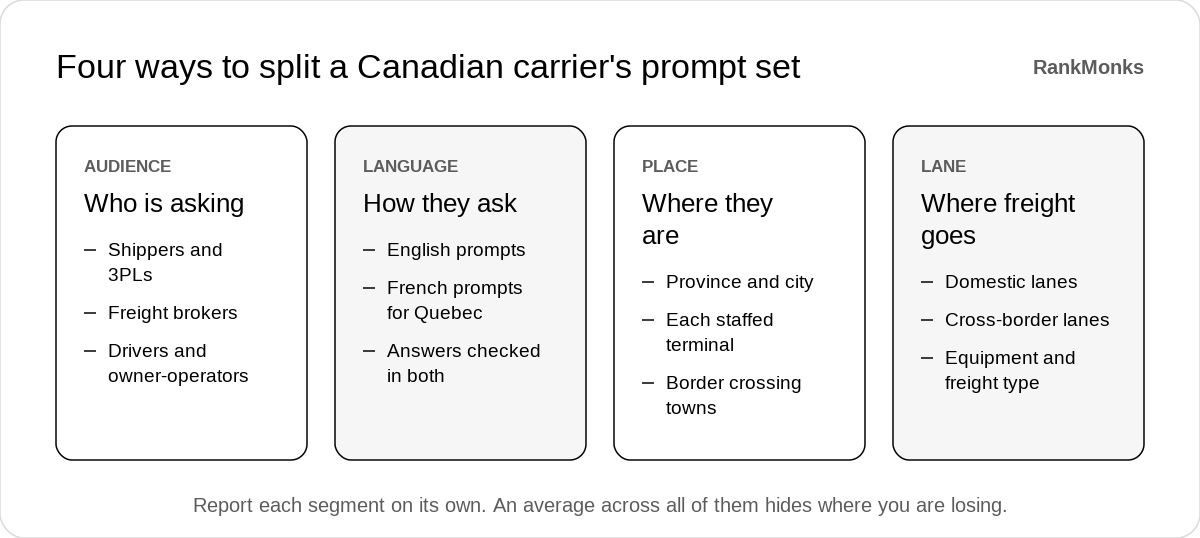
The practical result is that a Canadian prompt set needs more segments than a typical one. Split it by audience, by language, by place and by lane, and report each segment on its own. An overall average hides exactly the gaps you need to find.
What should a Canadian carrier track?
A Canadian carrier should track whether it is named, whether it is cited, where it appears in the answer, and whether the facts about its authority, services and hiring are right. Those six measures, recorded for every prompt in every tool, cover almost everything you need.
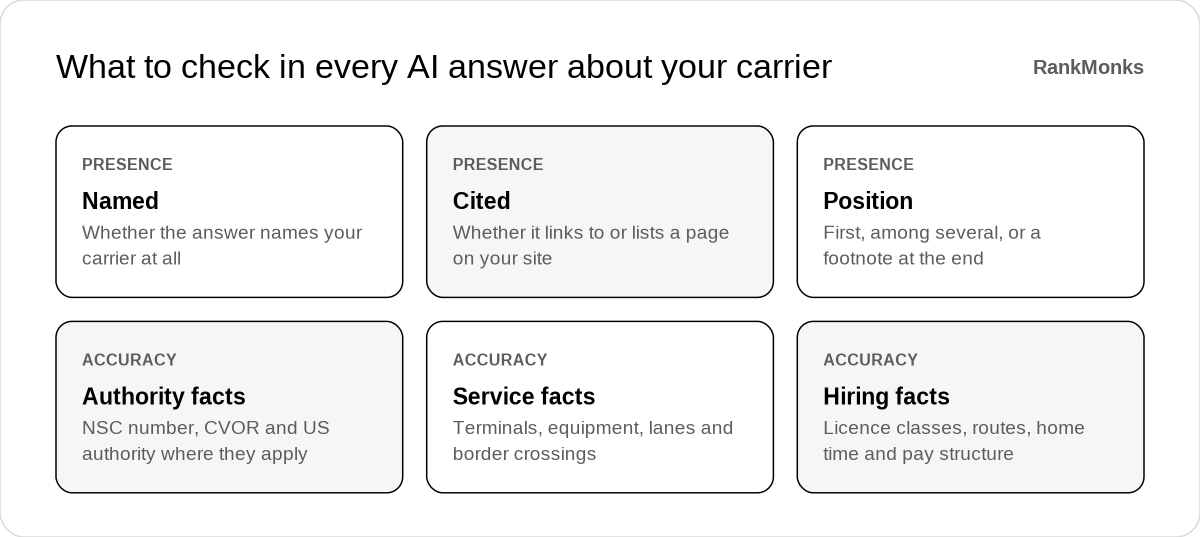
- Share of answers. The percentage of tracked answers that name you. This is the headline number, and our guide to AI share of voice explains how to calculate it fairly.
- Citation rate. How often an answer cites a page on your site. A high citation rate means your pages are doing the work. A low one means the answer is built from other people's pages about you.
- Position. Whether you are named first, among several, or as an afterthought.
- Authority facts. Your legal and trade names, NSC number, CVOR where it applies, and US identifiers if you cross the border. Check that no answer confuses you with a similarly named company.
- Service facts. Terminals, equipment (dry van, reefer, flatbed, Super B-trains, step decks), freight types, dangerous goods handling under the TDG regulations, lanes and crossings.
- Hiring facts. The roles you hire for, the licence classes you need (AZ in Ontario, Class 1 in most other provinces), routes, home time and how pay is structured.
Record the competitors named when you are not. Over a few months that list tells you who the AI tools treat as the default carriers for each lane, and which sources they lean on to say so.
How do you read AI visibility results without fooling yourself?
You read AI visibility results as a trend across many runs, split by segment, and never from a single answer. AI tools word their answers differently from one run to the next, and the brands they name can shift too.
Four habits keep the numbers honest:
- Keep the prompt set fixed. Add new prompts in a separate group, so this month's number can be compared with last month's.
- Repeat each prompt. Run each one several times per cycle and count how often you appear, rather than recording one answer.
- Control the setting. Use fresh sessions, note the location and language, and keep both the same from cycle to cycle. Some tools use the person's approximate location for local questions, so a prompt run from Toronto can name different carriers than the same prompt run from Calgary.
- Report by segment. Show shippers and drivers, English and French, each province and each lane group separately.
Also note that AI features do not always arrive in Canada at the same time as in the US, and the way a tool searches the web can change without notice. When a number jumps, check whether the tool changed before you credit or blame your own work.
How does AI visibility fit with SEO, AEO and GEO?
AI visibility is the measurement layer, and SEO, AEO and GEO are the work that moves it. Tracking tells you where you are missing or misdescribed. The other three disciplines fix the causes.
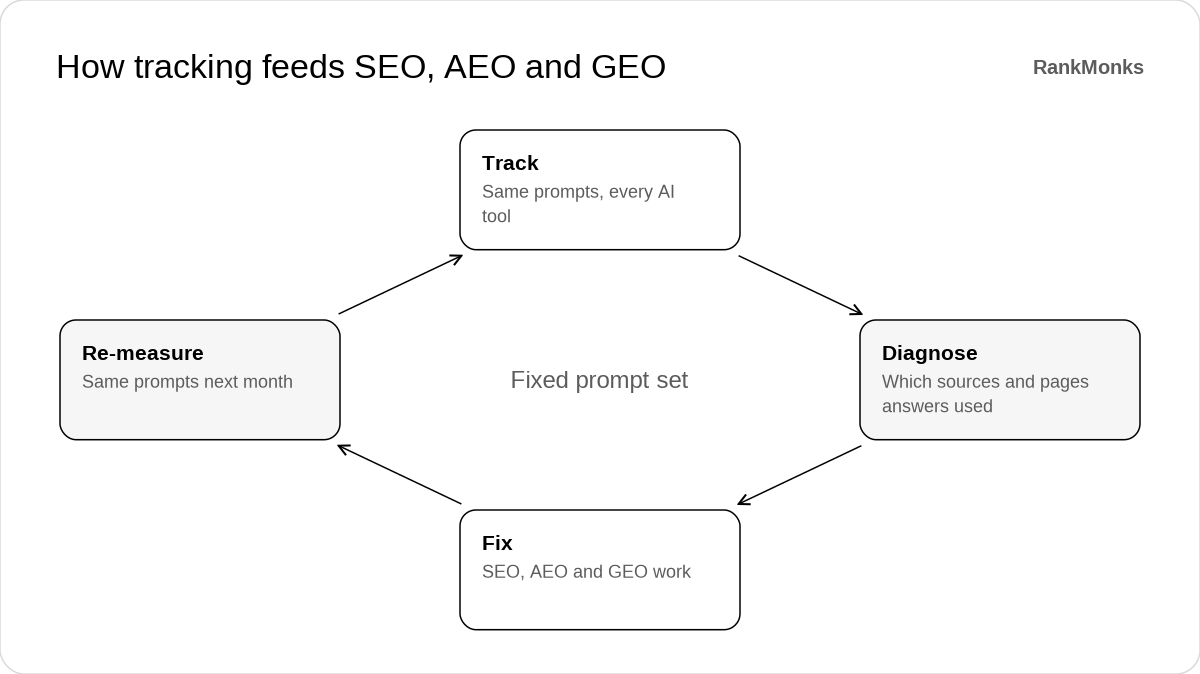
- SEO makes sure your pages can be found and read. Many AI tools search the web before they answer, and they tend to read pages that search engines can find. Our guide to SEO for Canadian trucking companies covers lane pages, terminal pages, French versions and the technical basics.
- AEO shapes your pages so the answer is easy to lift: a clear definition, a short list, a table of equipment or crossings. See AEO for Canadian trucking companies.
- GEO works on the wider picture the AI tools form from trade press, association listings, directories and reviews. See GEO for Canadian trucking companies.
The difference between the four is covered in more depth in our guide to GEO vs SEO vs AEO, and the wider shift in how search works is the subject of SEO in the AI era.
Where should a Canadian trucking company go from here?
Start by understanding why the work matters to your business, set up tracking properly, cover your local and terminal answers, and then use what you learn to direct the rest of your search work. Each step has its own guide.
Why AI visibility matters for a Canadian carrier
Shippers, brokers and drivers can now build a shortlist before they ever visit a carrier's website, and a carrier left out of that answer has no way to notice the loss. Our guide on why AI visibility is important for Canadian trucking companies sets out the business case and compares AI answers with load boards, brokers and job boards.
How to set up tracking properly
Good tracking starts with a fact sheet, a bilingual prompt set agreed with the people who talk to customers and drivers, and a baseline taken before anything changes. The step-by-step plan, including a first 90 days and the mistakes carriers make, is in how to implement AI visibility tracking properly for Canadian trucking companies.
How to win local and map answers
Many questions are local: "trucking companies hiring near Milton", "reefer carrier in Delta". AI tools increasingly answer them with map results, and the details often come from business listings that are out of date. Our guide to how Canadian trucking companies win on local maps with AI visibility tracking shows how to track terminal-level answers and fix what is wrong.
How tracking improves the rest of your search work
Every report should end in work. Our guide on how AI visibility tracking improves SEO, AEO and GEO for Canadian trucking companies explains how findings become page fixes, answer rewrites and source work, and how to decide what to do first.
If you also run a US operation or US terminals, our guide to AI visibility for US trucking companies covers the American side, from FMCSA identifiers to US freight hubs.
What warning signs should you watch for in an AI visibility provider?
The biggest warning sign is a promise that a provider can guarantee your carrier a place in ChatGPT or any other tool. Nobody controls those answers, and anyone who says otherwise is either guessing or planning something that will not last.
Watch out for these as well:
- Brand-name prompts only. "What is [your company]?" tells you little. Shippers and drivers ask about lanes, equipment and jobs, not your name.
- English only. If you serve Quebec and nobody is checking French answers, half your picture is missing.
- One run per prompt. A single answer is an anecdote, and a report built on it will swing from month to month for no reason.
- No accuracy checks. Counting mentions without checking what they say misses the most expensive errors, such as wrong authority or terminal details.
- No actions. A dashboard full of numbers with no list of fixes at the end is a cost, not a service.
- Hidden methods. You should be able to see the prompts, the tools, the dates and how share of answers is calculated.
Our guide to choosing an SEO agency covers the general warning signs, and our guide to the best AI visibility agency for small businesses applies them to AI tracking.
What should you ask before you hire help with AI visibility?
Ask questions that reveal how the prompts are chosen, how the results are measured and what happens after each report. A good provider answers them plainly.
- Where will the prompts come from, and can our dispatchers, sales staff and recruiters correct them?
- Will you track French prompts, and who checks that they sound like our customers?
- Which AI tools will you run, and how often will you repeat each prompt?
- How will you check accuracy for our authority, terminals, equipment and border programs?
- Will you track driver and recruiting prompts as well as shipper prompts?
- How will you report each province, terminal and lane group?
- What does a report end with, and who does the work it recommends?
- What will you do when an AI tool states something false about us?
The last question matters. Our guide to fixing wrong AI answers about your brand explains what can be done and how long it tends to take.
How does RankMonks approach AI visibility for Canadian trucking companies?
RankMonks tracks AI visibility with a fixed prompt set that we draft and you correct, so it sounds like your shippers, brokers and drivers rather than a keyword tool. We run the same prompts across ChatGPT, Claude, Perplexity, Gemini, Grok, and Google's AI Overviews and AI Mode, and record whether you are named, where in the answer, how you are described and who is named instead.
Before anything changes, we take a baseline of where you and your competitors stand in every model. Then we track on a schedule, because movement only means something against a fixed measure. Each month you get one report in plain language: your share of answers, how you are described, what changed, and a short list of things to do about it, such as pages to fix, sources to get onto and claims to correct.
We are a boutique agency and take on a small number of clients at a time. The person who plans your tracking is the person who does the work. We will not promise that any AI tool will recommend you, because nobody can. We will tell you what is realistic before you sign anything: AI citations can shift faster or slower than search rankings, depending on the model.
Frequently asked questions
Do Canadian trucking companies really need to track AI answers?
Yes, if shippers, brokers or drivers in your market use AI tools to find carriers or jobs. Those answers name only a few companies, and you cannot see them unless you ask the questions yourself. Tracking is the only way to know whether you are on the shortlist and whether the facts about you are right.
Should we track French prompts if most of our customers speak English?
Track French prompts if you serve Quebec or French-speaking customers anywhere else. AI tools can answer the same question differently in each language, and a carrier visible in English can be missing in French. If you have no French-speaking customers or drivers, English alone is enough to start.
How many prompts does a Canadian carrier need to track?
Most carriers can start with a few dozen prompts, split across shippers and drivers, each province or terminal, your main lanes and each language you serve. What matters more than the number is that the prompts are real and stay fixed, so each month can be compared with the last. Our guide to building an AI visibility prompt set shows how.
How long does it take to improve AI visibility for a trucking company?
It depends on the cause. Fixing a wrong listing or adding a missing page can show up in some AI answers within weeks, while earning mentions in trade press and directories takes months. Different AI tools also refresh at different speeds, so judge progress over several cycles, not one.
AI visibility becomes something you can manage once the questions and the method are fixed. Running the prompts, checking the answers and turning the gaps into work is what our AI visibility tracking service does every month. If you want to see where your carrier stands, start a conversation.
Written by RankMonks.