
AI Visibility Tracking11 min read
How to Track Brand Mentions in AI Search (ChatGPT, Perplexity, Gemini)
Published · RankMonks
Right now, someone is asking ChatGPT whether your product is worth evaluating. Someone else is asking Perplexity to compare you with three competitors. Another buyer is asking Gemini what your company does.
In all three conversations, an AI tool is writing an answer about your brand, and you cannot see it. Google gives you Search Console. Social platforms give you reach figures. Review sites give you ratings. ChatGPT, Perplexity and Gemini give site owners no report of the questions they answered or the brands they named.
This guide explains what tracking brand mentions in AI search involves, how the three platforms differ, which numbers are worth recording and how to set up a method you can repeat every month.
Key takeaways
- Tracking brand mentions in AI search means asking AI tools a fixed set of questions and recording the answers, which is a different job from scanning published pages for your name.
- A mention and a citation are separate results, and you need to count both.
- Each platform draws on different sources, so a brand can be named often on one and be absent from another.
- The useful measure is visibility rate, the percentage of relevant prompts that name your brand, because position inside a single answer changes from run to run.
- A prompt library of 30 to 50 real buyer questions, run on a regular schedule, is enough to start.
Why is tracking brand mentions in AI search different?
Tracking brand mentions in AI search is different because there is nothing published to scan. Traditional media monitoring looks for your name in articles, posts and reviews that already exist. An AI answer is written at the moment someone asks, shown to one person and then gone.
The only way to see it is to ask the question yourself. That turns monitoring from a search of the web into a survey of the models: a defined set of prompts, run the same way each time, with the answers recorded.
Most teams have not built this yet. In a 2026 survey by Semrush, 45% of marketing leaders said they could not accurately measure their brand visibility in AI answers, and only 9% said they had the tools to track every relevant metric across platforms. The interest is there. The measurement habits are not.
This kind of tracking is one part of AI visibility, and it sits beside the work of earning mentions in the first place, which we cover in our guide to brand mentions for AI search.
What is the difference between a mention and a citation?
A mention is when the AI tool names your brand in the text of its answer, and a citation is when it links to a page on your site as a source. They are different results with different effects.
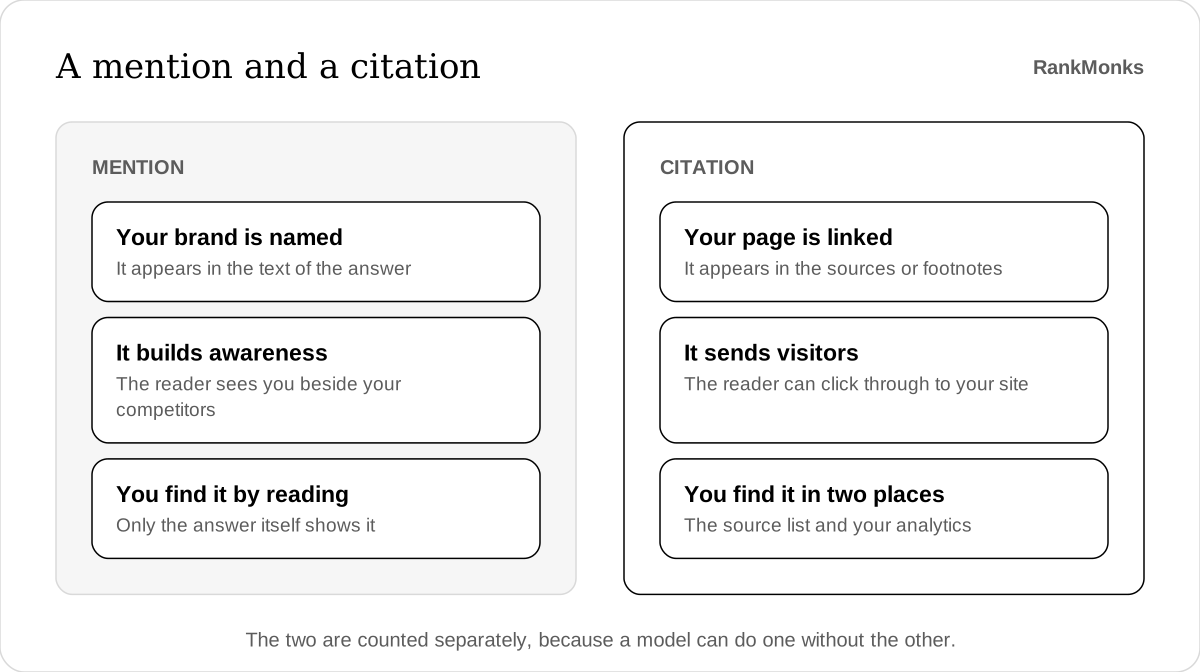
- A mention builds awareness. A line such as "tools like Ahrefs and Semrush are commonly used for this" puts those two brands in front of the reader, whether or not a link follows.
- A citation sends visitors. Your URL appears in the footnotes or the source panel, and some readers click it.
Read together, the two numbers tell you where you stand:
| What you see | What it means |
|---|---|
| Many mentions, few citations | You are talked about, but your own pages are not being used as a source |
| Many citations, few mentions | Your pages are trusted as a reference, but your brand is not being recommended |
| Both | The strongest result |
| Neither | You are absent for that question |
The gap between the two can be wide. Semrush's 2026 AI Visibility Index found that the overlap between the brands an AI tool mentions and the sites it cites can be as low as 30% on Gemini. Being named and being cited are close to separate contests, and it is worth winning both. Our guide on how to get cited in AI answers covers the citation side.
How does each platform work differently?
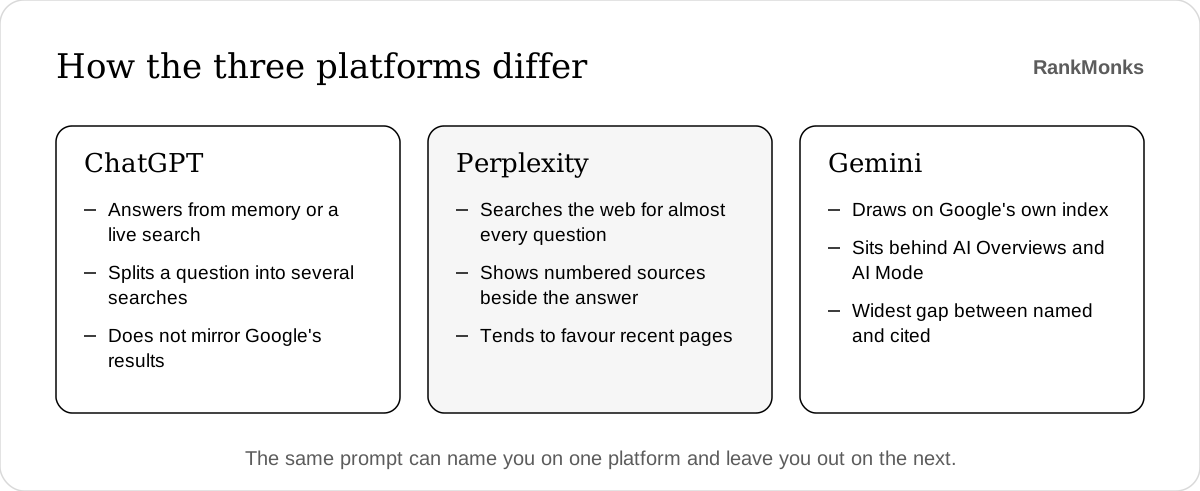
Each platform finds and uses sources in its own way, so the same question can produce different brands on each one. Treating them as interchangeable gives you misleading data.
ChatGPT
ChatGPT has the largest user base of the three. It answers some questions from what it learned in training and searches the web for others. When it searches, it breaks your question into several narrower searches and writes one answer from the results.
That is why ranking well on Google does not guarantee a place in the answer. A 2025 study by Ahrefs found that, on average, only 12% of the URLs cited by ChatGPT, Gemini and Copilot ranked in Google's top 10 for the same prompt. A page that ranks reasonably for several related searches can be cited ahead of a page that ranks first for one.
ChatGPT's search also draws on more than one search provider, and OpenAI has named Bing among them. If your site is missing from Bing's index, check that before anything else.
Perplexity
Perplexity searches the web for almost every question and shows numbered sources beside the answer. It also runs its own crawler, PerplexityBot.
Because every answer carries visible links, Perplexity is the easiest of the three to audit. You can read exactly which pages an answer was built from, and visits from those links show up in your analytics as referrals. It also tends to favour recent pages, so content that has not been updated for a long time is at a disadvantage.
Gemini
Gemini is the model behind Google's AI Overviews and AI Mode, and it is also a standalone assistant. In Google Search it draws on Google's own index, so your existing SEO work carries over more directly here than anywhere else. Our guide to Google AI Overviews explains how those answers are assembled.
The standalone Gemini app is harder to follow. It gives site owners no report, and its answers often name brands without linking to them, which is why the gap between mentions and citations is widest here.
Why this matters for tracking
A brand might appear in 60% of ChatGPT answers for its category and in 15% of Perplexity answers to the same questions. If you only watch one platform, you see a partial picture and may draw the wrong conclusion from it.
What should you actually track?
Track five things: visibility rate, share of voice, the split between mentions and citations, sentiment on each platform and the prompts where a competitor is named and you are not. Position within an answer is not on the list.
Traditional SEO taught everyone to watch rank. In AI answers that habit misleads. Research published in 2026 by SparkToro and Gumshoe ran the same prompts through AI tools many times and found that the list of recommended brands, and the order they came in, changed on almost every run. Being "second" in one answer tells you very little.
The measures that hold up:
- Visibility rate. The percentage of relevant prompts whose answer names your brand. A 40% rate across 200 answers is a figure you can repeat and compare.
- Share of voice. Your visibility rate beside your competitors'. If you appear in 30% of answers and your main competitor appears in 65%, the gap matters more than your own number. Our guide to AI share of voice shows how to calculate it.
- Mention and citation split. Whether you are named in the text, linked as a source, or both.
- Sentiment per platform. What each tool says about you. A negative or wrong description can do more harm than no mention at all, and ChatGPT's wording may differ sharply from Perplexity's.
- Competitor displacement. The prompts where a competitor is named and you are not. Each one is a recommendation that went to someone else.
How much room there is to compete depends on your industry. In Semrush's 2026 index, the three most visible brands in News and Media held 82.9% of that category's AI visibility. In Finance the figure was 41.4%.
How do you set up a tracking system?
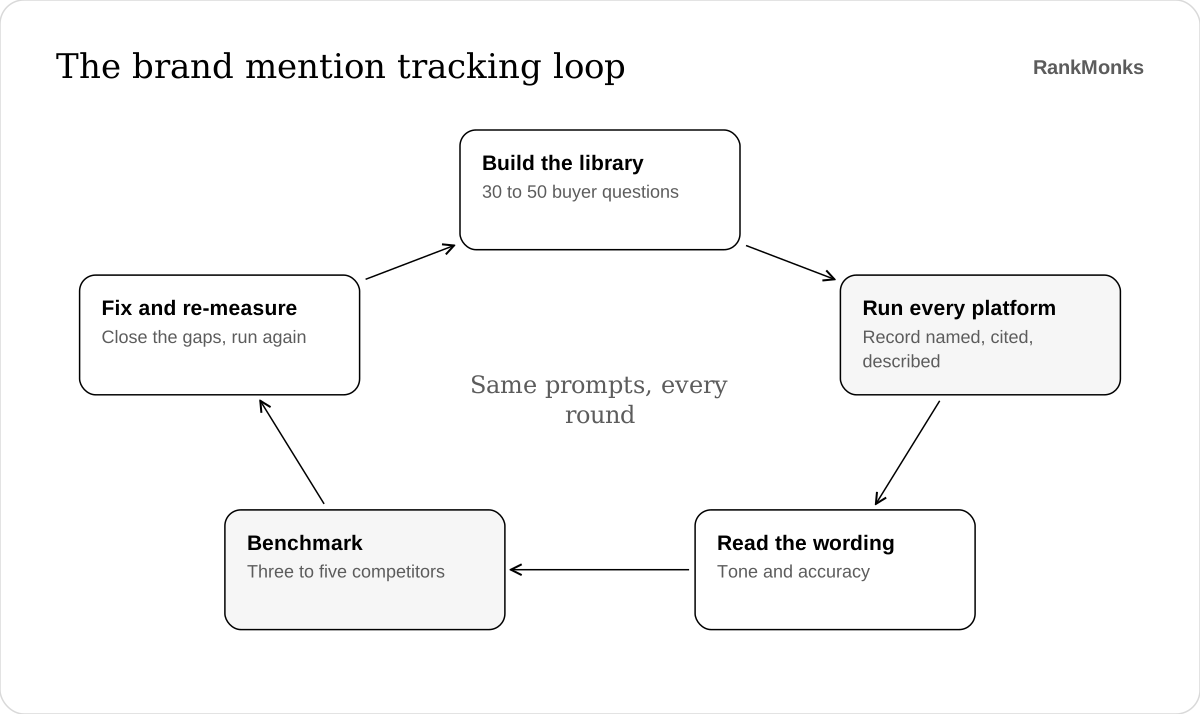
Set up tracking in five steps: build a prompt library, run it on every platform, read how you are described, benchmark against competitors and turn the gaps into fixes. A spreadsheet is enough for the first version.
Step 1: build your prompt library
Write down the 30 to 50 questions your customers ask most often. Good places to look:
- The queries in Google Search Console that already bring people to your site.
- The questions prospects raise on sales calls.
- The topics your competitors rank for.
The list should include category questions ("best [your category] for [use case]"), comparisons ("[your brand] vs [competitor]") and brand questions ("what does [your brand] do"). Everything else builds on this list, so keep it fixed between rounds. Our guide to building an AI visibility prompt set covers wording and numbers in detail.
Step 2: run the prompts on every platform
Run the full list on ChatGPT, Perplexity and Gemini, and on Claude, Grok and Google AI Overviews if your buyers use them. For each answer, record four things:
- Whether your brand was named.
- Whether your site was linked as a source.
- Which competitors appeared.
- What the answer said about you.
Keep mentions and citations in separate columns. They point to different problems and need different fixes. Use a fresh session for each run, and repeat each prompt more than once, because answers vary.
Step 3: read how you are described
Knowing that you appeared is half the picture. Read the wording.
Is ChatGPT positive while Perplexity sounds lukewarm? Does Gemini call you "enterprise-focused" while a competitor is described as "easy to set up"? These descriptions shape what a buyer thinks before they ever reach your site, so note them and check them for accuracy.
Step 4: benchmark against competitors
Your own numbers mean little alone. Record the same data for three to five direct competitors: who appears more often, on which platforms and for which kinds of question.
When a competitor starts being named for a prompt and you are not, look at which sources the answer cites. That turns a vague sense of falling behind into a short list of pages to study. The method is set out in our guide to AI source analysis.
Step 5: turn the data into fixes
A chart that nobody acts on is a cost. End every round with a prioritised list: which pages to restructure, which crawlers to unblock, which content gaps to close and which third-party sources to approach.
Then run the same prompts again next month. Track where you stand, understand why, fix the gaps and measure the result.
What can you do once you have the data?
Once you have the data, match each pattern to its fix. Four patterns cover most of what you will find.
| What the data shows | Likely cause | What to do |
|---|---|---|
| Mentioned but not cited | The model knows your brand but does not find your pages useful as a source | Add sourced claims, comparison tables, FAQ sections and answer-first writing to your key pages |
| Present on one platform, absent on another | The platforms read different sources | For ChatGPT, confirm Bing has indexed your site and submit a sitemap in Bing Webmaster Tools. For Perplexity, update stale pages |
| A competitor is cited and you are not | A specific page of theirs is clearer, better structured or more recent | Study that page and improve your equivalent |
| The answer is inaccurate | The sources the model found are wrong, old or thin | Publish a clear, authoritative statement of the fact and correct the sources you can reach |
Two of these deserve a note. If an AI tool cannot reach your pages at all, nothing else will help, so check your robots.txt against our guide to AI crawlers and llms.txt. And when an answer gets a fact wrong, treat it as a gap in the sources, not a fault you can report to the model. Our guide on how to fix wrong AI answers about your brand walks through that process.
All of this rests on the same foundation as ordinary search work: pages that machines can reach, read and trust. That link is the subject of our guide to SEO in the AI era.
Frequently asked questions
What are brand mentions in AI search?
Brand mentions in AI search are the times a tool such as ChatGPT, Perplexity, Gemini or Google AI Overviews includes your company, product or website in an answer it writes. A mention can come with a link to your site or without one.
Why is my brand not showing up in AI answers?
Your brand is usually missing for one of five reasons: AI tools cannot work out what you do, your content is poorly structured, competitors are covered by more of the sources the tools read, your pages are hard to crawl, or your brand is not strongly linked to the topic of the prompt. Looking at which sources are cited for the prompts you are missing from will show which reason applies.
Can SEO tools track AI brand mentions?
Traditional SEO tools report rankings, backlinks, traffic and technical health, and that is still useful. Tracking AI brand mentions means recording answers written by AI tools, which is a separate layer. Several SEO platforms now sell an AI visibility add-on, and you can also do the work by hand with a prompt list and a spreadsheet.
How often should you track AI brand mentions?
Track your most important prompts monthly, and weekly during a launch or after a significant change to your site. Answers shift as new content is published, as competitors update their pages and as the AI tools refresh their sources.
How do you track brand mentions in Gemini?
Track Gemini by running category and comparison prompts in the Gemini app, reading how it describes your brand, and comparing those answers with what Google shows in AI Overviews for the same questions. Record mentions and citations separately, because the two diverge more on Gemini than elsewhere.
AI answers are becoming part of how buyers find suppliers, and most brands still have no record of what those answers say. A fixed prompt library and a monthly round is enough to change that. If you would like it run for you, our AI visibility tracking service runs the same prompts across every major model each month and reports the results with a list of fixes. To get a baseline for your brand, start a conversation.
Written by RankMonks.