
AI Visibility Tracking8 min read
AI Share of Voice: How to Measure Your Share of Answers
Published · RankMonks
AI share of voice is the percentage of AI answers, across a fixed set of buyer questions, that name your brand. It is also called share of answers, and it is the nearest thing AI search has to a headline metric.
This guide gives the formula, explains the difference between being mentioned and being cited, shows how to split the figure and compare it with competitors, and covers how to report it without being misled by noise.
Key takeaways
- AI share of voice is the number of tracked answers that name your brand, divided by the total number of tracked answers.
- Mention share and citation share measure different things, and you should report both.
- The overall figure hides the detail, so you should split it by AI tool and by prompt type.
- Competitor figures give the number meaning, and the shares add up to more than 100% because one answer can name several brands.
- AI answers vary between runs, so you should use repeat runs and judge the trend over several months.
What is AI share of voice?
AI share of voice is the proportion of answers, from a defined set of prompts and AI tools, in which your brand is named. If you track 200 answers and 60 of them mention you, your share of voice is 30%.
The term is borrowed from advertising, where it meant a brand's share of the advertising in its market. In AI search, the market is the set of answers buyers receive when they ask about your category.
It is a useful headline because it is simple, it can be compared with competitors and it can be tracked over time. It rests entirely on the prompts behind it, so a share figure should always be quoted with its prompt set. Our guide to building a prompt set explains how to choose the questions, and the wider picture is in our guide to AI visibility.
How do you calculate share of answers?
You calculate share of answers by dividing the number of tracked answers that name your brand by the total number of tracked answers, then multiplying by 100. An answer counts once, however many times it repeats your name.
Share of answers = answers that name you ÷ tracked answers × 100
The steps:
- Fix the scope. Decide the prompt set, the AI tools and the number of runs per prompt. Include Google AI Overviews alongside the assistants, since many buyers meet AI answers there first.
- Run the set. Every prompt, in every tool, under the same conditions.
- Count the tracked answers. Multiply prompts by tools by runs. Forty prompts across five tools, run once, gives 200 answers.
- Mark each answer. Named or not named, for your brand and for each competitor you track.
- Divide. Answers that name you, divided by tracked answers.
Agree the counting rules before you start, and write them down:
- Count misspellings and obvious variants of your name.
- Count a product name as a mention of the brand if buyers would recognise it.
- Do not count an answer where you appear only in a cited link and not in the text. That belongs to citation share.
- Count negative mentions, and record sentiment separately.
What is the difference between mention share and citation share?
Mention share counts answers that name your brand in the text, while citation share counts answers that list a page from your site as a source. The first reflects your reputation and the second reflects whether your content is read, and the two often differ.
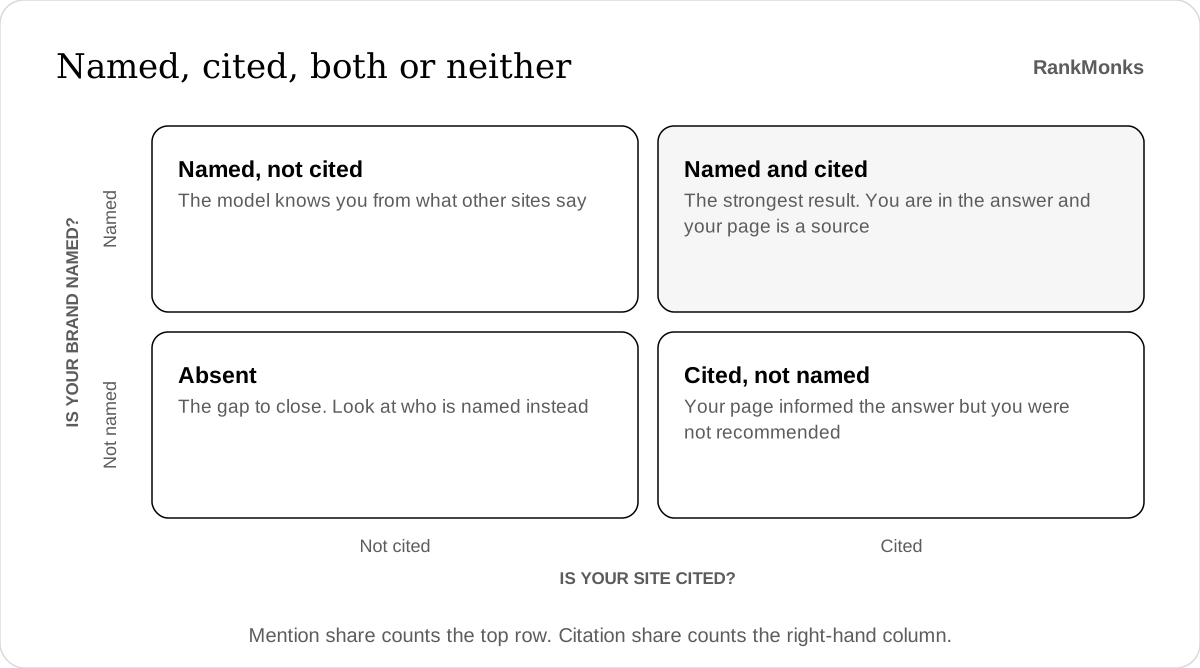
A high mention share with a low citation share suggests that your reputation on other sites is doing the work, which is common for well known brands. The fix is on your own site: clearer, more quotable pages, as described in our guide on how to get cited in AI answers.
A high citation share with a low mention share suggests that your content is useful but your brand is not seen as an answer to the question. That is usually solved away from your site, through the brand mentions that tell models who you are and what you are known for.
Citation share has one practical limit. Tools differ in how they show sources, and some answers show none. Calculate citation share only across answers where sources were displayed, and say so in the report.
How do you split the figure and compare it with competitors?
Split the figure by AI tool and by prompt type, and set it beside the same figure for your main competitors. The overall number says whether you are visible. The splits say where, and against whom.
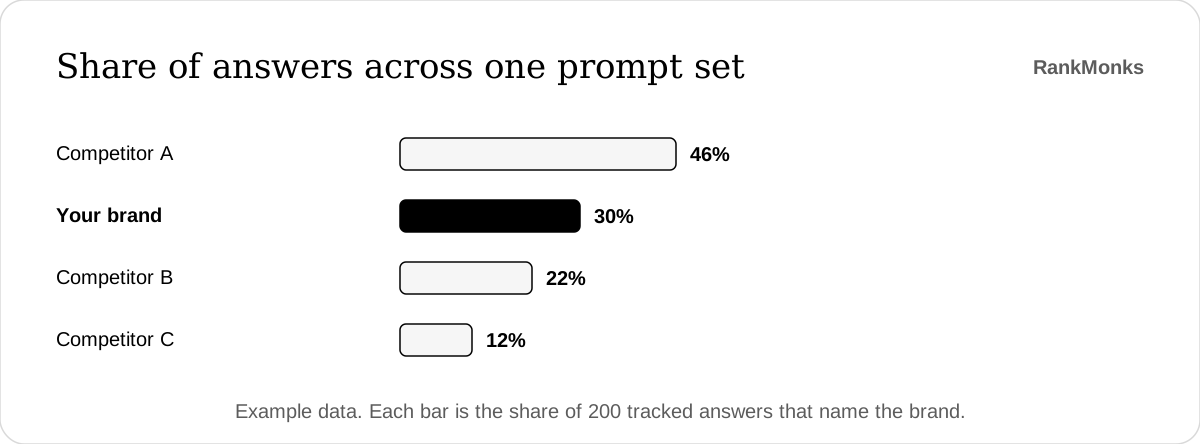
For example, a payroll software company tracks 40 prompts across five tools, run once, giving 200 answers. The figures below are invented to show the method.
| Brand | Answers naming the brand | Share of answers |
|---|---|---|
| Competitor A | 92 | 46% |
| Your brand | 60 | 30% |
| Competitor B | 44 | 22% |
| Competitor C | 24 | 12% |
The shares add up to more than 100% because one answer can name several brands. That is normal. Share of voice here is a rate of appearance, not a slice of a pie.
The same 60 mentions, split by AI tool, with 40 answers from each:
| AI tool | Answers naming your brand | Share |
|---|---|---|
| Perplexity | 16 | 40% |
| ChatGPT | 14 | 35% |
| Gemini | 12 | 30% |
| Claude | 10 | 25% |
| Google AI Overviews | 8 | 20% |
And split by prompt type:
| Prompt type | Tracked answers | Naming your brand | Share |
|---|---|---|---|
| Category | 60 | 12 | 20% |
| Comparison | 40 | 16 | 40% |
| Problem | 50 | 5 | 10% |
| Alternative | 30 | 8 | 27% |
| Brand | 20 | 19 | 95% |
The last table is the most useful. The company is named in almost every brand prompt, but in only one in ten problem prompts. Buyers who already know it get an answer. Buyers describing a problem rarely hear its name. That points the work at problem-led content and coverage, not at brand facts.
Brand prompts nearly always name you, so report a non-brand share as well. Here that is 41 of 180 answers, or about 23%, which is a more honest headline than 30%.
How do you deal with noise in the numbers?
Deal with noise by running each prompt more than once, keeping the method identical and reading the trend across several rounds. AI answers vary from run to run, so a small movement in one month is often chance.
Practical rules:
- Repeat runs. Run each prompt three times per tool where you can, and count every answer. More answers give a steadier percentage.
- Mind small samples. A split with 20 answers moves five points when a single answer changes. Treat small groups as indications.
- Hold the method still. Same prompts, same tools, same conditions, same counting rules.
- Log model changes. A new model version can shift every figure at once. Note the date so that the cause is clear.
- Wait for a pattern. Two or three rounds moving the same way is a trend. One round is a reading.
Avoid quoting the figure to a decimal place. "About 30%" is honest. "30.4%" claims a precision the method does not have.
How should you report AI share of voice?
Report AI share of voice as a trend line with competitor context, the main splits and a short list of actions. One number on its own invites the wrong questions.
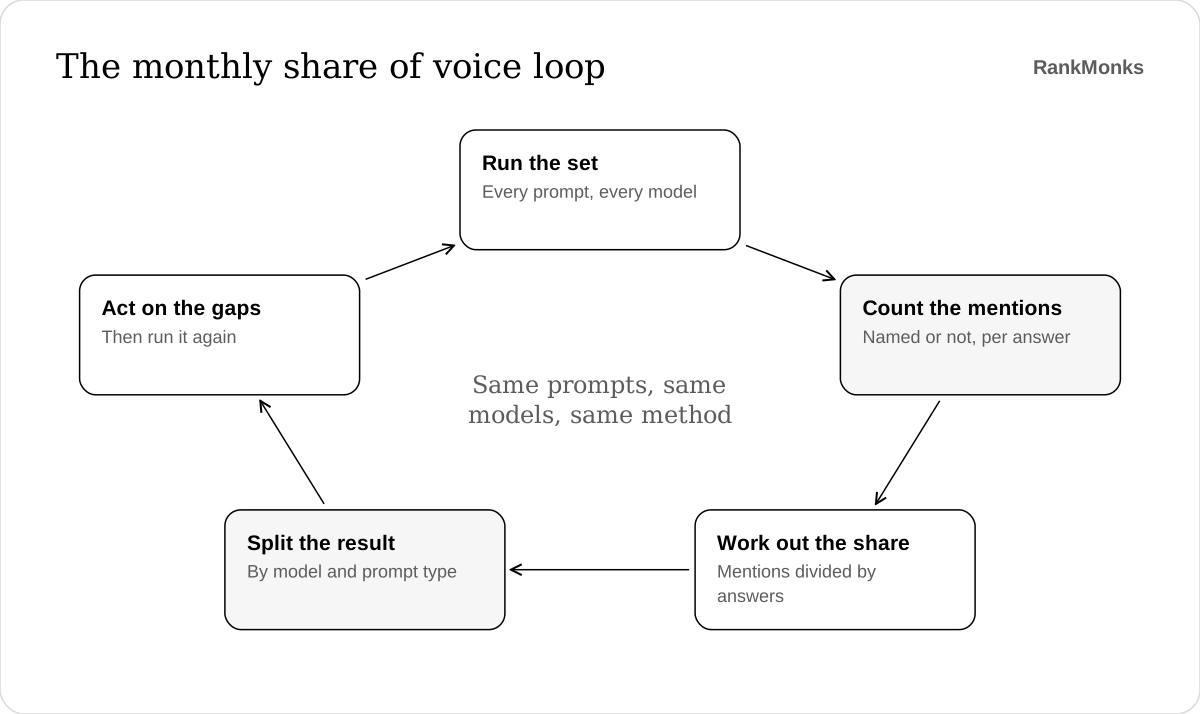
A monthly report should contain:
- The overall share of answers, this round and the previous ones, for you and each tracked competitor.
- The non-brand share, with brand prompts removed.
- The split by AI tool and by prompt type.
- Citation share, with the caveat about tools that do not show sources.
- Notable changes in how you are described.
- The prompts where you are absent and a competitor is named.
- What was done last month, and what will be done next.
Item six is where the report becomes useful. Each absent prompt is a specific gap, and the sources cited in those answers show what to do about it. That is the job of AI source analysis.
AI share of voice sits best beside your search figures, not in place of them. Rankings, clicks and enquiries still describe most of your organic performance, and our guide to SEO reporting covers how to present them. As more questions are answered on the results page, a pattern described in zero-click searches, the two sets of numbers together give the fuller picture. The reasoning for tracking both is set out in our guide to SEO in the AI era.
Pitfalls to avoid:
- Changing the prompt set and then comparing with the old figures.
- Filling the set with brand prompts to lift the headline.
- Reporting a single screenshot as evidence.
- Comparing your figure with another company's, which was built on different prompts.
- Treating a mention as good news without reading what was said.
Frequently asked questions
What is a good AI share of voice?
There is no universal good AI share of voice, because the figure depends on the prompt set and on the number of competitors in the category. Judge it against the competitors you track on the same prompts, and against your own earlier rounds. Leading on non-brand prompts is a stronger sign than any fixed percentage.
Is AI share of voice the same as share of answers?
AI share of voice is the same as share of answers in most usage. Both mean the percentage of tracked AI answers that name your brand. Some tools use share of voice for a weighted version that also considers position in the answer, so check the definition before comparing figures from different sources.
How many answers do you need for a reliable figure?
You need at least a few hundred answers per round for a reasonably steady overall figure. Forty prompts across five tools with three runs each gives 600. Splits by tool or by prompt type contain fewer answers and should be read with more caution.
Should negative mentions count towards share of voice?
Negative mentions should count towards share of voice, as long as sentiment is recorded alongside. Being named is a fact about visibility, and how you are described is a separate fact about reputation. Reporting both stops a rising share from hiding a worsening description.
Share of answers is only as good as the prompts and the discipline behind it. Our AI visibility tracking service runs the same prompts across every major model each month and reports the share, the splits and what to do next. If you want a baseline for your brand, start a conversation.
Written by RankMonks.