
AI Visibility Tracking13 min read
AI Visibility for US Trucking Companies
Published · RankMonks
AI visibility for a US trucking company is how often, and how accurately, AI tools name your carrier when people in freight ask them questions. A logistics manager might ask ChatGPT, "Which asset-based reefer carriers run Fresno to Chicago and can handle produce in summer?" A driver might ask Gemini, "Which trucking companies near Dallas hire CDL-A drivers with one year of experience and get them home every weekend?" Each answer names a few fleets. Your AI visibility is whether yours is one of them, and whether what the answer says about you is true.
This guide explains what AI visibility means for a carrier, how shippers, drivers and brokers use AI tools, what to track, which facts AI answers tend to get wrong about trucking companies, how to read a monthly report and how to choose help. It also links to four deeper guides on why it matters, how to set it up, how to win local map answers and how tracking feeds your other search work.
Key takeaways
- AI visibility measures whether AI tools name your carrier, describe it correctly and cite your pages when shippers, drivers and brokers ask questions.
- A trucking company has at least two audiences in AI answers, freight buyers and drivers, and each needs its own set of questions to track.
- The facts that matter most are the ones a buyer or recruit acts on: carrier type, equipment, lanes, terminals, safety and authority details, and hiring status.
- One answer proves little, because AI answers change between runs. The same prompts, run on a schedule, give a trend you can manage.
- Tracking only pays when every report ends in work: pages to fix, listings to correct and sources to get onto.
What is AI visibility for a US trucking company?
AI visibility is the degree to which AI tools mention, cite and correctly describe your trucking company when people ask the questions you want to be part of. It covers assistants such as ChatGPT, Claude, Perplexity, Gemini and Grok, and the AI Overviews and AI Mode answers that Google shows in search.
Three things make up the idea, as our general guide to AI visibility explains:
- Mentions. The answer names your company in its text.
- Citations. The answer links to your site, or lists a page of yours as a source.
- Accuracy. What the answer says about you is true and current.
For a carrier, the third point carries more weight than it does for most businesses. A shipper who reads that you are a freight broker when you run your own trucks, or that you haul flatbed when you sold those trailers two years ago, either moves on or calls with the wrong request. A driver who reads an old pay figure applies with the wrong expectations, or does not apply at all.
The two audiences also need to be kept apart. A carrier can be named often for driver questions in its home market and almost never for the shipper questions that bring revenue, or the other way round.
| Audience | Example question | What the answer needs to get right |
|---|---|---|
| Shipper | "Dry van carriers in Georgia that handle retail freight to distribution centers" | That you run dry van, the lanes you serve, that you are asset-based |
| Driver | "Trucking companies near Joliet hiring CDL-A regional drivers" | That you are hiring, the terminal, the type of route and home time |
| Broker or 3PL | "Flatbed carriers with their own trucks in the Houston area" | Equipment, location, and how to reach dispatch |
| Anyone checking you | "Is [your company] a broker or a carrier?" | Carrier type, USDOT number, how long you have operated |
How do shippers, drivers and brokers use AI tools to find carriers?
Shippers, drivers and brokers use AI tools to build shortlists, check a company they have heard of and compare options, often before they visit a single website. Each group asks in its own way.
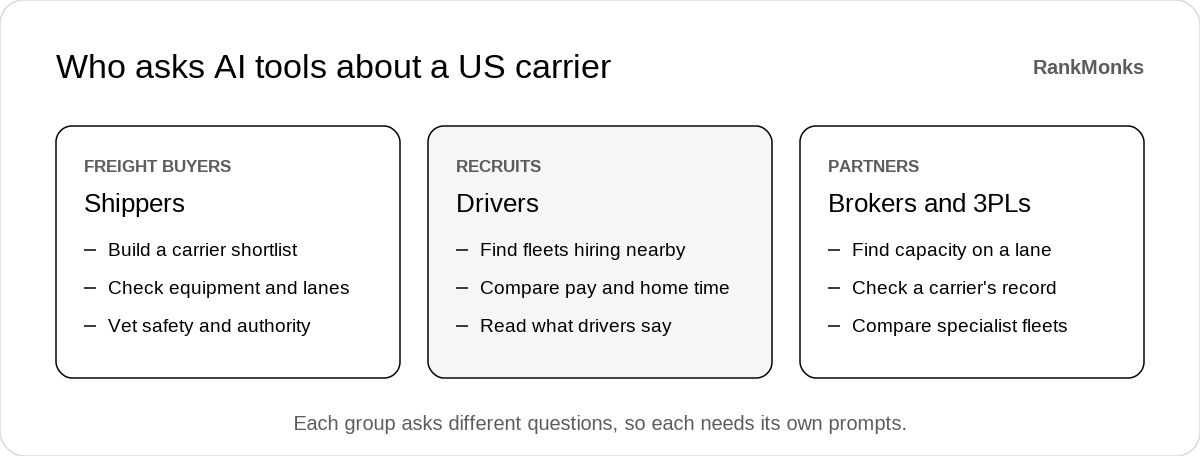
Shippers describe a need in detail and ask for options. A plant manager in Ohio might ask for "carriers that run dedicated dry van service between Columbus and Indianapolis and can do drop trailers." That question is too long and too specific to show up in a keyword tool, but it is exactly the kind of question AI tools are good at answering. Shippers also use AI tools to check a carrier they have been given, asking about its safety record, its authority and whether it really runs its own equipment.
Drivers ask about jobs near them, pay structure, home time, equipment and what other drivers say. An answer about a fleet's reputation among drivers often draws on job sites, review sites, forums and Reddit threads, so it may reflect old complaints or praise you have never seen.
Brokers and 3PLs look for capacity on a lane, especially for specialist freight such as hazmat, heavy haul or temperature-controlled loads, and check a carrier's record before they tender a load.
The pattern behind all three is the same. The answer arrives with a few names already in it, and the person asking may never see the companies that were left out. That is the core of the case made in our guide on why AI visibility is important for US trucking companies.
What should a trucking company track in AI answers?
A trucking company should track how often it is named, how accurately it is described, which competitors are named instead and which sources each answer draws on, split by shipper and driver questions. A single "visibility score" hides too much to act on.
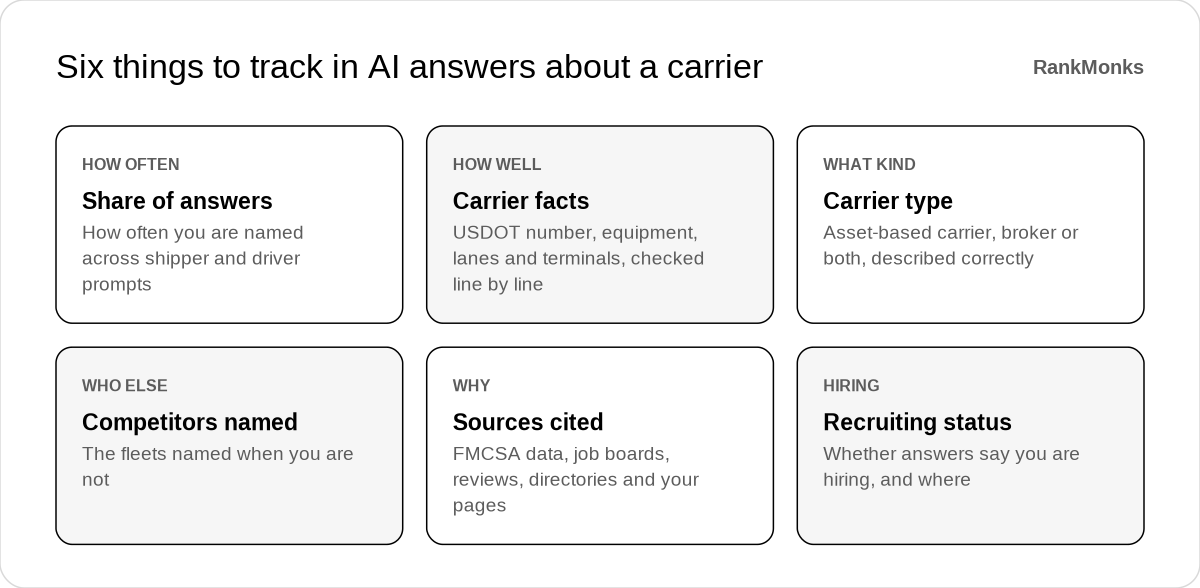
| Measure | What it tells you | Example |
|---|---|---|
| Share of answers | How often you are named across the prompt set | Named in some reefer shipper prompts but no driver prompts |
| Carrier facts | Whether equipment, lanes, terminals and identifiers are right | An answer lists a terminal you closed |
| Carrier type | Whether you are called a carrier, a broker or both | You are described as a brokerage because of an old affiliate |
| Position | Whether you are named first, among several or last | Named last in a list of five |
| Competitors named | Which fleets take your place | The same two regional carriers appear for every Texas prompt |
| Sources cited | Which pages and listings shaped the answer | A job board page with pay figures from two years ago |
| Recruiting status | Whether answers say you are hiring, and where | Answers say you hire only in one state |
Split every measure by audience and by region. A carrier that runs out of Dallas, Atlanta and Memphis can be well known in one market and absent in the other two, and an average across all three would hide it. The deeper method for counting is in our guide to AI share of voice.
Which facts do AI tools get wrong about trucking companies?
AI tools most often get a carrier's type, equipment, locations, hiring details and name wrong, usually because an old or inconsistent source says so. Trucking has a few traps of its own.
- Carrier or broker. Many companies run both an asset-based fleet and a brokerage arm, sometimes under similar names. Answers mix them up, and a shipper looking for a carrier with its own trucks may skip you.
- Similar names. Trucking is full of companies with near-identical names in different states. An answer can merge two of them, attach the wrong safety record or send a driver to the wrong company.
- Old equipment and services. If you dropped flatbed or added reefer, old directory listings and old pages keep the past alive.
- Closed or moved terminals. A yard you left can stay on listings and maps for years.
- Pay and home time. Job boards and old job posts carry figures that no longer apply. AI answers repeat them.
- Safety and authority details. Shippers may ask about your safety record or operating authority. Answers can quote outdated information or mix you up with a similarly named company. Make sure the public record under your USDOT number is current and that your site states it plainly.
Most of these trace back to a source you can find and fix. Our guide on how to fix wrong information about your brand in AI answers walks through the method: find the source, correct it, make the right fact consistent everywhere, then check again.
How does AI visibility tracking work for a carrier?
AI visibility tracking works by running the same set of shipper and driver questions through several AI tools on a schedule, recording every answer and reading the results as a trend. The questions stay fixed so that this month can be compared with the last.
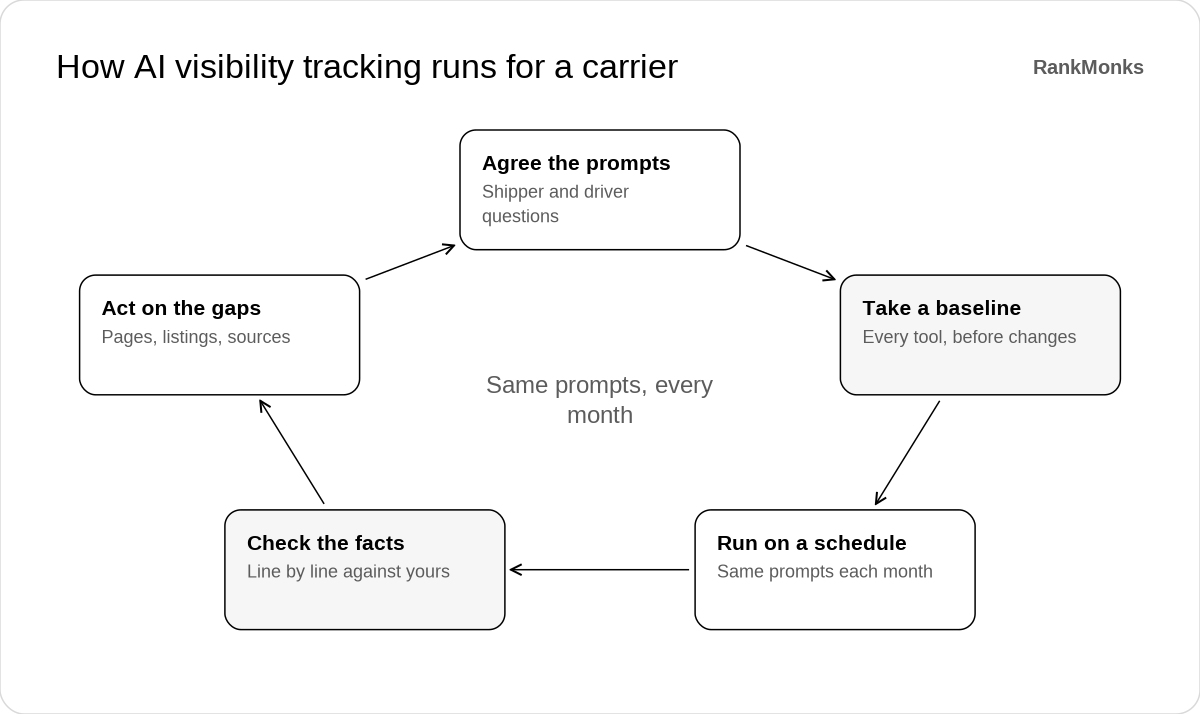
- Agree the prompts. Questions from sales calls, dispatch, recruiting and your own search data, written the way shippers and drivers actually ask. Our guide to building an AI visibility prompt set covers the general method.
- Take a baseline. Run every prompt in every tool before anything changes, so later movement means something.
- Run on a schedule. The same prompts, the same tools, repeated, because one answer is an anecdote.
- Check the facts. Compare every answer that names you with a short fact sheet of your own: equipment, lanes, terminals, carrier type, identifiers and hiring areas.
- Act on the gaps. Fix the pages, listings and sources behind each problem, then run the prompts again.
The full setup, including who in a trucking company should own each part, is in our guide on how to implement AI visibility tracking properly for US trucking companies.
What should an AI visibility report show a trucking company?
An AI visibility report should show a carrier where it is named and where it is not, split by audience, region and AI tool, list every wrong fact found and end with a short list of fixes. It should be readable by the owner, the dispatcher and the recruiter without a glossary.
A useful monthly report for a US carrier covers:
- Share of answers by audience. Shipper prompts and driver prompts reported separately.
- Share of answers by market. Each terminal city or region you serve, so a gap in one market is not hidden by strength in another.
- Share of answers by tool. ChatGPT, Gemini, Perplexity, Claude, Grok and Google's AI answers can disagree, and a pattern in one tool often points to one source.
- Accuracy issues. Every wrong fact, where it appeared and the likely source.
- Competitors. The fleets named most often when you are not, and what their sources have that yours lack. Our guide to AI source analysis explains how to read this.
- Actions. Three to five fixes for the coming month, each with an owner.
If a report ends with a chart and no actions, it is a status update, not tracking.
What are the warning signs when hiring an AI visibility agency?
The main warning signs are guaranteed placements, scores you cannot trace back to real answers and prompt sets that ignore how freight buyers and drivers actually talk. Trucking is specialist enough that generic tracking misses most of what matters.
- Promises to "get you recommended by ChatGPT." Nobody controls what an AI tool says. An honest agency measures, explains and works on the inputs.
- A score with no answers behind it. You should be able to read the actual answers that produced any number.
- Prompts written from a keyword tool. "Trucking company" and "freight shipping" are not how a shipper with a produce load or a driver looking for home time asks.
- No split between shippers and drivers. Mixing the two hides the gap that costs you most.
- Prompts that change every month. Without a fixed set, there is no trend, only noise.
- No accuracy checks. Counting mentions without checking what they say misses the errors that cost loads and hires.
- Reports without actions. Tracking that does not change your work is a cost, not a tool.
What should you ask an agency before you hire it?
Ask how it builds the prompt set, which tools it tracks, how it handles answers that vary, how it checks facts and what a report looks like. The answers should be specific to trucking.
- How will you write prompts for shippers, brokers and drivers, and will we approve them?
- Which AI tools do you track, and do you record the sources each answer cites?
- How many times do you run each prompt, and how do you deal with answers that change between runs?
- How do you check accuracy for facts like carrier type, equipment, terminals and hiring areas?
- Can you split results by terminal or region?
- What does a monthly report look like, and does it end with actions and owners?
- What will you not promise?
The general version of these questions, for any search agency, is in our guide on how to choose an SEO agency. For a smaller business view of the same decision, see our guide to the best AI visibility agency for small businesses.
How does AI visibility fit with SEO, AEO and GEO for a US carrier?
AI visibility is the measurement layer that sits on top of SEO, AEO and GEO: those three change what AI tools read about your carrier, and tracking shows whether the change reached the answers. None of them replaces the others.
- SEO gets your pages found and ranked. Many AI tools search the web before answering, and pages that rank well are often the ones they read. See SEO for US trucking companies.
- AEO shapes your pages so a direct answer is easy to lift, for featured snippets, AI Overviews and voice assistants. See AEO for US trucking companies.
- GEO works on the outside sources AI tools trust when they name carriers: directories, associations, trade press, review sites and forums. See GEO for US trucking companies.
Our guide to GEO vs SEO vs AEO explains the differences in general terms, and SEO in the AI era sets out the playbook that ties them together. If your fleet also runs cross-border lanes, the Canadian side has its own regulators, languages and sources, covered in our guide to AI visibility for Canadian trucking companies.
Where should a US trucking company go from here?
Start with the guide that matches where you are: whether to invest, how to set tracking up, how to win local answers around your terminals or how to use the results across your other search work.
Why AI visibility matters for carriers
If you are still weighing whether AI visibility is worth the effort next to load boards, brokers, job boards and ads, read why AI visibility is important for US trucking companies. It sets out what a carrier loses when AI tools leave it out and why the gains compound.
How to set up tracking properly
When you are ready to start, how to implement AI visibility tracking properly for US trucking companies gives an ordered plan for the first 90 days, the roles involved and the mistakes to avoid.
How to win local map answers around your terminals
Drivers and local shippers ask AI tools about trucking companies near a specific place. How US trucking companies win on local maps with AI visibility tracking shows how to track those questions terminal by terminal and fix what the answers get wrong.
How tracking improves the rest of your search work
Tracking findings point SEO, AEO and GEO at the right problems. How AI visibility tracking improves SEO, AEO and GEO for US trucking companies shows how to turn a report into work for each.
How does RankMonks approach AI visibility for US trucking companies?
RankMonks runs AI visibility tracking for carriers with a fixed prompt set agreed with you, covering shipper, broker and driver questions. The same prompts run across ChatGPT, Claude, Perplexity, Gemini, Grok, Google AI Overviews and AI Mode. Before anything changes, we take a baseline of where you and your competitors stand in every model.
Each month you get one report in plain language: your share of answers, how you are described, what changed and a short list of things to do about it, such as pages to fix, sources to get onto and claims to correct. Because we work across SEO, AEO and GEO as well, those actions can be carried out rather than handed back to you.
We take on a small number of clients at a time, and the person who plans your tracking is the person who reads your answers. We do not promise placements in any AI tool. AI answers can shift faster or slower depending on the model, and we tell you what is realistic before you sign anything.
Frequently asked questions
Can a trucking company pay to appear in ChatGPT answers?
You cannot buy your way into what an AI tool writes in its answer. What you can do is make sure the sources it reads, your own site, your listings, directories, reviews and coverage, describe your carrier clearly and consistently. Tracking tells you whether that work is reaching the answers.
How often should a carrier check its AI visibility?
Monthly is a sensible rhythm for most carriers, with the same prompts each time. Answers vary from one run to the next, so each prompt should be run more than once per cycle. A check after a major change, such as opening a terminal or adding a service, is also worth doing.
Do drivers really use AI tools to choose a trucking company?
Some do, alongside job boards, referrals and word of mouth, and the share differs by region and age group. The simplest way to find out for your fleet is to add "an AI tool such as ChatGPT" as an option when you ask new applicants how they heard about you.
Is AI visibility tracking only for large fleets?
No. A smaller carrier often has more to gain, because a large fleet is likely to be named anyway, while a smaller one has to earn its place in a short answer. The prompt set can be scaled to the markets and services you actually run.
AI visibility turns a question you cannot see into a number you can manage. Running the prompts, checking the answers and turning the gaps into work is what our AI visibility tracking service does every month. If you want to see where your carrier stands, start a conversation.
Written by RankMonks.