
AEO for a US trucking company is the work of making the carrier the direct answer when a shipper, a broker or a driver asks a question in Google, in an AI Overview or out loud to a voice assistant. Instead of aiming for a place on a list of links, it aims to be the sentence that gets lifted, quoted or read aloud: what you haul, where you run, how to check your authority and how to apply.
Trucking is full of questions with one right answer. "Do you run reefer out of the Central Valley?", "What is your USDOT number?", "How often are drivers home?" A carrier that answers those plainly, on pages search engines can read, gives every answer engine something safe to repeat. A carrier that hides them behind "reliable solutions nationwide" leaves the answer to a broker, a load board or a job site.
This guide covers what answer engine optimization means for a US carrier, which questions matter, which pages and listings answer them, how to measure the work and where to go next.
Key takeaways
- AEO makes a trucking company the reply that search engines and assistants choose when they answer a question directly, rather than one link among ten.
- A carrier answers three audiences at once: shippers buying capacity, brokers vetting partners and drivers deciding where to work.
- The best answers are short, specific and checkable: equipment, lanes, states served, USDOT number, pay structure and home time.
- Listings matter as much as pages, because maps and voice assistants answer local questions from Google Business Profile, Apple Business Connect and Bing Places.
- No one can guarantee a featured snippet, an AI Overview citation or a voice answer, so measure which answers you win and improve the pages that are not chosen.
What is AEO for a trucking company?
AEO, or answer engine optimization, is the practice of structuring a trucking company's content and business information so that search engines and AI assistants use it as the direct answer to a question. It sits between classic SEO, which earns a ranking, and GEO, which earns a mention inside a written AI answer.
The answers turn up in several places, and each one chooses its source in its own way.
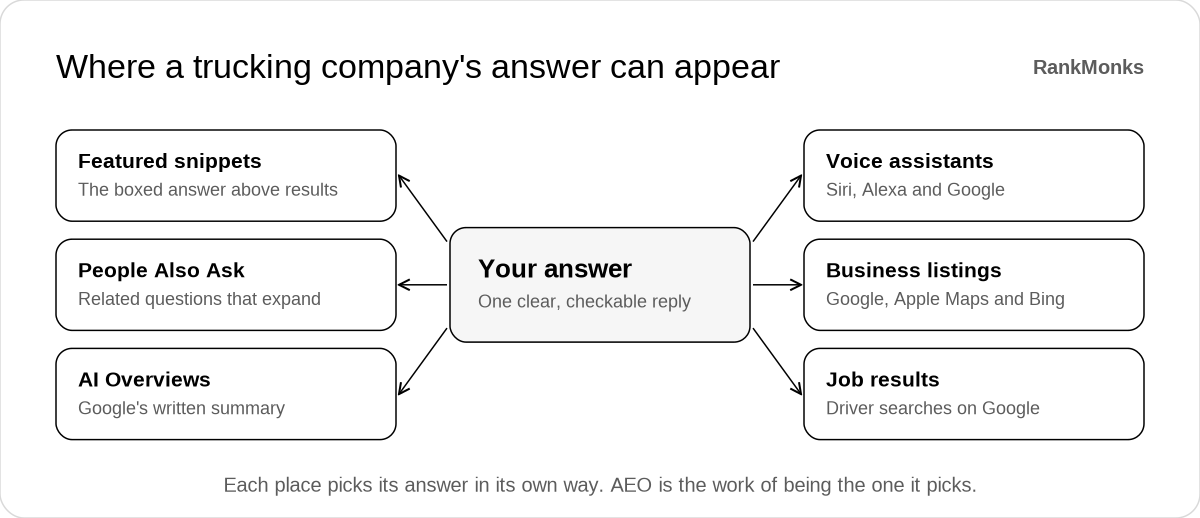
- Featured snippets are the boxed answers above Google's results. A clear definition of drayage or a short list of what a flatbed carrier needs from a shipper can win one. Our guide to featured snippets explains how they are picked.
- People Also Ask boxes show related questions with a short answer and a source under each.
- Google AI Overviews summarize an answer at the top of many searches and link to the pages they drew on. Our guide to Google AI Overviews covers how sources are chosen.
- Voice assistants such as Siri, Alexa and Google's assistant read out one answer, often from a business listing. A driver asking for directions to your terminal while on the road is using one.
- Business listings answer questions about hours, location and phone numbers directly in search and maps.
- Google's job results show driver jobs pulled from job pages that carry structured data, so a recruiting page can be the answer to "CDL-A jobs near me".
| Surface | Typical trucking question | What usually wins |
|---|---|---|
| Featured snippet | "What is the difference between LTL and FTL?" | A two-sentence definition followed by a short comparison |
| People Also Ask | "How do I check a carrier's safety record?" | A direct answer that names the FMCSA SAFER snapshot |
| AI Overview | "Best way to ship temperature-controlled freight from California to Texas" | Specific, well-structured pages that rank for the topic |
| Voice assistant | "Call the nearest trucking company hiring drivers" | An accurate, complete business listing |
| Job results | "Regional CDL-A jobs home weekly" | A job page with clear pay, home time and JobPosting markup |
Many of these searches end without a click. That is not automatically bad for a carrier. If the answer names you correctly and the shipper calls dispatch, the job is done. Our guide to zero-click searches explains how to judge that trade.
Which questions do shippers, brokers and drivers ask?
Shippers ask whether you can move their freight, brokers ask whether you are safe and legitimate, and drivers ask whether you are a good place to work. A trucking site has to answer all three groups, and the questions are different enough that one page rarely serves them all.
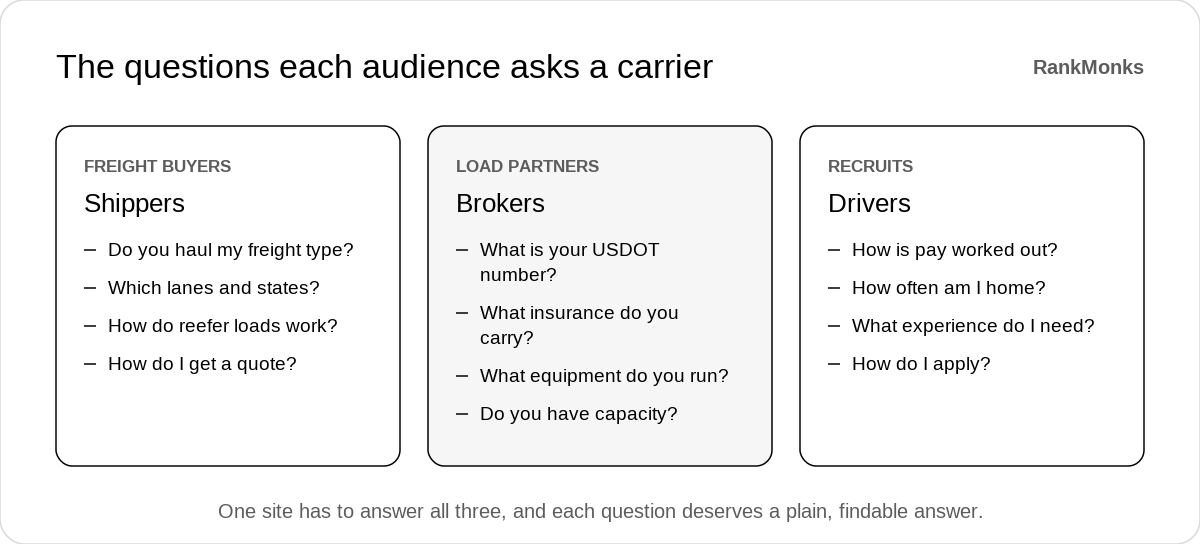
Shippers search by equipment, freight type, lane and region. A logistics manager at a food manufacturer may ask "reefer carriers that run Fresno to Dallas" or "does a full truckload need to be one shipper?" They want a plain description of what you haul, where you run and how to get a quote.
Brokers and 3PLs check partners before they tender a load. Their questions are about your USDOT number, operating authority, insurance, equipment and capacity. Most of the facts they need sit in public FMCSA records, so your site should state the same numbers and point to them. FMCSA has been moving toward the USDOT number as the single identifier for carriers, so check the current rules before you decide what to display alongside it.
Drivers and owner-operators ask about pay, home time, equipment, experience requirements, lease options and the application process. Many of these questions are asked by voice, from a cab, which is one reason clear listings and short answers matter.
The best source of these questions is your own business. Dispatch hears shipper questions every day. Your recruiter hears driver questions. Your safety manager hears broker questions about compliance. Search data and tools add volume figures, but the wording your customers use is worth more. Our guide to keyword research covers how to turn both into a list.
Which pages should answer them?
Each question should have one page that owns it, and that page should answer it near the top. Most carrier sites have the right page types but bury the answers in marketing copy.
| Page | Questions it should answer | Audience |
|---|---|---|
| Service or equipment page (dry van, reefer, flatbed, hazmat) | What you haul, trailer specs, loading requirements, regions | Shippers |
| Lane or region page | Which origins, destinations and states you run, typical transit expectations | Shippers, brokers |
| Terminal page | Address, gate hours, truck entrance, who to call | Drivers, shippers |
| Safety and compliance page | USDOT number, authority, insurance, ELD use, safety programs | Brokers, shippers |
| Careers page, one per driver role | Pay structure, home time, equipment, experience, how to apply | Drivers |
| Quote page | What information you need for a quote and how fast you respond | Shippers |
| Knowledge pages | Definitions such as drayage, intermodal, LTL and FTL, detention | All three |
Knowledge pages are where small and mid-sized carriers can win answers against much larger companies. A definition of "detention time" written by a carrier that deals with it every week is often clearer than one written by a software vendor. Keep each one short, accurate and linked to the service it relates to, as set out in our guide to site architecture.
How should a trucking page be written so it gets chosen?
A page gets chosen when its answer is easy to find, easy to lift and safe to repeat. That comes down to a few habits.
- Put the answer first. Under a heading phrased as the question, answer it in one or two sentences before adding detail. "Yes, we haul hazmat in dry vans across the Southeast. Our drivers hold hazmat endorsements, and we do not haul explosives or radioactive materials."
- Be specific. Name the equipment, states, corridors and limits. "Flatbed and step deck, mainly Texas, Oklahoma and Louisiana, on I-35 and I-10" can be quoted. "Coast-to-coast solutions" cannot.
- Use the right format for the question. Definitions suit a sentence, processes suit a numbered list, comparisons suit a table.
- Keep facts in text. Lane maps, rate sheets and equipment lists often sit in images or PDFs. Put the key facts in the page text as well.
- Show who stands behind it. A safety page written and signed by your safety director carries more weight than an anonymous paragraph. Our guide to E-E-A-T explains why.
- Keep it current. Out-of-date pay, closed terminals and old equipment lists are worse than no answer, because an assistant may repeat them for months.
Driver pages deserve particular care. Pay should be described the way you actually pay, whether by the mile, by percentage or by the hour, with honest notes about what affects it. Vague or inflated claims cost you trust with drivers, and the same words may be quoted back to them by an assistant.
Which structured data and listings matter?
Structured data and business listings restate your facts in a form machines read reliably. They do not guarantee an answer, but they reduce the chance of a wrong one.
- Organization markup on the homepage, with your legal name, logo, contact details and links to official profiles.
- LocalBusiness markup on each terminal page that is a real, staffed location, with address, phone and hours.
- JobPosting markup on each driver job page, which is what makes the job eligible for Google's job results.
- Breadcrumb markup so search engines understand how pages fit together.
Google stopped showing FAQ rich results for most sites in 2023, so do not expect FAQ markup to win you extra space. Clear question-and-answer sections still help, because they make the page easy to read and quote. Our guide to schema markup explains which types are worth the effort.
Listings carry just as much weight for local questions. Your Google Business Profile, Apple Business Connect listing and Bing Places listing should show the same name, address, phone and hours as your terminal pages and your FMCSA registration. When they disagree, assistants have to guess, and they sometimes guess wrong.
How do you measure AEO for a carrier?
Measure AEO by recording which answers you appear in for a fixed list of questions, and what happens after: calls, quote requests and applications. Rankings alone miss most of it.
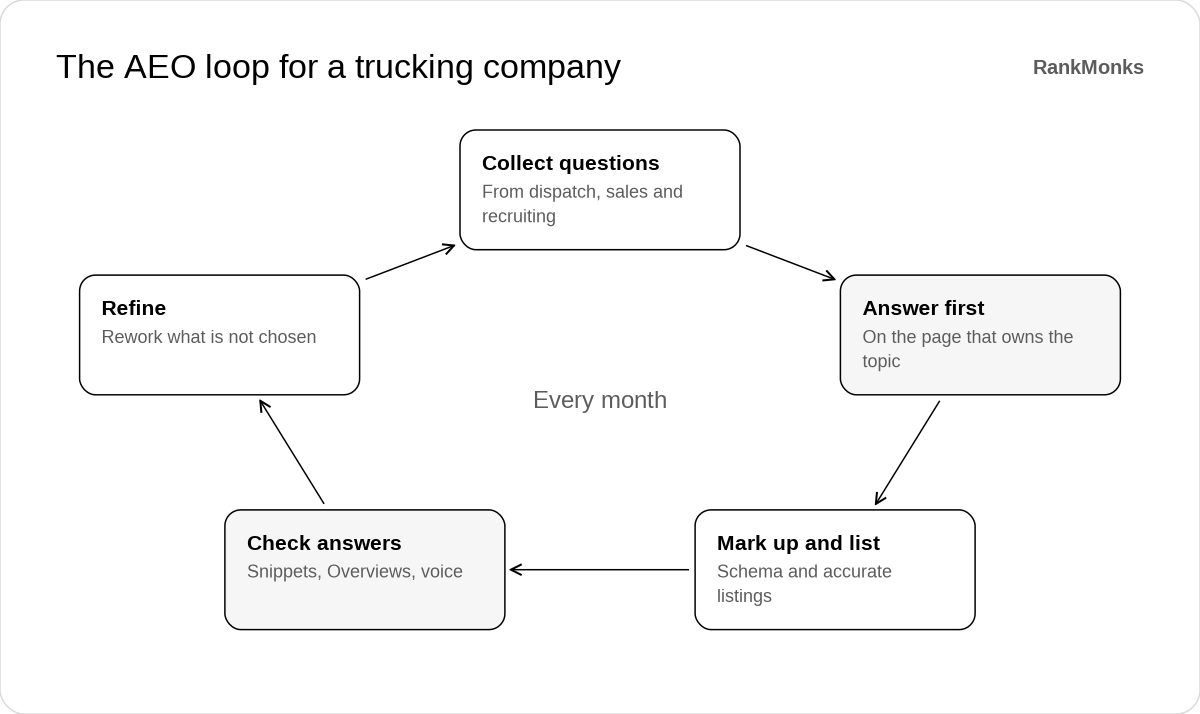
- A question list. Thirty to fifty real questions from shippers, brokers and drivers, checked each month.
- Snippets and People Also Ask. Note whether your page is the source for each question.
- AI Overviews. Note whether your page is linked as a source when an Overview appears.
- Voice checks. Ask the main assistants a handful of local questions and record what they say.
- Listings data. Calls, direction requests and website clicks from your Google Business Profile.
- Outcomes. Quote requests, broker setup requests and driver applications, with the source recorded.
Answers change, so read the trend over several months rather than reacting to one week. Our guide to SEO reporting covers how to present the numbers.
Where should a US trucking company go from here?
Start with the piece that matches where you are. Each of these guides goes deeper on one part of AEO for US carriers.
Why AEO matters for your fleet
If you are still deciding whether answers are worth the effort, read why AEO is important for US trucking companies. It sets out what a carrier loses when brokers, load boards and job boards answer the questions first, and why answer pages keep paying back.
How to put it in place
For an ordered plan, read how to implement AEO properly for US trucking companies. It covers the first 90 days, who in the business does what, and how to check each step worked.
How to win local answers
Terminals, yards and offices answer a different kind of question. Our guide on how US trucking companies win on local maps with AEO covers listings, voice answers and terminal pages.
How AEO feeds AI visibility
Clear answers are also what ChatGPT, Perplexity and Gemini prefer to quote. Read how good AEO boosts AI visibility for US trucking companies to see how the two connect and how to measure it.
How does AEO fit with SEO, GEO and AI visibility?
AEO is one layer of a wider job. The four disciplines share foundations, and each one makes the others work harder. Our guide to GEO vs SEO vs AEO explains the terms in general.
- SEO gets your pages crawled, indexed and ranked. Answer engines mostly choose from pages that already rank, so SEO for US trucking companies comes first.
- AEO shapes those pages so the answer is easy to lift.
- GEO works on what the rest of the web says about you, which shapes how AI tools describe and recommend carriers. See GEO for US trucking companies.
- AI visibility tracking measures whether all of this shows up in AI answers. See AI visibility for US trucking companies.
If your company also runs cross-border lanes or has Canadian terminals, our guide to AEO for Canadian trucking companies covers what changes north of the border, including French-language search. For the bigger picture of search in the AI era, read SEO in the AI era.
What warning signs should a carrier watch for?
Be wary of any agency or plan that treats AEO as a trick rather than as better answers.
- Guaranteed snippets or AI Overview placements. No one controls which source Google or an assistant chooses.
- FAQ pages stuffed with keywords. Dozens of thin questions written for search engines, not for shippers or drivers, rarely win and can make the site harder to trust.
- Invented facts. Pay figures, fleet sizes or safety claims that you cannot back up will be repeated back to people, and brokers can check your public records.
- Listings for places that are not real. Profiles for drop yards, unstaffed lots or virtual offices break Google's guidelines and can get listings suspended.
- Reports with no answers in them. If the report shows only rankings and traffic, nobody is checking whether you are the answer.
What should you ask an agency before you hire one for AEO?
Plain questions get the most useful answers.
- Which shipper, broker and driver questions would you target first, and why?
- How will you get those questions from our dispatchers, recruiters and safety team?
- Which of our existing pages would you rewrite, and can we see an example?
- How will you keep our listings, site and FMCSA details consistent?
- How do you measure snippets, AI Overview citations and voice answers?
- What will we see in the monthly report, and what will we be asked to do?
For a wider checklist, our guide on how to choose an SEO agency covers contracts, pricing models and reporting.
How does RankMonks approach AEO for US trucking companies?
RankMonks starts by listening. We read your site, your listings, your analytics and what search engines and AI tools currently say about your company, then talk to the people who field questions every day: dispatch, recruiting and safety.
You get a written audit covering SEO, AEO and GEO, with problems ranked by what they cost you. For a carrier that usually means listings that disagree with each other, service and careers pages that bury the answer, and facts locked in PDFs. We fix the foundations first, then rewrite and publish in small, steady releases.
The person who plans the work is the person who does it. We are honest about time: technical and listing fixes can show within weeks, while content usually takes three to six months to move. We do not promise snippets or AI placements. Each month you get a plain-language report on rankings, traffic, citations and share of AI answers, with what we did and what comes next.
Frequently asked questions
Is AEO different from SEO for a trucking company?
Yes, but they overlap. SEO earns your pages a place in the results, while AEO shapes those pages so a search engine or assistant can lift a direct answer from them. A carrier needs both, because answer engines mostly choose from pages that already rank.
Which AEO work should a small carrier do first?
Fix your listings and your facts first, then rewrite the two or three pages that matter most, usually your main service page and your driver careers page. Make sure each answers its main questions in the first lines. That costs little and supports every other answer surface.
Does a trucking company need FAQ schema for AEO?
Not for rich results, because Google limited FAQ rich results to a small set of sites in 2023. Clear question-and-answer sections still help search engines and assistants find and quote your answers. Spend the effort on Organization, LocalBusiness and JobPosting markup first.
How long does AEO take to show results for a carrier?
Listing fixes can change voice and map answers within weeks. Rewritten pages usually need several weeks to be recrawled and months to win snippets or AI Overview citations reliably. Track a fixed set of questions each month so you can see the trend.
Being the answer is mostly a matter of knowing your customers' questions and answering them plainly. That is how our SEO service approaches AEO for carriers. If you want to know which answers your company wins today, start a conversation.
Written by RankMonks.