
AEO is important for US trucking companies because the people who hire, vet and drive for carriers now get many of their answers before they reach a website. A shipper reads an AI Overview, a broker scans a People Also Ask box, a driver asks a voice assistant from the cab. Whoever supplies those answers shapes the decision, and often gets the call.
Answer engine optimization is the work of being that answer. Our guide to AEO for US trucking companies explains the whole practice. This article makes the business case: what changes when someone else answers your customers' questions, how AEO compares with the channels carriers already rely on, and why the work keeps paying back.
Key takeaways
- Shippers, brokers and drivers increasingly read an answer on the results page, in an AI Overview or from an assistant before they choose who to contact.
- When a carrier does not answer, a broker, load board, marketplace or job board usually does, and the relationship goes with the answer.
- AEO is not a replacement for brokers, load boards or paid ads, but it reduces how much a carrier depends on them.
- Specific, accurate answers can beat a larger company's vague ones, which gives small and mid-sized fleets a fair chance.
- Answer pages keep working once written, and one good answer can feed snippets, AI Overviews, voice replies and AI chat tools.
How do shippers, brokers and drivers look for answers now?
They ask full questions and expect a direct reply. The habit of typing two words and scanning ten blue links is fading, especially for practical questions with one right answer.
- Shippers ask Google or an AI tool questions such as "how do I ship a temperature-controlled load from Georgia to Ohio" or "what does a dedicated carrier contract include". Google often answers with an AI Overview, and the carriers named or linked in it start ahead.
- Brokers and 3PLs look up carriers before they tender loads. Many start with a USDOT number and the FMCSA SAFER snapshot, then check the carrier's site for equipment, lanes and insurance. If your site answers those questions plainly, setup is quicker.
- Drivers often search by voice from the cab, on breaks or at truck stops: "trucking companies hiring near me", "regional CDL-A jobs home weekly". Assistants answer from business listings and job results, not from long recruiting pages.
All three groups still visit websites, but later, and with an answer already in mind. Our guide to zero-click searches explains why more searches now end on the results page.
What does a carrier lose when someone else is the answer?
A carrier loses the first impression, the terms of the conversation and, often, the direct relationship. The question gets answered either way. AEO decides whose answer it is.
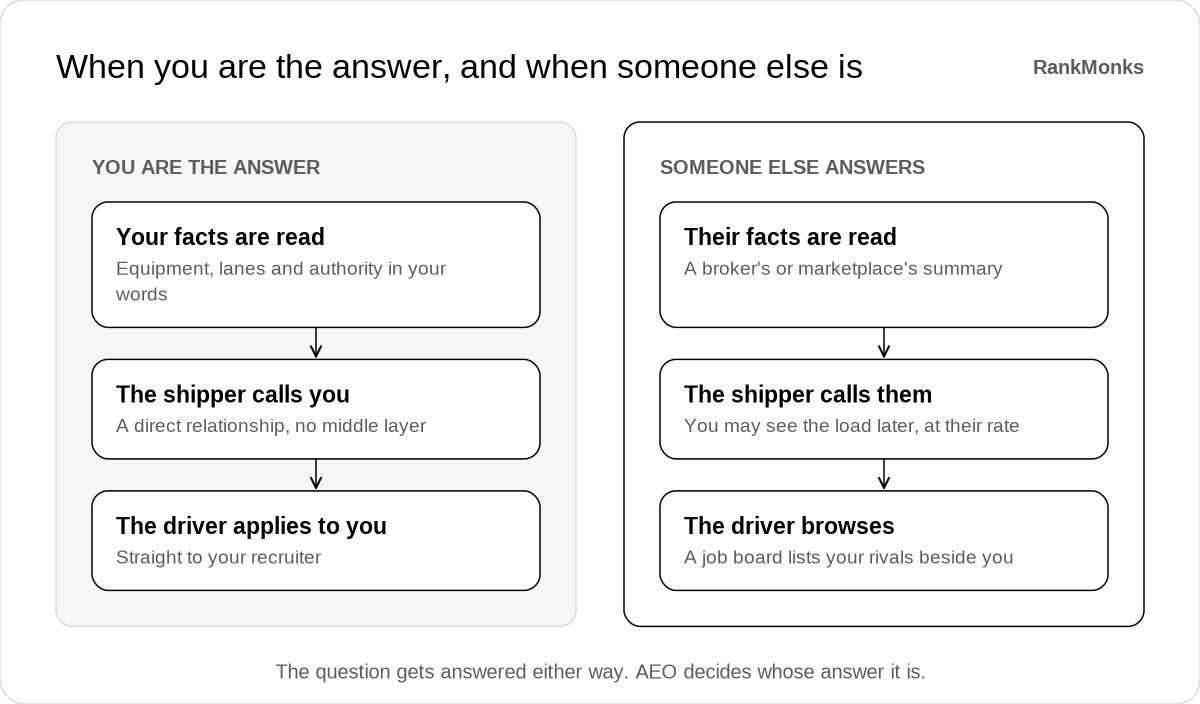
Consider a family-owned reefer carrier in California's Central Valley. A food producer asks "who can haul refrigerated produce from Fresno to Dallas?" If the answer comes from a freight marketplace, the producer posts a load there, and the carrier may only see it later through a broker, at the broker's rate. If the carrier's own lane page answers the question, the producer can call dispatch directly.
The same thing happens with drivers. A driver who asks "which flatbed companies near Houston pay by the hour?" gets an answer built from job boards and listings. If your careers page states your pay structure plainly and carries job markup, you can be in that answer. If not, the driver sees a job board where your rivals are listed beside you.
There is also a quieter loss. When a broker, a software vendor or a competitor writes the definitive explanation of "detention pay" or "drop and hook", they frame how buyers think about it. A carrier that answers those questions well earns a little authority every time the answer is shown.
How does AEO compare with brokers, load boards, job boards and paid ads?
AEO does not replace the channels carriers already use. It reduces how much you depend on them, and it costs less to keep running once the pages exist.
| Channel | What it gives a carrier | What it costs or limits |
|---|---|---|
| Brokers and 3PLs | Steady loads without your own sales effort | A margin on every load and less direct contact with shippers |
| Load boards | Quick access to spot freight | Competing on price with every other carrier on the board |
| Job boards | Driver applications at volume | Paying per post or per applicant, beside your competitors |
| Paid search ads | Traffic as soon as you pay | Traffic stops when the spend stops |
| Referrals | Trusted, high-quality leads | Hard to scale and slow to grow |
| AEO | Your answer shown where questions are asked | Takes months of steady work and cannot be guaranteed |
The value of AEO is that it works on the questions that come before any of these channels. A shipper who reads your answer may never need a load board to find you. A driver who hears your terminal named may never open a job board. Our guide to B2B SEO shows the same logic for companies that sell to other businesses.
Why can a smaller carrier win answers against bigger fleets?
Because an answer engine choosing two sentences cares more about clarity and accuracy than about the size of the company. A national carrier's page that says "we serve all 48 states with a full range of solutions" gives a search engine nothing specific to quote.
A 30-truck flatbed carrier that writes "we haul steel coils, lumber and building materials on flatbed and step deck trailers across Texas, Oklahoma and Louisiana, with tarping and chains included" has answered several real questions at once. For a shipper searching that lane and that freight, it is the better answer.
Smaller carriers also tend to know their niche better. A hazmat tanker carrier in the Gulf region, a drayage company at the Port of Savannah or a livestock hauler in the Plains states can answer specialist questions that large fleets do not bother with. Those questions get fewer searches, but the people asking them are much closer to a decision.
Why does AEO keep paying back?
Answer pages keep working once they are written, and one good answer can travel to many places. That is what makes AEO different from paid channels.
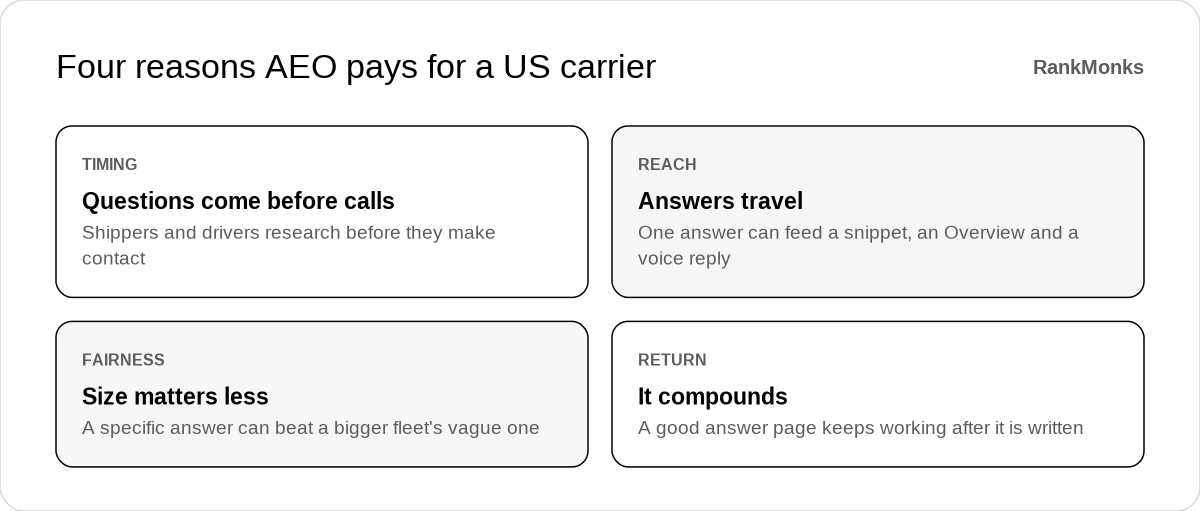
- Questions come before calls. Getting into the research stage means getting onto the shortlist.
- Answers travel. A clear definition on your site can be shown in a featured snippet, linked from an AI Overview, read out by a voice assistant and quoted by ChatGPT or Perplexity. Our guide to featured snippets explains the first of these.
- Size matters less. Specific beats vague, which suits carriers with a clear niche.
- It compounds. Each answer page adds to the topics your site is trusted on, which makes the next one easier to win.
The work does need upkeep. Pay, equipment, terminals and lanes change, and an out-of-date answer can be repeated for months. Treat answer pages like your trucks: maintained on a schedule, not left until something breaks.
What are the warning signs that a carrier is losing answers?
You are probably losing answers if the questions your team hears every day are answered online by someone else.
- Search your own common questions and note who supplies the answer. If it is a broker, a marketplace or a competitor every time, you are not in the running.
- Ask a voice assistant for trucking companies near your main terminal. If it names others, or reads out old hours for you, your listings need work.
- Look at how driver applicants say they found you. If nearly all come through paid job boards, your own careers pages are not being shown.
- Ask brokers what they checked before setting you up. If they mention calling to confirm basic facts, your site is not answering them.
What should you ask an agency about AEO?
Before you commit budget, ask questions that show whether an agency understands trucking as well as search.
- Which shipper, broker and driver questions would you target first for a fleet like ours?
- How would you measure whether we are the answer, not just whether we rank?
- What would you change on our careers pages, and how would you handle pay claims?
- How will you keep our site, listings and FMCSA details consistent?
- What can we realistically expect in three months, and in a year?
Be cautious of anyone who guarantees snippets or AI Overview placements. Nobody controls those.
How does AEO fit with SEO, GEO and AI visibility?
AEO depends on SEO and feeds AI visibility. The case for each discipline is related but not identical.
- Why SEO is important for US trucking companies covers being found at all, which every answer depends on.
- Why GEO is important for US trucking companies covers how AI tools decide which carriers to recommend.
- Why AI visibility is important for US trucking companies covers measuring what those tools say about you.
Once you are convinced, the next steps are practical. Our guide to implementing AEO properly for US trucking companies sets out a 90-day plan, and our guide on winning local maps with AEO covers terminals and voice answers. If you also run cross-border lanes, see why AEO is important for Canadian trucking companies. Our full guide to AEO for US trucking companies ties it together.
How does RankMonks approach AEO for US trucking companies?
We start by reading everything: your site, your listings, your analytics and what search engines and AI tools say about your company today. Then we talk to the people who hear the questions: dispatch, recruiting and safety.
You get a written audit covering SEO, AEO and GEO, with problems ranked by what they cost you. We fix the foundations first, then rewrite and publish in small, steady releases. The person who plans the work does the work. We are honest about time: listing fixes can show within weeks, content usually takes three to six months, and we do not promise any placement. Each month you get a plain-language report on rankings, traffic, citations and share of AI answers.
Frequently asked questions
Is AEO worth it for a small trucking company?
Often more than for a large one. Small carriers usually have a clear niche, such as particular equipment, lanes or freight, and specific answers about a niche are easier to win than broad terms. A handful of well-written pages and accurate listings can be enough to start.
Will AEO replace brokers and load boards for a carrier?
No. Most carriers will keep using brokers and load boards for some of their freight. AEO gives shippers and drivers a direct route to you, which can reduce how much you depend on those channels over time.
Does AEO help with driver recruiting?
Yes. Drivers ask practical questions about pay, home time, equipment and experience, often by voice. Clear careers pages with job markup and accurate listings make it more likely your company is the one named.
What if an AI Overview answers the question and nobody clicks?
That can still be a win if the answer names your company correctly and the shipper or driver contacts you. Measure calls, quote requests and applications alongside clicks, so you see the full value of being the answer.
Being the answer is cheaper than paying for every lead, and it lasts longer. That is the thinking behind our SEO service for carriers. If you want to see which questions your company answers today, start a conversation.
Written by RankMonks.