
AEO9 min read
How to Implement AEO Properly for US Trucking Companies
Published · RankMonks
To implement AEO properly, a US trucking company should work in a fixed order: gather the real questions its shippers, brokers and drivers ask, make its facts and listings consistent, rewrite the pages that own each question so the answer comes first, add structured data, and then measure which answers it wins. Most carriers that struggle with answer engine optimization skipped the first two steps and went straight to writing.
This guide sets out a 90-day plan, who in a trucking business should do what, how to build each answer page and how to check every step worked. For the full picture of what AEO is and why it matters, start with our guide to AEO for US trucking companies.
Key takeaways
- Start with questions from your own people, especially dispatch, sales, safety and recruiting, before you open a keyword tool.
- Fix facts and listings before writing new pages, because answer engines repeat whatever they find, including mistakes.
- Give each question one page that owns it, and put a one- or two-sentence answer directly under the heading.
- Add Organization, LocalBusiness and JobPosting markup in that order, and only where it matches what the page says.
- Measure answers, not just rankings, using a fixed list of questions checked every month.
What should be in place before you start?
You need a site that search engines can read, access to your accounts and someone who owns the work. Without those, the rest stalls.
- A crawlable site. Pages should load without errors and not depend on scripts to show their main text. If you are unsure, a technical SEO audit will tell you.
- Google Search Console and analytics. You need them to see which questions you already appear for and what visitors do next.
- Access to every listing. Google Business Profile, Apple Business Connect and Bing Places, for every staffed terminal and office. Find out who set each one up and get the logins.
- Your official facts in one place. Legal name, USDOT number, any other authority numbers that still apply, insurance details, terminal addresses, phone numbers, hours, equipment and the states and lanes you serve.
- One owner. Someone in the business who can approve answers quickly, usually the owner, operations manager or marketing lead.
What should a carrier do in the first 90 days?
Spend the first month gathering questions and fixing facts, the second rewriting the pages that matter most, and the third filling gaps and setting up measurement.
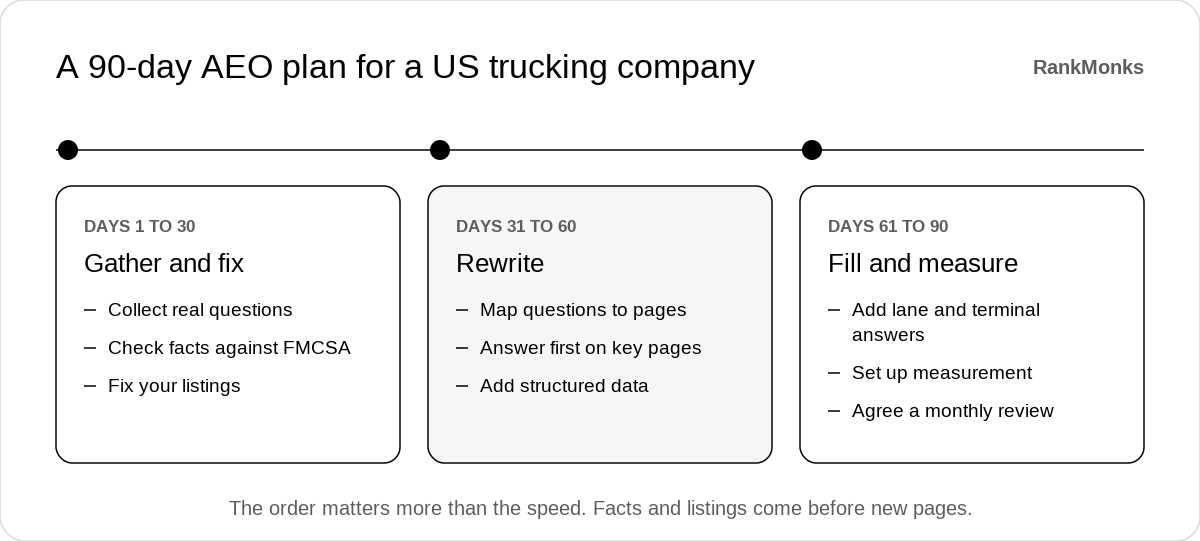
Days 1 to 30: gather and fix
- Collect questions. Ask dispatch for the ten questions shippers ask most, recruiting for the ten drivers ask most and safety for what brokers ask during setup. Add questions from emails, call notes and reviews.
- Add search data. Check Search Console for queries phrased as questions, and look at People Also Ask boxes for your main services. Our guide to keyword research shows how to expand a short list.
- Check your facts. Compare your site, your listings and your FMCSA registration. Names, addresses and phone numbers should match exactly.
- Fix your listings. Correct hours, categories, phone numbers and website links. Remove or merge duplicates, and do not list drop yards or unstaffed lots.
Days 31 to 60: rewrite
- Map each question to one page. Shipper questions usually belong on service, equipment or lane pages. Driver questions belong on careers pages, one for each role. Broker questions belong on a safety and compliance page.
- Rewrite the most important pages answer-first. Start with your main service page and your main driver job page.
- Add structured data that matches what each page says.
Days 61 to 90: fill and measure
- Fill the gaps. Write short answers for questions that have no page yet, such as lane pages, terminal pages and plain definitions of terms like drayage, detention and drop and hook.
- Set up measurement. Fix the list of questions you will check every month and record where you stand today.
- Agree the monthly review. Decide who checks answers, who updates pages and when.
Who in the business does what?
AEO for a carrier works best when the people who hear the questions help write the answers. An agency or marketer can shape the pages, but the facts come from operations.
| Role | What they contribute | Time needed |
|---|---|---|
| Owner or general manager | Approves claims, sets priorities, decides what to publish about pay and safety | An hour or two a month |
| Dispatch or sales | Shipper questions, lane and equipment detail, quote requirements | A short call each month |
| Safety manager | Authority, insurance, ELD, safety program facts and broker questions | A review of the safety page each quarter |
| Recruiter | Driver questions, pay structure, home time, experience requirements | A review of careers pages each month |
| Web developer | Page templates, structured data, speed and crawlability | Project work, then occasional fixes |
| Agency or marketer | Question research, writing, listings, measurement and reporting | Most of the hours |
How should each answer page be built?
Each answer page should open with the answer, follow with the facts, then give detail, proof and a next step. That shape works for snippets, AI Overviews and voice answers at once.
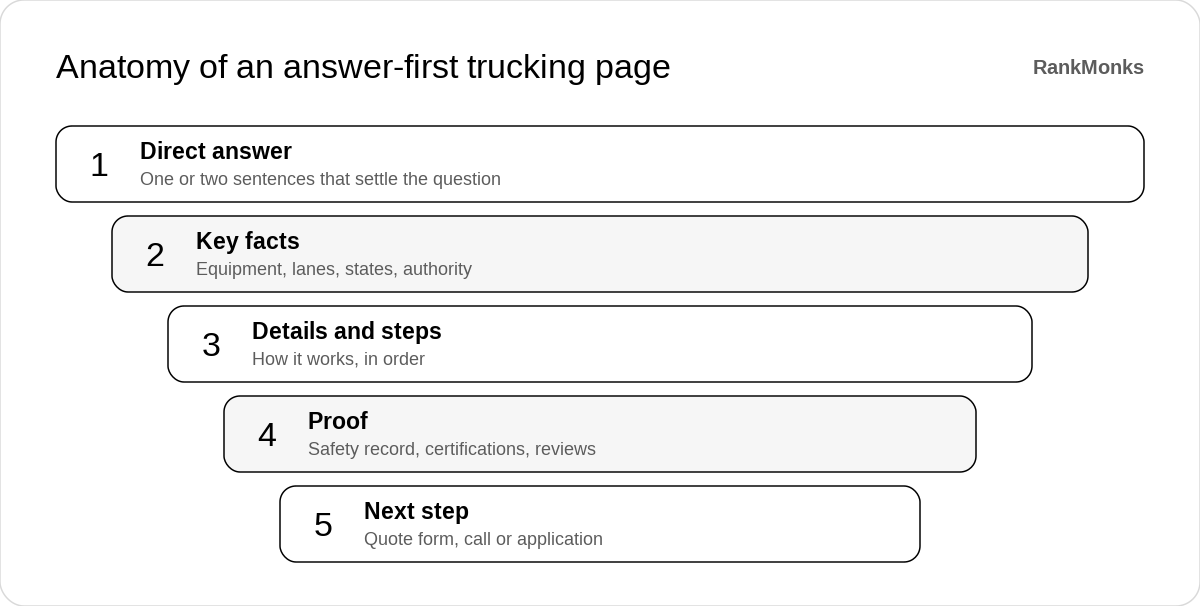
Here is how a reefer service page might open:
Do you haul refrigerated freight from California to Texas? Yes. We run refrigerated and frozen loads from California's Central Valley to Dallas-Fort Worth, Houston and San Antonio, mainly on I-10 and I-40. Our reefer trailers record temperatures for every load, and we share the record on request.
Under that, list equipment, temperature ranges you handle, pickup windows and what a shipper needs to provide for a quote. Then add proof, such as food safety training and how temperature records are shared, and finish with a quote form.
A few rules keep these pages working:
- One question per heading. Phrase the heading as the question people ask.
- Answer in one or two sentences. Then expand.
- Use lists and tables for specs. Trailer dimensions, weight limits and accessorial charges suit tables.
- Put facts in text. If your lane map is an image, repeat the main lanes in words.
Our on-page SEO checklist covers titles, headings and internal links for the same pages.
Which structured data should you add, and in what order?
Add Organization markup first, then LocalBusiness on each staffed terminal page, then JobPosting on each driver job page. Each should restate what the page already says.
- Organization on the homepage: legal name, logo, main phone, address and links to your official profiles.
- LocalBusiness on each terminal page: name, address, phone, hours and coordinates for that location.
- JobPosting on each driver job page: title, description, pay, employment type, location and date posted. This makes the job eligible for Google's job results. Remove or update the markup when a job closes.
- BreadcrumbList across the site, so search engines see how pages fit together.
FAQ markup is optional. Google stopped showing FAQ rich results for most sites in 2023, so it will not win extra space, though clear question-and-answer sections still help. Our guide to schema markup covers testing and common errors.
How do you check each step worked?
Check each step against something you can see, rather than assuming it worked.
| Step | How to check it |
|---|---|
| Listings fixed | Search your company name and terminal city, and confirm the details shown are correct |
| Pages rewritten | Use Search Console's URL Inspection tool to confirm Google has recrawled the page |
| Structured data added | Run the page through Google's Rich Results Test and fix any errors |
| Job markup live | Search for the role and town and look for your job in Google's job results |
| Answers won | Check your question list for snippets, People Also Ask and AI Overview sources |
| Business results | Compare calls, quote requests and applications from search month by month |
What mistakes should you avoid?
Most AEO mistakes come from rushing or from trying to trick the system.
- Writing before fixing facts. A beautiful answer page with the wrong phone number does more harm than good.
- Thin FAQ pages. Fifty one-line questions written for search engines rarely win and make the site feel less trustworthy.
- Inflated driver pay claims. Drivers compare notes, and assistants repeat what you publish. State how pay works and what affects it.
- Hiding answers in PDFs and images. Rate sheets, lane maps and equipment lists should have their main facts in page text.
- Markup that does not match the page. Structured data that claims something the page does not say can be ignored or cause problems.
- No one owning updates. Answers go stale when terminals move, pay changes or equipment is sold.
What should you ask an agency before handing it over?
If you bring in outside help, ask how they will run each phase.
- How will you collect questions from our dispatch, recruiting and safety teams?
- Which pages would you rewrite first, and why those?
- Who approves pay, safety and compliance claims before they go live?
- How will you keep our listings consistent with our site and FMCSA details?
- What will you measure each month, and what will you change based on it?
How does RankMonks approach AEO for US trucking companies?
We follow the same order: listen, diagnose, build and measure. We read your site, listings and analytics, talk to the people who field the questions, and write an audit covering SEO, AEO and GEO with problems ranked by what they cost you.
Then we fix the foundations and publish in small, steady releases, with the person who plans the work doing it. Listing and technical fixes can show within weeks; rewritten content usually takes three to six months to move. We do not promise snippets or AI placements. Each month you get a plain-language report on rankings, traffic, citations and share of AI answers, with what we did and what comes next.
What should you read next?
Implementation is one part of a wider plan. If you need to make the case internally first, read why AEO is important for US trucking companies. For terminals and voice answers, read how US trucking companies win on local maps with AEO. To connect this work to AI tools, see how good AEO boosts AI visibility.
The same order applies to the other disciplines. Our guides to implementing SEO properly for US trucking companies and implementing AI visibility tracking follow the same steps. If you have Canadian terminals or cross-border lanes, see how to implement AEO for Canadian trucking companies, which covers French-language pages. Our main guide to AEO for US trucking companies ties the pieces together.
Frequently asked questions
How long does it take to implement AEO for a trucking company?
The first round of work takes about 90 days: a month to gather questions and fix facts, a month to rewrite key pages and a month to fill gaps and set up measurement. Results build over the following months as pages are recrawled and answers are tested. After that, it becomes a monthly routine.
Can a carrier implement AEO without an agency?
Yes, if someone in the business has time to own it. The hardest parts are collecting questions and keeping facts current, which your own team does best. An agency mainly adds speed, writing and measurement.
Which page should a trucking company rewrite first?
Usually the main service page shippers land on and the main driver job page. Those answer the questions that bring in revenue and drivers. After that, the safety and compliance page that brokers check.
Do we need separate pages for every driver role?
Yes, where the roles differ. Local, regional, over-the-road, team and owner-operator positions have different pay, home time and requirements. A separate page for each lets you answer those questions clearly and mark each job up properly.
Implementing AEO is mostly about doing simple things in the right order and keeping them current. That is how our SEO service runs it for carriers. If you would like a plan for your fleet, start a conversation.
Written by RankMonks.