
AI Visibility Tracking10 min read
How to Implement AI Visibility Tracking Properly for US Trucking Companies
Published · RankMonks
To implement AI visibility tracking properly, a US trucking company needs four things in place before the first answer is recorded: a fact sheet that says what is true about the carrier, a fixed list of questions shippers and drivers really ask, a clear choice of AI tools and settings, and a named person for each kind of fix. With those in place, tracking becomes a monthly routine rather than a one-off look at ChatGPT.
This guide gives the ordered plan: what to prepare, how to write the prompt set, which tools to track, how to run the baseline, what to record, a 90-day timeline, the mistakes to avoid and how to check each step worked. For what AI visibility is and why it matters, start with our complete guide to AI visibility for US trucking companies.
Key takeaways
- Write a one-page carrier fact sheet first, because accuracy can only be checked against facts that are written down.
- Build separate prompts for shippers, drivers and brand checks, and keep the set fixed once it is agreed.
- Track several AI tools, run each prompt more than once per cycle and use fresh, logged-out sessions.
- Record more than "named or not": position, description, wrong facts, sources and competitors all point to different fixes.
- Give every kind of fix an owner inside the company, or the reports will pile up unread.
What do you need before you start tracking?
You need a written carrier fact sheet, a short list of competitors and a named owner for each kind of fix. Without these, you will collect answers but have nothing to judge them against and nobody to act on them.
The fact sheet is a single page that states what is true today:
- Legal name and any trade names, plus any affiliated brokerage or sister company and how it differs.
- USDOT number, and MC number where it applies.
- Carrier type: asset-based, brokerage or both.
- Equipment you run: dry van, reefer, flatbed, step deck, tanker, intermodal chassis and so on.
- Freight and services: full truckload, LTL, dedicated, drayage, hazmat, expedited, cross-border.
- Lanes and regions, and every terminal or office with its address and hours.
- Hiring: driver roles, hiring areas, route types and how pay is structured, as published on your careers pages.
Then decide who owns what. In a trucking company the facts are spread across several people, and tracking only works if each of them is involved.
| Role | What they own in tracking |
|---|---|
| Owner or president | Priorities, competitor list, final say on the prompt set |
| Operations or dispatch manager | Equipment, lanes, services and terminal facts |
| Safety and compliance manager | Authority, insurance and safety details, and what can be published |
| Recruiter | Driver questions, hiring areas, pay structure and job posts |
| Marketing or web developer | Fixes to pages, listings and structured data |
A small fleet may have one person in three of these roles. That is fine, as long as each job has a name next to it.
How do you write a prompt set for a carrier?
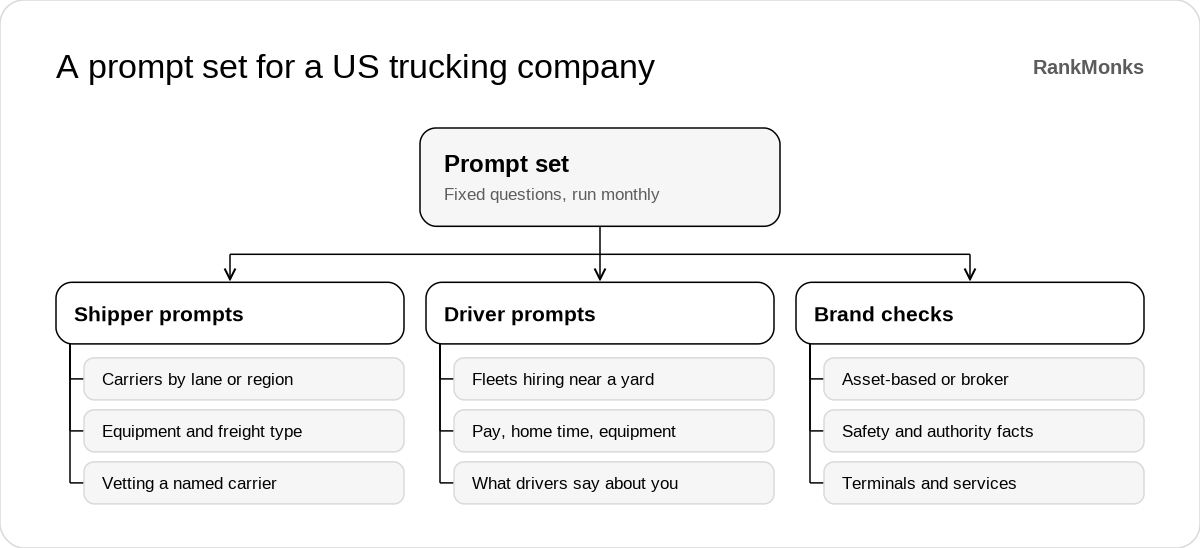
Write the prompts the way shippers, brokers and drivers actually ask, split them into groups by audience, and include both questions that name you and questions that do not. Then freeze the list so that every month can be compared with the last.
Good sources for prompt wording are close to hand:
- Sales and dispatch. The way shippers describe loads on the phone and in emails.
- Recruiting. The questions drivers ask in interviews and in messages.
- Google Search Console. The longer queries that already bring people to your site.
- Request for quote forms and lost deals. What buyers asked for that you could or could not offer.
Group the prompts like this:
- Shipper discovery. Unbranded questions about carriers for a lane, region, equipment or freight type, such as "reefer carriers that run California produce to the Midwest".
- Shipper vetting. Questions that name you, such as "Is [your company] an asset-based carrier?" or "What equipment does [your company] run?"
- Driver discovery. "Trucking companies near Joliet hiring CDL-A regional drivers", "OTR fleets that hire recent graduates with ELDT training".
- Driver vetting. "What do drivers say about [your company]?", "Does [your company] pay detention?"
- Market checks. The same discovery prompts for each terminal city or region you serve.
A few dozen prompts is enough to start for most carriers. Breadth across audiences and markets matters more than volume. Our general guide to building an AI visibility prompt set covers wording and size in more detail.
Which AI tools should a trucking company track?
Track the tools your shippers and drivers are most likely to use, which for most US carriers means ChatGPT, Google's AI Overviews and AI Mode, Gemini, Perplexity, Claude and Grok. Each draws on different sources, so they often disagree.
Settings matter as much as the list:
- Use fresh sessions. Log out, or use a clean profile, so past conversations do not shape the answer.
- Fix the location for local prompts. Where a tool allows it, set the location to the market you are testing, or name the city in the prompt. Local prompts around each terminal are covered in how US trucking companies win on local maps with AI visibility tracking.
- Run each prompt more than once. Answers vary between runs. Two or three runs per cycle give a fairer picture than one.
- Note the date and tool version. Models change. A sudden shift across every prompt may be the tool, not you.
How do you run the first baseline?
Run every prompt in every tool before you change anything, record the full answers, and check each one against your fact sheet. The baseline is the line every later month is measured against.
- Run the full prompt set in each tool, using the settings above.
- Save the full text of every answer, not only a yes or no.
- Mark whether you are named, and in what position.
- Check every statement about you against the fact sheet and flag anything wrong.
- List the sources each answer cites, where the tool shows them.
- List the competitors named, especially when you are not.
- Write a one-page summary: where you are strong, where you are absent and which errors need fixing first.
Run the same baseline for two or three competitors you lose loads or drivers to. It turns "we are named in some answers" into "we are named less often than the fleet down the road, and here is why".
What should you record for each answer?
Record the prompt, tool, date, whether you were named, your position, how you were described, any wrong facts, the sources cited and the competitors named. Each field points to a different kind of fix.
| Field | Why it matters | Where the fix usually goes |
|---|---|---|
| Named or not | Your share of answers | Pages, listings and outside sources |
| Position | First names get the call | Clarity of your pages and strength of mentions |
| Description | Whether the summary of you is right | Your own pages and the sources quoted |
| Wrong facts | Errors that cost loads and hires | The source of the error, then everywhere else |
| Sources cited | What the tool read | Pages to improve, directories to correct |
| Competitors named | Who takes your place | What their sources have that yours lack |
Our guide to AI source analysis explains how to read the sources column, and how to track brand mentions in AI search covers the recording method in general terms.
What does the first 90 days look like?
The first 90 days move from setup to fixing to a settled routine. By the end, you should have a baseline, a first round of fixes and a monthly rhythm that does not depend on one person remembering.
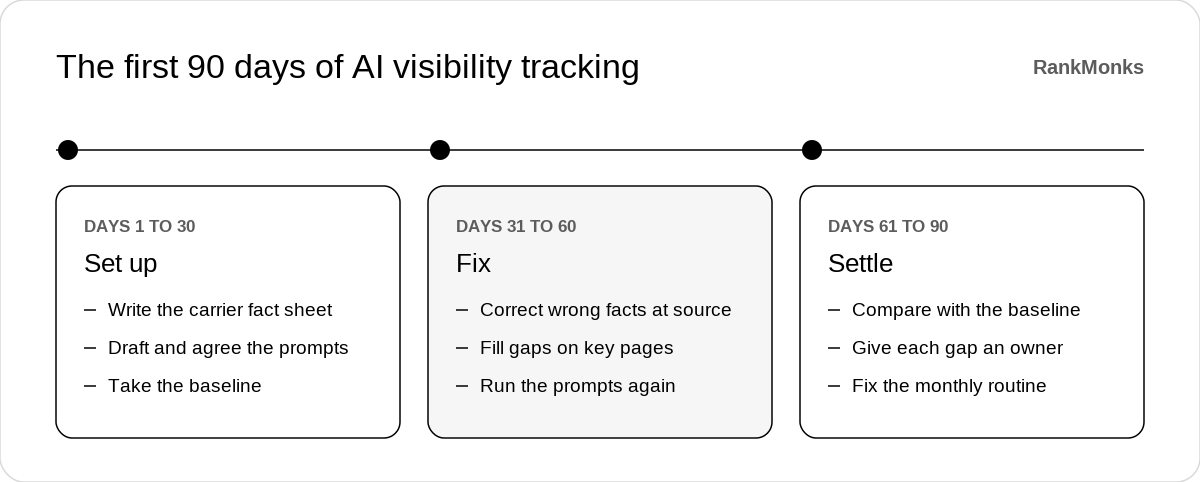
- Days 1 to 30: set up. Write the fact sheet, draft the prompts with sales, dispatch and recruiting, agree the final list and take the baseline.
- Days 31 to 60: fix. Correct wrong facts at their source, such as directory listings, old job posts and your own pages. Fill the most obvious gaps, for example a missing page for an equipment type or a terminal. Run the prompts again.
- Days 61 to 90: settle. Compare the second run with the baseline, give each remaining gap an owner and agree the monthly routine: when prompts run, who reads them and when fixes are reviewed.
Do not expect every number to move in 90 days. Some tools update quickly, others slowly, and some fixes, such as earning new mentions, take months. The aim of the first quarter is a reliable measure and a working routine.
What mistakes should you avoid?
The most common mistakes are changing the prompts every month, relying on single runs and tracking only the questions that name you. Each one makes the numbers look like information when they are not.
- Changing prompts. If the list changes, the trend means nothing. Add new prompts as a separate group and keep the core set fixed.
- One run per prompt. A single answer is an anecdote.
- Only branded prompts. You will look visible because you asked about yourself. Unbranded discovery questions are where shortlists are formed.
- Ignoring drivers, or shippers. Many carriers track one audience and miss the other.
- Logged-in, personalized sessions. Your own history can make you look more visible than you are.
- Trusting a score you cannot open. Any number should lead back to the answers behind it.
- No owner for fixes. Reports nobody acts on are a cost, not a tool.
How do you check that each step worked?
Check each step against something you can see: the fact sheet is signed off, the prompt set is approved, the baseline has full answers saved, and each fix shows up in the next run. If a step cannot be checked, it is not finished.
- Fact sheet. Operations, safety and recruiting have each confirmed their part.
- Prompt set. Sales and recruiting agree it sounds like real shippers and drivers.
- Baseline. Every prompt has saved answers in every tool, with sources where available.
- Fixes. The corrected listing or page is live, and the same prompt in the next cycle no longer repeats the error, or the source it cites has changed.
- Routine. The second and third months ran on schedule without being chased.
What should you ask an agency that offers to set this up?
Ask whether it will build the prompt set with your sales, dispatch and recruiting teams, how it handles answers that vary, and what it does after each report. Watch for guarantees and for numbers you cannot trace back to answers.
- Will we approve the prompt set, and will it cover both shippers and drivers?
- How many runs per prompt, and in which tools?
- How do you check accuracy against our facts?
- Can results be split by terminal or region?
- What does the monthly report contain, and who carries out the fixes?
How does RankMonks approach AI visibility tracking for US trucking companies?
RankMonks follows the same order. We draft the prompt list and you correct it, so it sounds like your shippers and drivers rather than a keyword tool. We take a baseline across ChatGPT, Claude, Perplexity, Gemini, Grok, Google AI Overviews and AI Mode before anything changes, then run the same prompts on a schedule.
Each monthly report ends with work: pages to fix, sources to get onto and claims to correct. Because we also work on SEO, AEO and GEO, the fixes can be done, not only listed. We take on a small number of clients at a time, and we do not promise placements in any AI tool.
Tracking is one of four disciplines. For the same practical plan applied to the others, see how to implement SEO properly for US trucking companies and how to implement GEO properly for US trucking companies. If you are still weighing the case, read why AI visibility is important for US trucking companies, and once tracking runs, how AI visibility tracking improves SEO, AEO and GEO for US trucking companies shows how to use the results. Carriers with Canadian lanes should also see how to implement AI visibility tracking properly for Canadian trucking companies. The wider picture is in our guide to AI visibility for US trucking companies.
Frequently asked questions
How many prompts does a trucking company need to track?
Most carriers can start with a few dozen, split between shipper, driver and brand-check questions, plus a version of the discovery prompts for each market they serve. It is better to have fewer prompts run consistently than a long list run once. You can add groups later without changing the core set.
Can we run AI visibility tracking ourselves?
Yes, a carrier can run a basic version with a spreadsheet and a few hours a month. The hard parts are keeping the method consistent, checking facts carefully and turning results into fixes. Many companies start in-house and bring in help when the routine slips or the fixes need specialist work.
How long before tracking shows results?
The baseline shows where you stand straight away. Fixes to wrong facts can show up in some tools within weeks, while gaining new mentions takes longer. Judge progress over several months, using the same prompts.
Should we track what AI tools say about our competitors?
Yes. Knowing which fleets are named when you are not, and which sources support them, is often the most useful part of the report. It shows what kind of page, listing or mention you are missing.
A tracking setup that runs every month without being chased is worth more than a perfect one that runs once. Building and running that routine is what our AI visibility tracking service does. If you want help setting it up for your carrier, start a conversation.
Written by RankMonks.