
AI Visibility Tracking14 min read
Best AI Visibility Agency for Small Businesses
Published · RankMonks
The best AI visibility agency for a small business is one that measures what AI tools actually say about you, on a schedule, and then helps you change it. It runs the questions your customers ask through ChatGPT, Gemini, Perplexity, Claude, Grok and Google's AI Overviews and AI Mode, records whether your business is named, whether the details are right and who is named instead, and ends every report with work to do.
That matters more for a small business than it might seem. A customer who asks an assistant for "a good plumber near me who can come today" or "a quiet Italian place for an anniversary dinner" gets a written answer with a few names in it, not a page of ten results. If your business is missing from that answer, or appears with the wrong hours, you lose the customer without ever knowing they were looking.
This guide explains what an AI visibility agency does, what separates a good one from a weak one, how the work is usually priced, the warning signs to watch for, the questions to ask, and how the work changes for restaurants, dental offices, plumbers, realtors and terpene flavor houses.
Key takeaways
- An AI visibility agency measures how often AI tools name your business, how accurately they describe it and which competitors they name instead.
- The method that works is a fixed list of real customer questions, run across several AI tools on a schedule, with the results read as a trend.
- For a small business, accuracy is often worth more than reach, because one wrong answer about hours, services or whether you are open costs real customers.
- Tracking only pays when each report ends in actions, such as pages to fix, listings to correct and sources to get onto.
- No agency can guarantee that ChatGPT or any other tool will recommend you, so treat any such promise as a reason to walk away.
What does an AI visibility agency do for a small business?
An AI visibility agency tracks how AI tools describe and recommend your business, works out why they say what they say, and points the fixing work at the causes. It is the measurement layer for AI search, in the way that rank tracking and analytics are the measurement layer for ordinary SEO.
The work has five parts:
- A prompt set. A fixed list of questions your customers really ask, written in their words. For a bakery that might include "where can I order a custom birthday cake in Riverside" and "which bakeries near me do gluten-free bread".
- Tracking. The same prompts run across several AI tools, again and again, with each answer recorded.
- Accuracy checks. Every answer that names you is checked against the facts: hours, location, services, prices and whether you are open at all.
- Source analysis. A record of which pages, listings and reviews each answer drew on, and which of those mention you.
- Reporting. A short monthly report on what changed, why, and what to do next.
Our guide to AI visibility explains the underlying idea in more detail. The short version is that you cannot manage what you have not measured, and an AI answer is impossible to see unless someone asks the question.
Why does AI visibility matter for a small business?
AI visibility matters for a small business because AI answers name only a handful of options, and a small business either makes that shortlist or does not. There is no page two to fall back on.
Four things make it more pressing for small firms than for large ones:
- Shortlists are short. An assistant asked for a local recommendation usually names a few businesses. A large brand is likely to be one of them. A small one has to earn the place.
- Wrong facts cost directly. If an answer says you close at 6 when you close at 9, or that you do not take walk-ins when you do, the customer goes elsewhere. An old listing can even mark a live business as closed.
- You cannot see it without checking. There is no report that shows every answer an assistant gave about you. Unless someone asks the questions and records the answers, problems stay hidden.
- Customer questions are specific. People ask AI tools long, detailed questions, such as a dentist who takes a particular insurance plan and sees emergencies on Saturdays. Those questions rarely show up in keyword tools, so they need to be tested directly.
None of this means ordinary search has stopped mattering. Many AI tools search the web before they answer, and pages that rank well tend to be the ones they read. AI visibility tracking tells you whether that work is reaching the answers. Our guide to zero-click searches covers the wider shift towards answers that are read without a click.
What makes an AI visibility agency the best fit for a small business?
The best AI visibility agency for a small business tracks real customer questions across several tools, checks the facts line by line, explains its method in plain language and turns every report into a few clear fixes. The detail of how it measures matters more than the size of its dashboard.
Look for these eight things:
- A prompt set built from your customers' words. The agency should draft the list from your calls, emails, reviews and search data, then let you correct it. Our guide to building an AI visibility prompt set explains why the list should stay fixed from month to month.
- Several AI tools, not one. ChatGPT, Gemini, Perplexity, Claude, Grok and Google's AI Overviews and AI Mode can give quite different answers to the same question. Tracking one tool tells you about one tool.
- Repeated runs. AI answers vary between runs. A good agency asks each question more than once and reports a rate, not a single answer. Our guide to AI share of voice explains how that rate is calculated.
- Accuracy checks. For a small business, the question "is what it says true?" often matters as much as "are we named?". Hours, prices, service areas and services should be checked in every answer that mentions you.
- Source analysis. The agency should record which pages each answer cited and why your competitors appear. Our guide to AI source analysis covers how this is done.
- Reports that end in actions. Every report should close with a short list of things to fix, in order of what they are likely to change.
- A size that fits you. A small business does not need thousands of prompts. It needs the questions that bring in customers, tracked carefully, and a report the owner can read in a few minutes.
- A link to the fixing work. Tracking shows the problem. Someone still has to fix the website, correct the listings and earn the mentions. The best agency either does that work or hands it over in a form your team can act on.
As an example, a two-location physiotherapy clinic might track 40 questions about back pain, sports injuries and appointment times across five AI tools, checked each month. That is enough to see a trend and small enough to act on.
What should an AI visibility report show a small business owner?
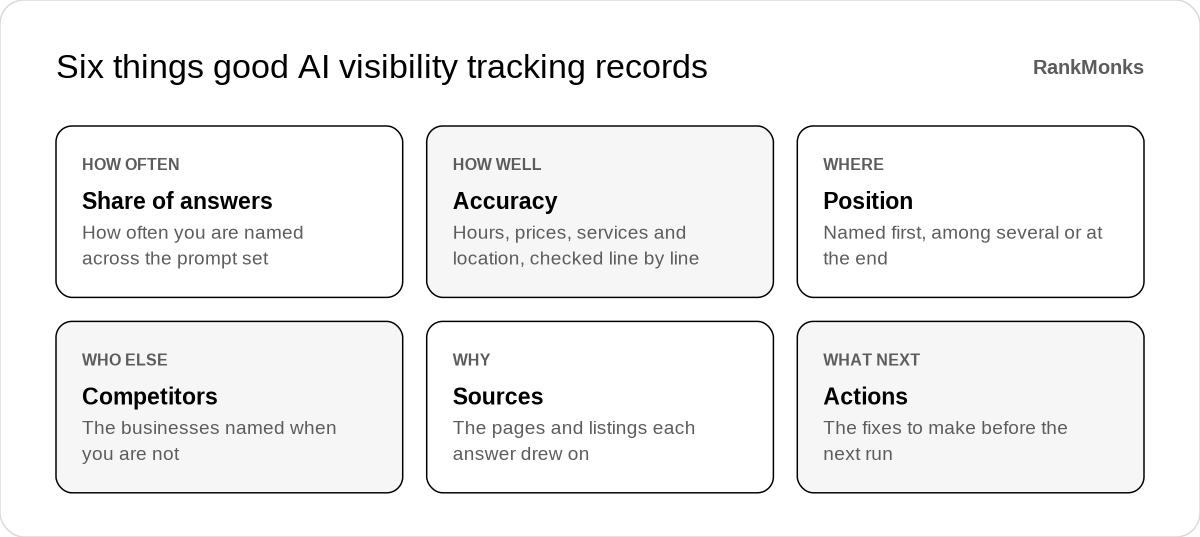
An AI visibility report should show how often you are named, whether what is said about you is right, who is named instead of you, where the answers come from, and what to do next. If a report cannot answer those five questions, it is a chart rather than a report.
| Measure | What it tells you | Small business example |
|---|---|---|
| Share of answers | How often you are named across the prompt set | Named in most brunch questions for your neighborhood, missing from dinner ones |
| Accuracy | Whether the facts in the answers are right | Two tools still show last year's opening hours |
| Position | Whether you come first, in the middle or last | Named, but always after two larger rivals |
| Competitors named | Who appears when you do not | A rival appears for every emergency question |
| Sources | The pages and listings the answers used | A local best-of list you are not on is cited often |
| Actions | What to fix before the next run | Update the listing, add the menu as text, pitch the list's editor |
Notice that two of these measures, accuracy and sources, point straight at fixes. That is why they matter so much for small businesses, which have little time for analysis that does not lead anywhere.
How is AI visibility tracking usually priced?
AI visibility tracking is usually priced as a monthly retainer, a one-off audit, or part of a wider SEO and AI search program. The price depends on the amount of work, not on a standard rate.
The common models are:
- A one-off baseline audit. The agency builds the prompt set, runs it once across the main tools and reports where you stand. It is a sensible first step if you are not sure tracking is worth it.
- A monthly tracking retainer. The same prompts run on a schedule, with a monthly report and a short action list.
- Tracking within a wider program. Tracking sits alongside SEO, AEO, GEO or digital PR work, and the report shows how that work is landing in AI answers.
What drives the cost:
- The number of prompts and the number of AI tools tracked.
- How many locations, service areas or product lines you need covered.
- How often the prompts run.
- Whether the agency also fixes what it finds, or only reports it.
Ask for the price of each part separately, so you can compare proposals fairly. Our guide on how to choose an SEO agency covers comparing proposals and contracts, and most of it applies here.
What results should a small business expect, and how fast?
You should expect a clear baseline within the first month, and changes in the answers over the following months, at a pace that differs by tool. Tracking itself is quick. Changing what the tools say takes longer.
Some changes can show up relatively quickly. AI tools that search the web before answering can pick up a corrected listing or a new page once it is found and indexed. Answers that rely on what a model learned during training change more slowly, often only when the model is updated. Content and authority work usually takes three to six months to move search rankings, and the AI answers that draw on those rankings tend to follow on a similar timescale.
A good agency tells you this before you sign, and reports progress in steps you can see: errors found and fixed, sources added, and share of answers by question group over time.
What are the warning signs when hiring an AI visibility agency?
The clearest warning sign is a guarantee. No agency controls what ChatGPT, Gemini or any other AI tool says, so a promise to put you "first in ChatGPT" is either a misunderstanding or a sales line.
| Good sign | Warning sign |
|---|---|
| Shows you the prompts and lets you edit them | Keeps the prompts secret |
| Tracks several AI tools | Tracks one tool, or does not say which |
| Repeats each prompt and reports a rate | Shows a single screenshot as proof |
| Checks the accuracy of every mention | Counts mentions only |
| Ends each report with actions | Sends charts with no next step |
| Explains limits and timescales | Guarantees a position or a date |
Be equally wary of tactics that try to trick the tools. Hidden text written for bots, fake reviews, mass-produced pages and paid "best of" lists dressed up as independent advice can backfire, and some breach the rules of the platforms they target. Advice about AI search should hold up if a customer read it too.
What should you ask before you hire an AI visibility agency?
Ask questions that reveal how the agency measures, how it reports and what happens after the report. The answers should be specific and short.
- Which questions will you track for my business, and can I see and change the list?
- Which AI tools will you check, and how often?
- How many times do you run each question, and how do you handle answers that vary?
- How do you check whether what the tools say about us is accurate?
- How do you find out which sources the answers are built from?
- What does a monthly report look like? Can I see an example with the client's name removed?
- Who fixes the problems you find, and how quickly?
- What will you not promise, and why?
If the agency cannot show you its method, or the answer to question eight is "nothing", keep looking.
How does the best AI visibility agency adapt to your industry?
The best AI visibility agency changes the prompt set, the facts it checks and the sources it studies to fit how customers in your industry choose. A restaurant and a terpene supplier both need tracking, but they need different questions tracked.
Small restaurants
Diners ask AI tools for places by dish, neighborhood, occasion and dietary need, then check whether a place is open and takes bookings. Tracking should cover those questions and check hours, menus and booking details closely. Our guide to the best AI visibility agency for small restaurants covers the prompt set and the facts that most often go wrong.
Dental offices
Patients ask about emergencies, treatments, insurance and whether a dentist is taking new patients. Accuracy matters even more here, because the subject is health and the rules on patient privacy are strict. See the best AI visibility agency for dental offices for what to track and what to keep out of the work.
Small plumbing companies
Plumbing questions are often urgent and asked from a phone, sometimes late at night. Tracking should be split by emergency, service and town, and it should check claims about availability closely. The best AI visibility agency for small plumbing companies explains how.
Small realtors
Buyers and sellers ask AI tools who knows a neighborhood and which agents work in a town. Answers often draw on portal profiles and reviews, and they can attach an agent to an old brokerage. Read the best AI visibility agency for small realtors for the buyer and seller prompts to track.
Small terpene flavor houses
Terpene and flavor buyers ask precise technical questions, and AI tools can confuse botanical and cannabis-derived products or invent claims a supplier never made. The best AI visibility agency for small terpene flavor houses covers the technical prompts and the claims to watch.
How does AI visibility fit with SEO, AEO and GEO?
AI visibility tracking measures the result, while SEO, AEO, GEO and digital PR change the inputs. Tracking on its own changes nothing. It shows which of the four kinds of work needs attention.
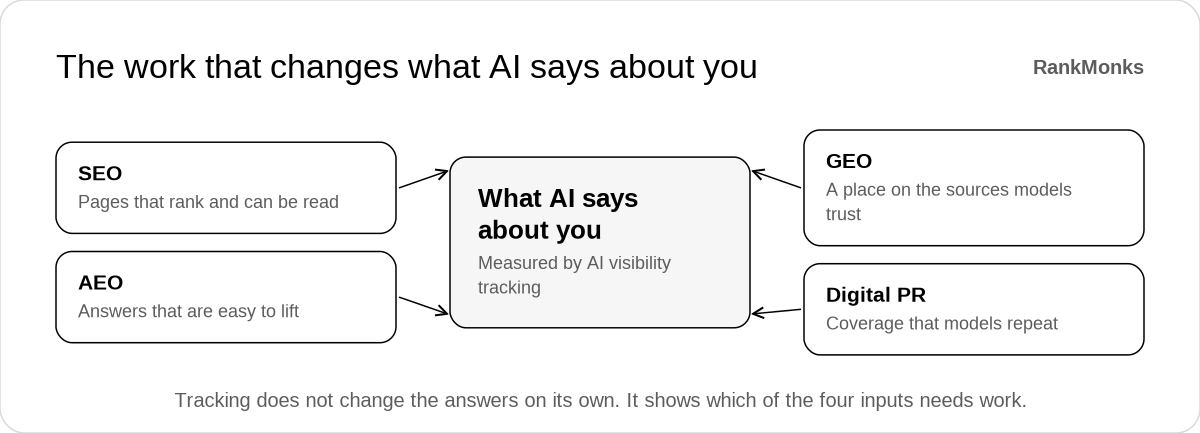
- SEO gets your pages ranked and readable. Many AI tools search the web before answering, so pages that rank tend to be the pages they read. Our guide to the best SEO agency for small businesses covers what that work involves.
- AEO shapes your pages so the answer is easy to lift into featured snippets, AI Overviews and voice answers. See the best AEO agency for small businesses.
- GEO works on the sources AI tools trust, such as review sites, directories, local press and best-of lists, so that more of them name you correctly. See the best GEO agency for small businesses.
- Digital PR earns coverage in the publications those tools cite. Our guide to digital PR explains how.
The three disciplines are compared side by side in our guide to GEO vs SEO vs AEO, and our main guide to SEO in the AI era sets out how they work together. When tracking turns up a wrong fact, our guide on how to fix wrong information about your brand in AI answers walks through tracing and correcting it.
How does RankMonks approach AI visibility for small businesses?
RankMonks runs AI visibility tracking as a fixed, repeatable measure tied to the work that changes the answers. We take on a small number of clients at a time, and the person who plans your tracking is the person who does the work.
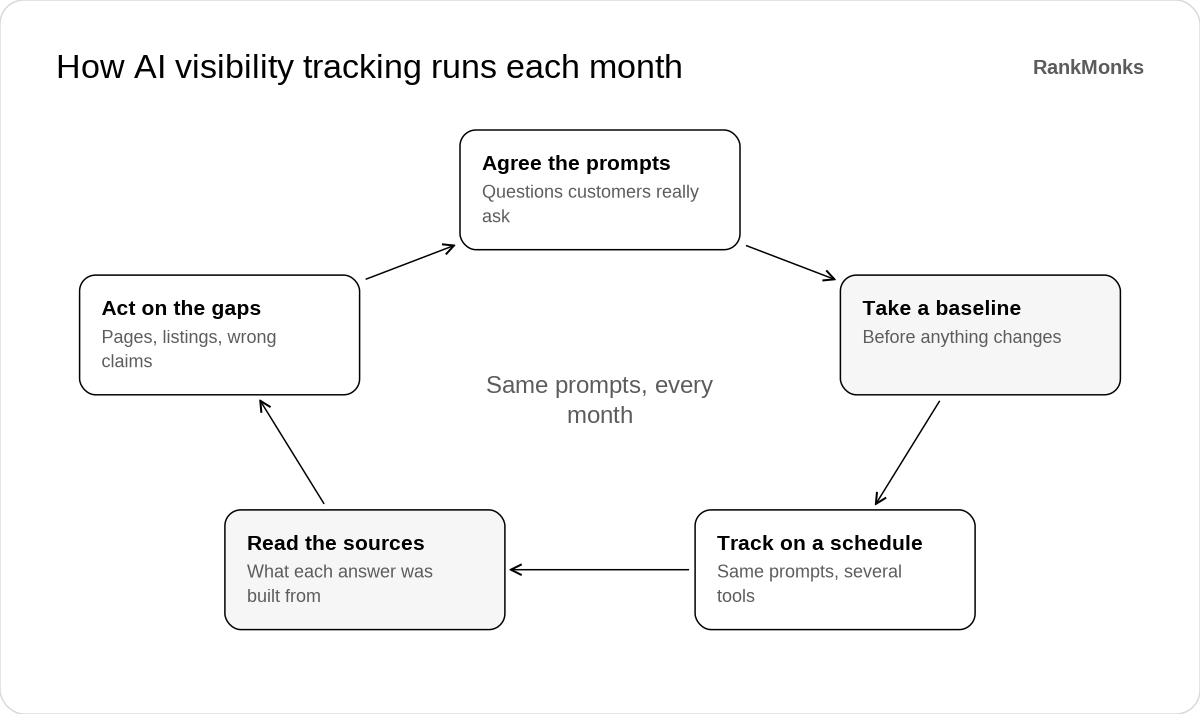
The process has four steps:
- Agree the prompts. We draft a list of questions from your customers' words, and you correct it. It should sound like your customers, not like a keyword tool.
- Take a baseline. Before anything changes, we record where you stand in ChatGPT, Claude, Perplexity, Gemini, Grok and Google's AI Overviews and AI Mode, and where your competitors stand.
- Track on a schedule. The same prompts, the same tools, run again and again, because movement only means something against a fixed measure.
- Act on the gaps. Each monthly report ends with work: pages to fix, sources to get onto and claims to correct.
Because we also work on SEO, AEO and GEO, the report connects to the fixes rather than stopping at the numbers. We will not promise a position in any AI tool, and we tell you what is realistic before you sign anything.
Frequently asked questions
What is an AI visibility agency?
An AI visibility agency measures how AI tools such as ChatGPT, Gemini, Perplexity and Google's AI Overviews describe and recommend your business. It tracks a fixed set of customer questions on a schedule, records whether you are named and described accurately, and recommends fixes. Many also do the SEO, AEO and GEO work that changes the answers.
Can an agency guarantee that ChatGPT will recommend my business?
No. No agency controls what ChatGPT or any other AI tool says, and answers vary from one run to the next. An agency can improve the inputs the tools read, such as your website, listings, reviews and coverage, and measure whether the answers change. Treat any guarantee as a warning sign.
How often should a small business check its AI visibility?
Monthly is a sensible rhythm for most small businesses, with the same prompts run several times in each cycle. Check sooner after a change that affects the facts, such as new opening hours, a move or a new service. A one-off check is a useful start, but only repeated checks show a trend.
Do I need an AI visibility agency if I already have an SEO agency?
Not always. If your SEO agency already tracks AI answers with a fixed prompt set across several tools and checks their accuracy, you are covered. If its reports show only rankings and traffic, you have no view of what AI tools say about you, and tracking fills that gap.
The best AI visibility agency makes the answers visible first, then helps you change them. That is how our AI visibility tracking service works. If you want to know what AI tools say about your business today, start a conversation.
Written by RankMonks.