
AI Visibility Tracking9 min read
Best AI Visibility Agency for Small Terpene Flavor Houses
Published · RankMonks
The best AI visibility agency for a small terpene flavor house is one that tracks what ChatGPT, Gemini, Perplexity and Google's AI answers tell product developers, brands and hobbyists about your company, and catches the claims that could cause you trouble. It measures whether you are named when someone asks for a terpene supplier for beverages, a blend that works in a particular product, or a supplier that publishes certificates of analysis, and it checks that what the answers say about your products is accurate.
That second job matters more for a flavor house than for most small businesses. AI tools can mix up botanical and cannabis-derived terpenes, attach health effects to a blend, or describe your regulatory status loosely. Ad platforms often restrict or flag cannabis-adjacent products, so organic search and AI answers carry more of the load for many terpene companies. This guide is part of our guide to the best AI visibility agency for small businesses.
Key takeaways
- Terpene and flavor buyers ask AI tools precise questions about suppliers, formulation, specifications, documents and wholesale, so the prompt set should be technical and split by product type.
- Accuracy is a compliance matter as well as a marketing one: watch for wrong sourcing, health claims, loose regulatory language and discontinued products.
- Wrong answers usually trace back to vague product pages, missing documents, old catalog pages or third-party listings that describe your products carelessly.
- Published certificates of analysis, safety data sheets and clear sourcing statements give AI tools accurate facts to repeat.
- A useful monthly report shows share of answers by product type against named competitors, wrong claims and their sources, and a short list of fixes.
How do terpene and flavor buyers use AI tools?
Terpene and flavor buyers use AI tools to find suppliers and to answer technical questions while they develop a product. Many are formulators at beverage, vape, edible, cosmetic or food brands, working under deadlines and looking for a supplier who can answer precisely. Others are smaller buyers and hobbyists looking for a specific profile.
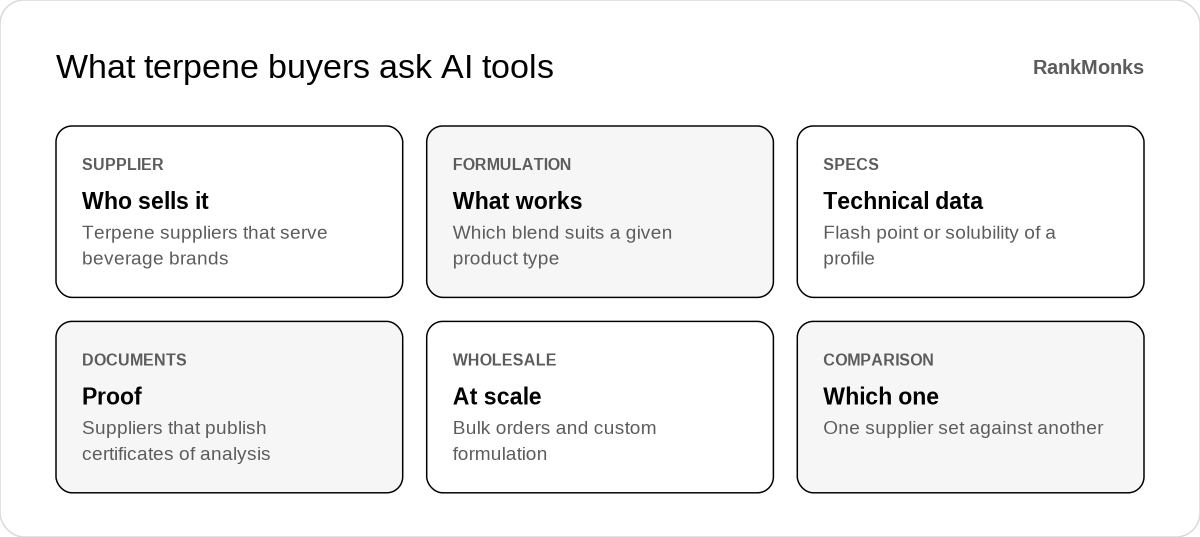
A product developer might ask "which terpene suppliers sell water-soluble blends for beverages", follow with "what dosage rate is typical for terpenes in a sparkling drink", and finish with "which of those suppliers publish certificates of analysis". The answers name a few suppliers and describe each briefly.
Those descriptions are built from what the tools can read, including:
- Your product, category and documentation pages.
- B2B directories and marketplaces where you are listed.
- Trade publications, industry newsletters and event listings.
- Forums and community threads, where product makers compare suppliers.
- Reviews and comparisons on other sites.
A flavor house with clear technical pages and published documents gives the tools something accurate to work with. One with thin product pages leaves the answer to whatever else is online.
What should an AI visibility agency track for a terpene flavor house?
An AI visibility agency should track a fixed set of supplier and technical questions, split by the product types your customers make, plus checks on the facts about your company. Splitting by product type matters, because a supplier that is named for vape blends may be missing from every beverage question.
| Prompt group | Example | What it shows |
|---|---|---|
| Supplier, by product type | "Terpene supplier for beverage brands" | Whether you are named for the markets you sell into |
| Formulation | "Which terpene blend suits a gummy formulation?" | Whether your guidance is read or cited |
| Specifications | "Flash point of a limonene-heavy blend" | Whether your technical data is the source used |
| Documents | "Terpene suppliers that publish certificates of analysis" | Whether your documents are visible |
| Wholesale and custom | "Custom terpene formulation for a new product line" | Whether you are named for higher-value work |
| Company check | "Are [your company]'s terpenes botanical or cannabis-derived?" | Whether the facts about you are right |
For a small flavor house selling into three or four product categories, a starting set might be 40 to 60 questions, with the supplier questions repeated for each category. Our guide to building an AI visibility prompt set explains how to word the questions so they can be compared over time.
Which claims do AI answers get wrong about a flavor house?
AI answers most often get a flavor house's sourcing, product claims, regulatory status and catalog wrong. Some of these errors cost sales, and some could create compliance problems if a customer relied on them.
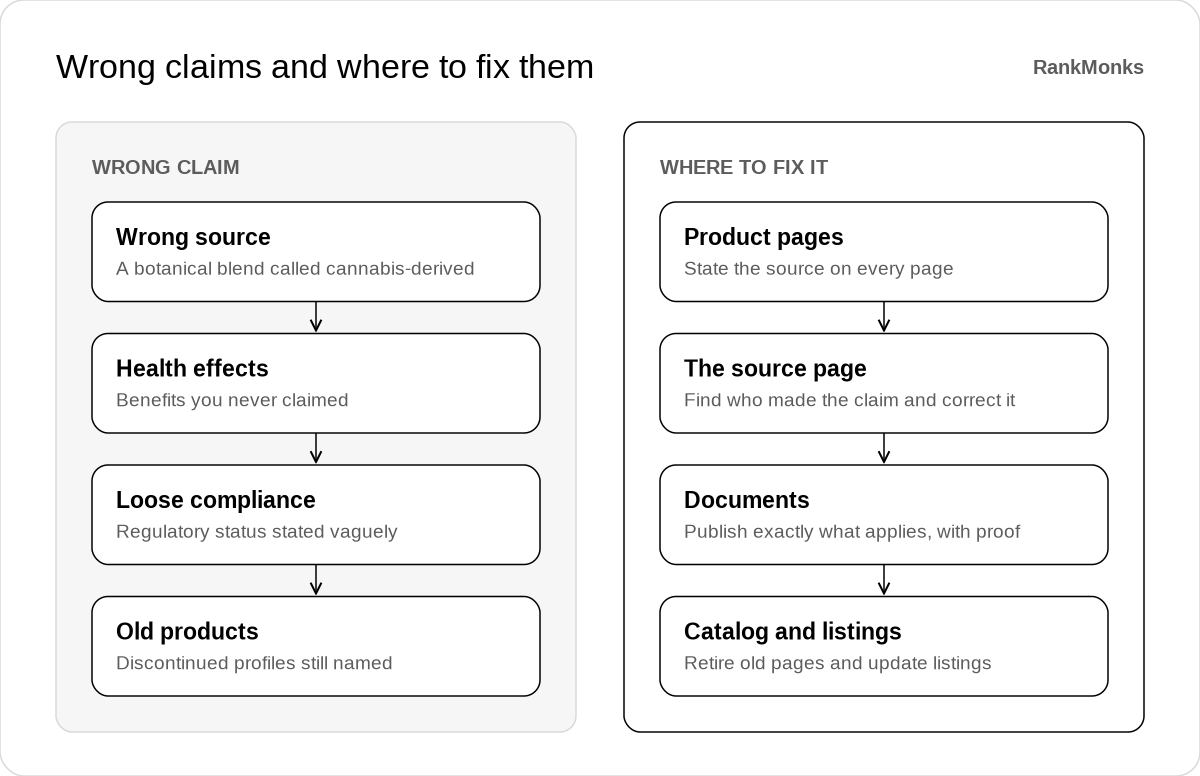
- Sourcing. A botanical blend is described as cannabis-derived, or the reverse. State the source plainly on every product page.
- Health effects. An answer attributes calming, energizing or medical effects to a blend, often borrowed from general articles about terpenes. If any of your own pages or listings make such claims, remove them, and correct third-party pages where you can.
- Regulatory status. An answer says your products are "FDA approved" or "food grade" without qualification. Publish exactly what applies to each product, such as the FEMA GRAS status of individual flavoring ingredients where it genuinely applies, and back it with documents.
- Old products. Discontinued profiles are still recommended, usually because old catalog pages or marketplace listings are still live.
A good agency traces each error to its source and fixes it there. That usually means clearer product pages, certificates of analysis and safety data sheets published as readable pages or well-labeled files, retired pages redirected to current products, and listings updated on the directories and marketplaces you control. Our guide on how to fix wrong information about your brand in AI answers covers the tracing, and our guide to AI source analysis covers finding which pages the answers rely on.
What should a flavor house's AI visibility report show?
A flavor house's AI visibility report should show where you are named by product type, which claims were wrong or risky, which sources the answers used and what to fix next. It should be short enough for the founder and the head of sales to read together.
A useful monthly report includes:
- Share of answers by product type, next to the suppliers you compete with most.
- A claims log of wrong or risky statements, their sources and whether they are fixed. Health and regulatory claims should be flagged first.
- The sources cited, such as a marketplace listing, a forum thread or a trade article.
- Changes since last month, with the likely reasons.
- Three to five actions, in order.
Read the numbers as a trend. AI answers vary between runs, and technical questions can be answered very differently by different tools, so several months tell you more than one. Our guide to AI share of voice explains how the figures are calculated.
What warning signs should a terpene company watch for?
The clearest warning sign is a guarantee that ChatGPT will recommend your products. No agency controls what AI tools say.
Watch for these as well:
- Advice to make health claims. Content that promises effects can create regulatory risk and is not worth the traffic.
- Loose compliance language. An agency that writes "FDA approved" or "all natural" without checking what applies to each product is creating the errors you are paying to fix.
- Mass-produced pages. Hundreds of thin strain-profile pages written without technical review tend to add inaccurate claims rather than remove them.
- One screenshot as proof. Ask how often each question is run.
- No technical understanding. If the agency cannot follow a question about solubility or flash point, it cannot judge whether an answer is right.
- Reports with no actions. A chart will not correct a sourcing error.
What should you ask an agency before you hire it?
Ask how the agency handles technical accuracy and compliance, and how it turns findings into fixes. The answers should be specific.
- Which supplier and technical questions will you track, and for which product types?
- Which AI tools will you check, and how often?
- How do you check claims about sourcing, health and regulatory status?
- Who reviews technical content before it goes live?
- Which competitors will you compare us with?
- Who makes the fixes, and how quickly?
- What does a monthly report look like?
How does AI visibility fit with SEO, AEO and GEO for a flavor house?
AI visibility tracking shows what buyers are told about you, while SEO, AEO and GEO change what the AI tools can read. A terpene flavor house usually needs some of each, and tracking shows where to start.
- SEO gets your product, category and documentation pages found in search, which matters more when paid ads are restricted. See the best SEO agency for small terpene flavor houses.
- AEO shapes your technical pages so precise answers, such as typical dosage rates by product type, can be lifted into AI Overviews and featured snippets. See the best AEO agency for small terpene flavor houses.
- GEO works on the trade publications, directories, marketplaces and forums that AI tools draw on. See the best GEO agency for small terpene flavor houses.
If tracking shows wrong claims, fix your own pages and listings first. If the facts are right but you are rarely named, the gap is usually in third-party sources and mentions. Our guide to the best AI visibility agency for small businesses shows how the four disciplines work together, and our guide to AI crawlers and llms.txt covers making sure AI tools can read your technical pages at all.
How does RankMonks approach AI visibility for terpene flavor houses?
RankMonks tracks a fixed set of supplier and technical questions, split by product type, across ChatGPT, Claude, Perplexity, Gemini, Grok and Google's AI Overviews and AI Mode. We take on a small number of clients at a time, and the person who plans your tracking does the work.
We agree the prompts with you first, using the questions your sales and technical teams really receive. We take a baseline for you and your competitors before anything changes, then run the same prompts on a schedule. Each monthly report covers share of answers by product type, wrong or risky claims and their sources, and ends with actions: pages to clarify, documents to publish and listings to correct. Because we also work on SEO, AEO and GEO, those actions can be carried out, not just recommended.
We will not promise a place in any AI answer, and we tell you what is realistic before you sign anything.
Frequently asked questions
Why do AI tools describe our botanical terpenes as cannabis-derived?
They are often generalizing from articles that discuss terpenes and cannabis together, or from listings that do not state the source. State the source clearly on every product page and listing you control, and use consistent wording everywhere. Then check the answers again after a few weeks.
Can AI tools make health claims about our products?
They can repeat claims from any source they read, including general articles about terpenes. You cannot control every answer, but you can make sure your own pages and listings make no health claims, correct third-party pages where possible, and track whether such claims keep appearing next to your name.
Should a terpene company publish its certificates of analysis online?
Publishing them usually helps. Buyers look for documents before they order, and published certificates give AI tools and search engines a verifiable source for your product facts. Make each one easy to find from the matching product page and clearly labeled with the product and batch.
How often should a flavor house check its AI visibility?
Monthly suits most companies, using the same questions each time. Check sooner after a change that affects the facts, such as a new product line, a discontinued profile or a change in how a product is sourced. Repeated checks matter because technical answers can vary a lot between runs.
Formulators trust answers that sound precise, so it is worth knowing what those answers say about you. That is the work of our AI visibility tracking service. If you want to see what AI tools tell product developers about your company, start a conversation.
Written by RankMonks.