
The best GEO agency for a small terpene flavor house is one that gets your company named when product developers ask AI tools where to source a blend, and makes sure the technical facts those tools repeat about your products, documents and compliance are correct. In a niche where advertising is often restricted and buyers ask precise questions, that visibility can matter more than in almost any other industry.
GEO, or generative engine optimization, is the work of shaping what tools such as ChatGPT, Perplexity, Gemini and Claude write when they answer a question. This guide is part of our look at the best GEO agency for small businesses, and it covers what changes when the business formulates and sells terpene blends and flavors.
Key takeaways
- Ad platforms often restrict or flag cannabis-adjacent products, which makes organic search and AI answers a larger share of how buyers find terpene suppliers.
- Most terpene buyers are businesses, such as vape, edible, beverage and cosmetics brands, and they ask AI tools detailed technical and sourcing questions.
- AI tools can only repeat specifications, documents and usage guidance that you have published in a form they can read.
- Claims need particular care. Avoid health or medical claims, and only state regulatory status where it genuinely applies to your products.
- In a small category, a handful of sources shape the answers, so a few strong trade mentions can make a visible difference.
Why does GEO matter more for terpene companies?
GEO matters more for terpene companies because paid channels are often limited and buyers do their research by asking detailed questions. When a product developer asks an AI tool for suppliers, the answer may be the first and only shortlist they see.
Three things set the category apart:
- Advertising is restricted. Ad platforms often limit or reject ads connected to cannabis, and terpene products are frequently caught by those rules, even when they are botanical. Organic visibility has to carry more of the load.
- Buyers are technical. Formulators want flash points, solubility, recommended usage rates and documentation. They ask for these facts directly, and an AI answer that cannot supply them sends the buyer elsewhere.
- The category is small. Fewer companies publish detailed information, so fewer sources shape what AI tools say. A small supplier with clear, specific pages can be cited alongside much larger ones.
What do buyers ask AI about terpene suppliers?
Buyers ask AI tools which blends suit their product, what the technical properties are, where the documents are, how much to use, who formulates to order and who sells in bulk. Each question needs a specific, published fact to answer it.
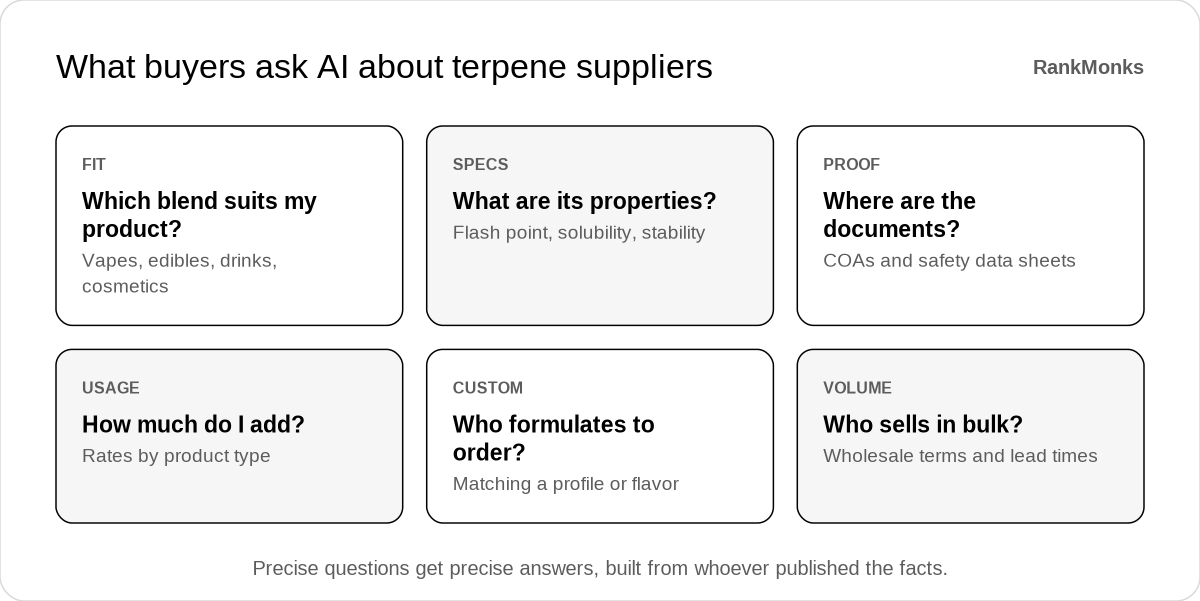
| Question type | Example | What the answer needs | Where you publish it |
|---|---|---|---|
| Fit | "Which terpene blends work in distillate vape cartridges?" | Application suitability per profile | Product pages, application guides |
| Specs | "What is the flash point of a limonene-dominant blend?" | Technical data per product | Product pages, specification sheets |
| Proof | "Which terpene suppliers publish COAs for every batch?" | Certificates of analysis and safety data sheets | Documents section, product pages |
| Usage | "How much terpene blend should I add to a beverage?" | Recommended rates by product type | Application guides |
| Custom | "Who can match a custom flavor profile for a gummy brand?" | Custom formulation process and minimums | Custom formulation page |
| Volume | "Wholesale terpene suppliers with short lead times" | Bulk terms, sizes, lead times | Wholesale page |
As an example, a small terpene house might find that Perplexity recommends two larger competitors for "food-grade terpenes for beverages" because both publish a usage guide for drinks and it does not. The supplier's products may be just as suitable, but the answer can only be built from what is published.
What should GEO work cover for a terpene flavor house?
GEO for a terpene flavor house should cover readable product pages, accessible documents, application guidance, compliant claims, trade mentions and crawl access. The best agency will start with the questions where you are currently missing.
- Take a baseline. Ask AI tools the questions your buyers ask, by application, specification and sourcing, and record whether you are named, what is said and who appears instead.
- Make product pages readable. One page per profile, with the aroma and flavor notes, main terpenes, suitable applications and available sizes written as text, not only in images.
- Make documents findable. Publish certificates of analysis and safety data sheets in a consistent place, with a short text summary on each product page and the full file linked.
- Write application guides. Usage rates and handling notes by product type, such as vapes, edibles, beverages and cosmetics, stated only where you can stand behind the figures.
- Describe custom formulation and wholesale. Explain the process, minimum order quantities, lead times and what a buyer needs to provide.
- Keep claims accurate. State food-grade or regulatory status only where it genuinely applies to that product, and avoid health, medical or effect claims entirely.
- Handle variants cleanly. Sizes and pack options should not create dozens of near-identical pages that confuse crawlers. Our guide to site architecture covers how to structure a catalog.
- Earn trade mentions. Industry publications, trade show listings, supplier directories and the sites of brands and distributors you work with are the sources models trust.
- Check crawl access. Some e-commerce platforms and security tools block AI crawlers. See our guide to AI crawlers and llms.txt.
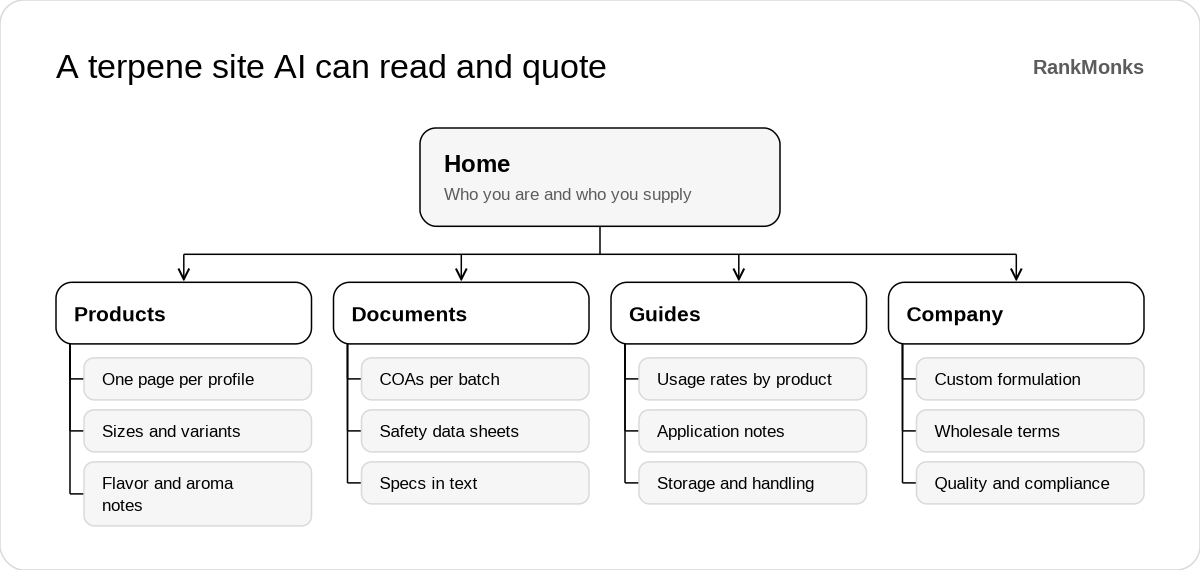
A clear structure like this helps people and machines alike. A buyer looking for a COA finds it in two clicks, and an AI tool asked about your documentation finds a page that states it plainly.
How should a terpene company handle claims and compliance?
A terpene company should treat every claim on its site as something an AI tool may repeat to a buyer, and write accordingly. Inaccurate or overreaching claims can mislead customers and attract regulatory attention, and once they are in AI answers they are hard to remove.
A few principles help:
- No health or medical claims. Do not suggest that a blend treats, relieves or prevents anything. In the US, the FDA and FTC both act against unsupported health claims.
- No claims about effects. Avoid describing how a blend will make someone feel.
- Be precise about source. State whether a profile is botanically derived or cannabis-derived, and what that means for your products.
- Only claim status you have. Food-grade, GRAS or similar statements should appear only where they genuinely apply to the ingredients and the product, and should be worded the way your regulatory adviser approves.
- Date your documents. A COA should be clearly tied to a batch and date, so an AI tool does not present an old result as current.
Rules vary by country and state and change often, so check your claims with whoever advises you on compliance. A good GEO agency will expect that review and build time for it.
How do you measure GEO for a terpene flavor house?
Measure GEO for a terpene flavor house by running the same buyer questions in the same AI tools each month and recording whether you are named, whether your specifications and claims are stated correctly, and which sources are cited. Then compare with inquiries and samples requested.
- Share of answers by application, such as vapes, beverages or cosmetics.
- Accuracy of specifications, sourcing and compliance statements.
- Citations of your product pages, guides and documents.
- Competitors named when you are not.
- Inquiry source, with "AI assistant" as an option on your contact or sample request form.
For a full method, see our guides to AI visibility and AI source analysis.
What warning signs should a terpene company watch for?
Watch for agencies that promise guaranteed placement, write claims without checking them, or treat a technical catalog like a consumer blog.
- Guarantees of a spot in any AI answer.
- Health or effect claims in drafted copy. If an agency writes "relaxing" or "uplifting" blends into product pages without discussing compliance, that is a problem.
- Generic content at volume. Dozens of thin articles about terpenes in general will not answer the specific questions your buyers ask.
- No grasp of B2B buyers. Formulators and procurement teams need specifications and documents, not lifestyle copy.
- No baseline or prompt list. Without them, there is nothing to measure progress against.
What should a terpene company ask a GEO agency?
Ask questions that show whether the agency understands technical buyers, compliance and measurement.
- Which buyer questions will you track, and can we agree the list?
- What do AI tools say about our company and products today?
- How will you present specifications and documents so AI tools can read them?
- How do you handle claims and compliance review?
- Which trade sources will you target for mentions?
- What will the monthly report show?
How does GEO fit with SEO, AEO and AI visibility for terpene companies?
GEO is one of four connected disciplines, and for a terpene flavor house they share most of their inputs: readable product pages, accessible documents and trade reputation.
- SEO for small terpene flavor houses gets your product and application pages ranking in Google's results.
- AEO for small terpene flavor houses structures your technical answers so they can be lifted into AI Overviews and featured snippets.
- AI visibility for small terpene flavor houses tracks what AI tools say about your company and flags wrong specifications or claims.
For how GEO works across every industry, see the best GEO agency for small businesses.
How does RankMonks approach GEO for terpene flavor houses?
RankMonks starts by asking AI tools the questions your buyers ask and showing you the answers, then fixes the causes in order of what they cost you. You receive a written audit covering SEO, AEO and GEO, with every problem ranked.
We fix the foundations first, such as crawl access, catalog structure and product pages, then build application guides, document pages and trade mentions in small steady releases, with your team reviewing technical and compliance statements. Each month we run the same prompts across ChatGPT, Claude, Perplexity, Gemini, Grok, Google AI Overviews and AI Mode, and report share of answers, accuracy and what changed in plain language.
We take on a small number of clients at a time, the person who plans the work does it, and we do not guarantee a place in any AI answer.
Frequently asked questions
Can a small terpene company get recommended by ChatGPT?
Yes, when the question is specific enough and your company has published the facts to answer it. Buyers often ask detailed sourcing and application questions, and a small supplier with clear product pages, documents and trade mentions can be named alongside larger companies. No one can guarantee it.
Should COAs be PDFs or web pages?
Both work best together. Keep the full certificate as a PDF for buyers who need the document, and add a short text summary on the product page with the batch, date and key results. The text version is easier for search engines and AI tools to read.
Do we need separate content for B2B buyers and hobbyists?
Usually, yes. Business buyers want specifications, documents, usage rates and wholesale terms, while hobbyists want simpler guidance and smaller sizes. Separate sections or pages let each group find what it needs, and give AI tools clearer answers for each kind of question.
How long does GEO take for a terpene flavor house?
Fixes to crawl access, product pages and documents can show in AI answers within weeks, especially in tools that search the web. Trade mentions and authority take longer, usually several months. Track the same questions monthly to see the trend.
For terpene flavor houses, GEO is careful work on technical content, compliance and reputation, planned and reported as part of our SEO service. If you want to know what AI tools tell buyers about your company today, start a conversation.
Written by RankMonks.