
The best AEO agency for a small terpene flavor house is one that makes your technical answers the ones search engines and assistants quote when a formulator asks how much terpene blend goes into a vape cartridge, whether a profile will dissolve in a beverage, or where to find a certificate of analysis. Those buyers ask precise questions, and they trust the company that answers them precisely.
Answer engine optimization, or AEO, is the work of being the direct answer in featured snippets, People Also Ask boxes, Google AI Overviews and voice assistants. This guide covers what that means for a terpene business, which questions to answer first, how to build pages that get lifted, and how to judge an agency. It is part of our guide to the best AEO agency for small businesses, which sets out the standards for any small company.
Key takeaways
- Most terpene buyers are product developers and brands who research technical questions long before they contact a supplier.
- Ad platforms often restrict or flag cannabis-adjacent products, so being the unpaid answer carries more weight than in most industries.
- The questions to answer first are about dosage rates, solubility, handling, food-grade status, documents, minimum orders and lead times.
- Specs and certificate summaries should be readable text on the page, with the PDF linked, not hidden inside a download.
- Every answer has to be accurate and free of health or medical claims, because an answer engine quotes your words as written.
What is AEO for a terpene flavor house?
AEO for a terpene flavor house is the work of making your product, application and technical pages the source that search engines and assistants use when they answer questions about terpene blends and flavors. A flavor house that formulates botanical and cannabis-derived terpene profiles for vapes, edibles, beverages, cosmetics and hobbyists has a lot of expertise to share, and most of it is the kind of thing buyers ask a search engine first.
It builds on SEO. Your product and category pages still need to rank, and our guide to the best SEO agency for small terpene flavor houses covers that side. AEO focuses on the questions behind the purchase and on whose answer is shown.
Because many of your buyers are businesses, the pattern looks more like B2B than retail. Several people research, each with their own questions, and the shortlist forms before anyone fills in a contact form. Our guide to B2B SEO explains that pattern in more detail.
Why does AEO matter more for a terpene business?
AEO matters more for a terpene business because paid channels are harder to rely on. Google, Meta and other ad platforms have strict policies on cannabis-related products, and terpene sellers often find ads limited, flagged or rejected even when their products are botanical. Policies change, so check the current rules, but most terpene companies cannot simply buy their way to the top of a search.
That leaves the unpaid results, and more of those now end in an answer rather than a list. When a formulator asks "what is the usual dosage of terpenes in a beverage?", the AI Overview or featured snippet that replies is the first supplier they meet. If it quotes your application guide, you are on the shortlist before the search is over.
There is a second reason. Technical buyers are wary of vague product copy. A page that says "premium strain-specific terpenes for every application" tells them nothing. A page that states recommended use rates by product type, the carrier if any, storage guidance and where the documents are tells them you know what you are doing.
Which questions should a terpene flavor house answer first?
A terpene flavor house should answer the questions buyers need settled before they request a sample: dosage rates, solubility, handling, food-grade status, documents, minimum orders and lead times.
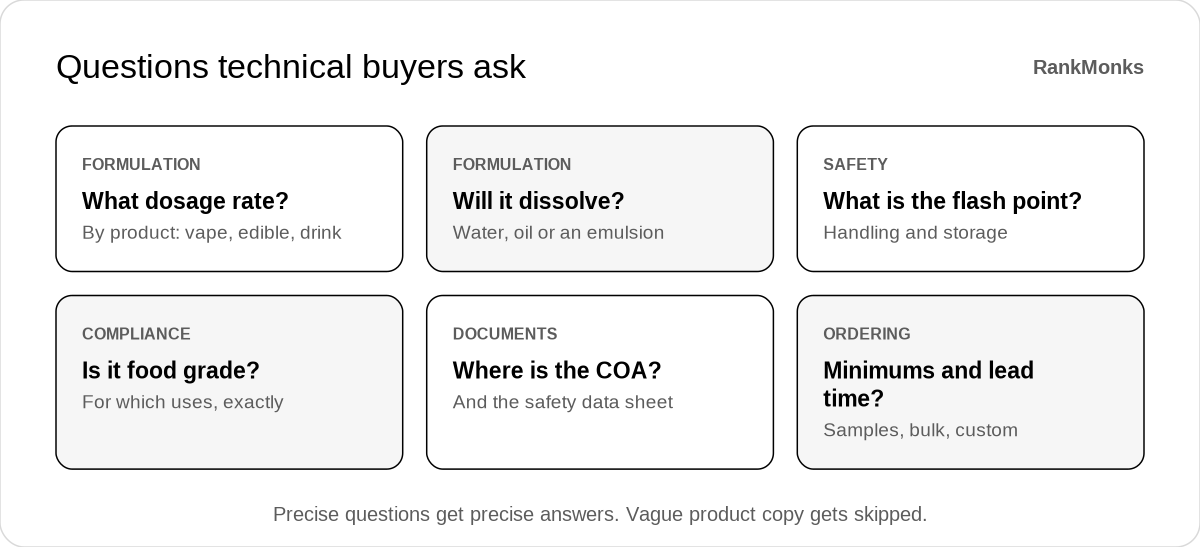
The best source for the list is your own inbox. The questions your team answers by email and on calls, and the questions that come with every sample request, are the questions being typed into search. Add the questions from reviews, forums your buyers use and search tools, then group them by the page that should answer them.
| Question | Example | Where the answer should live |
|---|---|---|
| Dosage | "How much terpene blend in a 1 ml cartridge?" | An application guide for vapes |
| Solubility | "Can terpenes be added to water-based drinks?" | An application guide for beverages |
| Handling | "What is the flash point of this blend?" | The product page and its safety data sheet |
| Compliance | "Is this blend food grade?" | The product page, stated for each use |
| Documents | "Where is the COA for this batch?" | The product page, with a text summary |
| Ordering | "What is the minimum order for a custom blend?" | A custom formulation page |
How should product and technical pages be built to be the answer?
Product and technical pages should open each section with the buyer's question and a direct answer in two or three sentences, then give the detail, the exceptions and the documents. That is the shape search engines lift into snippets and AI Overviews.
- Application guides. One page for each product type you supply: vapes, edibles, beverages, cosmetics, and so on. Each opens with the typical use rate you recommend, then covers carriers, mixing, testing and storage. Use your own tested figures, and say when the right rate depends on the base.
- Product pages with specs in text. The aroma profile, main terpenes, recommended uses, sizes, flash point and storage guidance belong in readable text on the page. Search engines can read many PDFs, but they quote pages far more readily.
- Certificate and safety summaries. Link the COA and safety data sheet, and add a short text summary beside them: batch number, test date, laboratory and what was tested.
- A terpene glossary. Short entries for limonene, myrcene, linalool, beta-caryophyllene and the rest, describing aroma, flavor and common uses. These are classic snippet material, as our guide to featured snippets explains.
- Structured data that matches. Product markup for name, SKU, sizes and availability, and Organization markup for the company. See our guide to schema markup.
As an example, a small flavor house selling thirty profiles might start with four application guides and the ten best-selling product pages, rather than thirty thin pages at once.
What claims and compliance rules shape terpene answers?
Claims rules shape every terpene answer, because an answer engine lifts your words without the small print. Anything you would not want quoted on its own should not be on the page.
- No health or medical claims. Do not say a terpene relieves stress, aids sleep or treats anything. In the US, claims like these can draw attention from the FDA and the FTC.
- Be exact about food-grade and GRAS status. If an ingredient has GRAS or FEMA GRAS status, say for which use. FEMA has said that its GRAS status for flavor use in food does not extend to inhaled products such as vapes, so do not imply that it does.
- Be clear about the source. State whether a profile is botanical or cannabis-derived. Rules for cannabis-derived products vary by state, so avoid legal claims you cannot support.
- Keep the documents current. An out-of-date COA linked from a live product page is a wrong answer waiting to be quoted.
How do you measure AEO for a terpene business?
Measure AEO by how often your pages are shown as the answer for your question list, and by the sample requests and enquiries that follow. Traffic alone hides what matters.
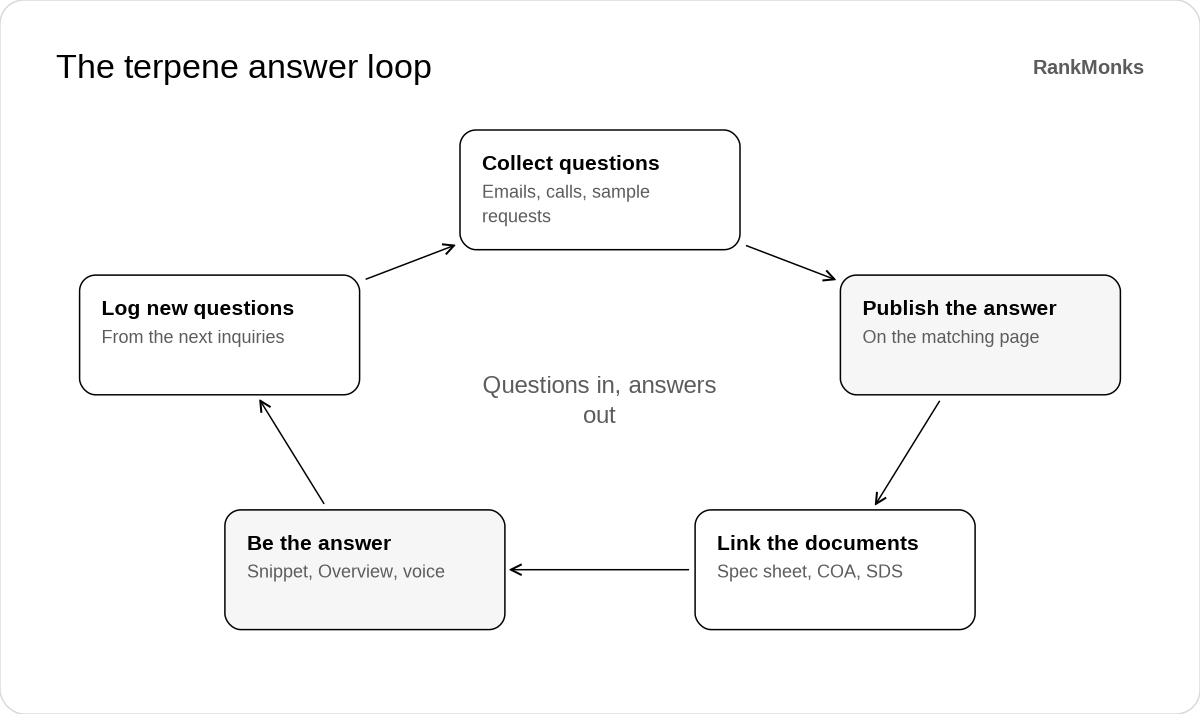
- Track the question list. Record which featured snippets, People Also Ask boxes and AI Overviews show or cite your pages. Our guide to Google AI Overviews explains how they pick sources.
- Track enquiries by landing page. Note which application guides and product pages start sample requests and wholesale enquiries.
- Ask how buyers found you. A field on the enquiry form catches searches, AI assistants and word of mouth that analytics miss.
- Feed new questions back in. Every new enquiry adds questions to the list, which is the loop above.
What warning signs should a terpene flavor house watch for?
- A guarantee. No agency controls which answer a search engine shows.
- Health-claim copy. An agency that writes "calming" or "energizing" benefits into product pages is creating a compliance problem, not an answer.
- Hundreds of generated profile pages. Thin, near-identical pages for every strain name rarely help and can weaken the site.
- No interest in your documents. If the agency never asks for your specs, COAs and safety data sheets, it cannot write accurate technical answers.
- Reports with rankings only. Without a record of which answers you appear in and the enquiries that follow, nobody is measuring AEO.
What questions should you ask an AEO agency before hiring?
- Which buyer questions would you answer first, and where would the list come from?
- How would you turn our specs and documents into pages that can be quoted?
- How do you handle claims about health, food-grade status and GRAS?
- Have you worked in a category where ads are restricted?
- How do you track snippets and AI Overviews for technical questions?
- What will the monthly report show besides rankings?
Our guide on how to choose an SEO agency covers contracts and proposals.
How does AEO fit with SEO, GEO and AI visibility for a terpene flavor house?
AEO is one of four connected jobs, and the same pages and documents serve all four.
- SEO gets your product and category pages ranked. See the best SEO agency for small terpene flavor houses.
- GEO gets you named when a formulator asks ChatGPT or Perplexity for terpene suppliers, which depends on what trade sites, forums and reviews say about you. See the best GEO agency for small terpene flavor houses.
- AI visibility tracking checks what those assistants actually say about your company and products. See the best AI visibility agency for small terpene flavor houses.
How does RankMonks approach AEO for small terpene flavor houses?
RankMonks treats AEO as part of one practice with SEO and GEO, built around the questions your buyers send you. We start by reading everything: your site, your specs and documents, your enquiries and what search engines and assistants currently say about your products.
You get a written audit with problems ranked by what they cost you. The work then ships in small, steady releases, starting with the application guides and best-selling product pages. Technical answers come from your figures and are checked by your team before they go live. Each month you get a plain-language report on rankings, the answers you appear in and the enquiries that follow.
We take on a small number of clients at a time, and the person who plans your work does it. We will not promise a snippet or an AI Overview place. Technical fixes can show within weeks, while content work usually takes three to six months.
Frequently asked questions
Can terpene companies advertise on Google and Meta?
It depends on the product, the wording and the current policy, which changes. Many terpene sellers find their ads limited or rejected because the platforms treat cannabis-related products strictly. That is why unpaid search and answer visibility matter so much in this category.
Should certificates of analysis be PDFs?
PDFs are fine for the certificate itself, since buyers expect the lab's own document. Add a short text summary on the product page as well, with the batch, test date, laboratory and what was tested. That way both buyers and search engines can find the key facts without opening a file.
Do AI Overviews appear for technical terpene questions?
They often appear for "what is" and "how to" questions, such as what a terpene smells like or how to add terpenes to a drink. When they do, they cite a few sources. A precise, answer-first application guide gives you a fair chance of being one of them.
How long does AEO take for a terpene flavor house?
Fixes such as structured data and readable specs can show within weeks. New application guides and rewritten product pages usually take a few months to be recrawled and chosen. Judge progress over three to six months.
Formulators remember the supplier whose answer was exact. If you want that work done alongside your SEO, start a conversation.
Written by RankMonks.