
The best GEO agency for a small business is one that gets you named, cited and described correctly when customers ask ChatGPT, Perplexity, Gemini, Claude or Google AI Mode for a recommendation, and that can show you the change in numbers rather than in screenshots. GEO stands for generative engine optimization: the work of influencing what AI tools write when they answer a question in your market.
For a small business, the question has changed shape. A customer who once searched "plumber near me" and scrolled a list now asks an assistant "who can fix a leaking water heater in Plano today?" and gets back two or three names with a reason for each. If your business is not one of them, you were never in the running. This guide explains what a GEO agency does, how AI tools choose which businesses to name, what separates a good agency from a bad one, and how the work changes by industry.
Key takeaways
- A GEO agency works on the inputs AI answers are built from: your own site, your business facts across the web, your reviews and what independent sources say about you.
- The best agency starts by measuring what AI tools say about you now, using the questions your customers actually ask, and repeats that measurement on a schedule.
- GEO rests on SEO. Assistants that search the web read pages that search engines can find, so weak foundations limit everything else.
- No one can guarantee that a model will recommend you, and an agency that promises it is a warning sign.
- The work differs by industry. A restaurant, a dental office and a terpene supplier each need different facts, sources and safeguards.
What does a GEO agency do for a small business?
A GEO agency makes your business easier for AI tools to find, understand and recommend, then measures whether it worked. It does this by changing the material models read, since there is no form to fill in and no setting to switch on.
For a small business, the work usually falls into six areas.
| Work | What it involves | Why it matters to AI answers |
|---|---|---|
| Baseline | Asking AI tools the questions your customers ask and recording the answers | Shows whether you are absent, described wrongly or outranked by competitors |
| Crawl access | Checking that AI crawlers and search engines can read your pages | A page a model cannot fetch cannot be cited |
| Business facts | Making your name, address, phone, hours and services identical everywhere | Conflicting facts produce vague or wrong answers |
| Content | Pages that answer specific customer questions in plain, quotable text | Assistants answer precise questions with precise facts |
| Third-party sources | Reviews, listings, local press, trade directories and best-of lists | Much of what models say comes from other people's pages |
| Measurement | Re-running the same questions on a schedule and reporting the trend | A single answer proves little because answers vary |
None of this is exotic. Most of it overlaps with good local SEO and reputation work. The difference is the target: the agency is aiming at the written answer, and it measures that answer directly.
How do AI tools decide which small businesses to recommend?
AI tools recommend businesses based on what they have learned in training and, more and more, on what they retrieve from the web when they answer. For local and specific questions, retrieval usually does most of the work.
When a tool searches, it runs one or more queries, reads some of the results and writes an answer from them. Those results tend to be pages that already do well in search, along with map listings and review platforms. That is why GEO and SEO are so closely linked, and why our guide to SEO in the AI era starts with the foundations.
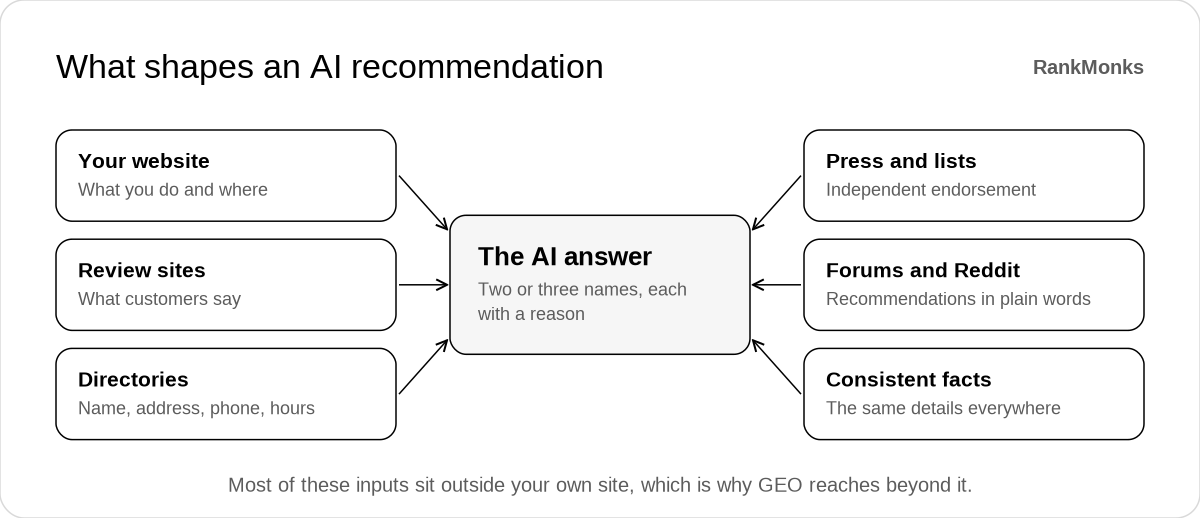
Six inputs come up again and again:
- Your website. What you do, where you do it and for whom, written as plain text a model can quote.
- Review sites. What customers say about you, and how recently they said it.
- Directories and listings. Your name, address, phone number and hours on maps, business profiles and industry directories.
- Local press and best-of lists. Independent sources that endorse you, which models tend to treat as stronger evidence than your own claims.
- Forums and Reddit. Recommendations in ordinary language, often for exactly the kind of specific question people now ask assistants.
- Consistent facts. When every source agrees on the basics, a model can state them with confidence. When sources conflict, answers get hedged or wrong.
Our guide to brand mentions in AI search explains why the third-party inputs carry so much weight, and how to get cited in AI answers covers the on-site side.
What makes a GEO agency the best fit for a small business?
The best fit is an agency that measures before it acts, treats SEO and reputation as the foundation, and does the off-site work most small businesses cannot do alone. Size and slogans matter far less than method.
Look for these qualities:
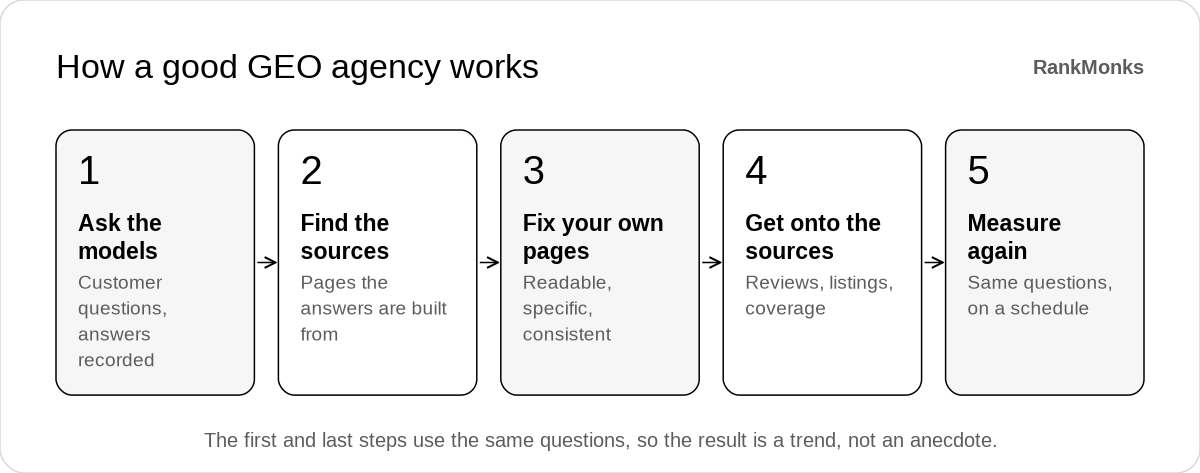
- It starts with a baseline. Before proposing work, it asks AI tools the questions your customers ask and shows you the answers, including which competitors are named instead of you.
- It agrees the questions with you. The prompt list should sound like your customers, not like a keyword tool. You should see it, correct it and keep it.
- It builds on SEO. An agency that sells GEO as a replacement for SEO misunderstands how retrieval works.
- It works off your site as well as on it. Listings, reviews, local coverage and directories shape answers. An agency that only edits your pages leaves most of the inputs untouched.
- It understands your industry's rules. A dental office has patient privacy rules, a realtor has fair housing rules, and a terpene company faces advertising restrictions and product-claim rules. Good GEO respects them.
- Senior people do the work. With a small budget, you want the person who plans the strategy to be the person who carries it out.
- It is honest about time and limits. Some answers change within weeks, others take months, and nobody controls what a model says.
How much does a GEO agency cost for a small business?
GEO pricing for small businesses usually follows one of four models, and the cost depends more on scope than on the label. Ask what is included before comparing fees.
| Pricing model | What you get | Suits |
|---|---|---|
| One-off audit | A baseline of AI answers, a source analysis and a prioritized list of fixes | Owners who want to know where they stand before committing |
| Monthly retainer | Ongoing fixes, content, off-site work and monthly reporting | Businesses ready to work on visibility over several months |
| Fixed project | A defined job, such as cleaning up listings across every platform | A specific problem with a clear end |
| Tracking only | Scheduled prompt runs and a monthly report, without the fixes | Teams that will do the work in house |
What drives the cost:
- Number of locations. Each location has its own listings, reviews and local questions.
- Number of questions and models tracked. More prompts across more tools means more runs and more analysis.
- How much content is needed. A site with thin service pages needs more writing than one with good pages that only need restructuring.
- How much off-site work is needed. Earning local press and listings takes longer than editing your own site.
- How competitive your market is. A dentist in a dense city faces more competition in answers than one in a small town.
A sensible first step for most small businesses is an audit or a short baseline engagement. It shows whether you have a problem worth paying to fix.
What results should you expect from GEO, and when?
Expect some changes within weeks and the larger ones over several months. The timing depends on whether a tool searches the web when it answers or relies on what it learned in training.
- Fixes to facts and access can show quickly in tools that search live, once the corrected pages and listings are crawled again.
- Content and authority work usually takes three to six months to move search rankings, and AI answers that lean on search results tend to follow.
- What a model learned in training changes only when a new version is trained, which you cannot schedule.
Because answers vary from one run to the next, judge progress on a trend. The useful measures are below, and our guide to AI share of voice explains how to calculate them.
| Measure | What it tells you |
|---|---|
| Share of answers | The percentage of tracked answers that name your business |
| Citations | How often an answer links to your pages |
| Accuracy | Whether hours, services, prices and areas are stated correctly |
| Competitors named | Who appears when you do not |
| Business results | Calls, bookings and inquiries where customers say they asked an AI tool |
What are the warning signs of a bad GEO agency?
The clearest warning sign is a guarantee. No agency controls what ChatGPT, Gemini or Perplexity writes, so a promised "spot in ChatGPT" is either a misunderstanding or a sales line.
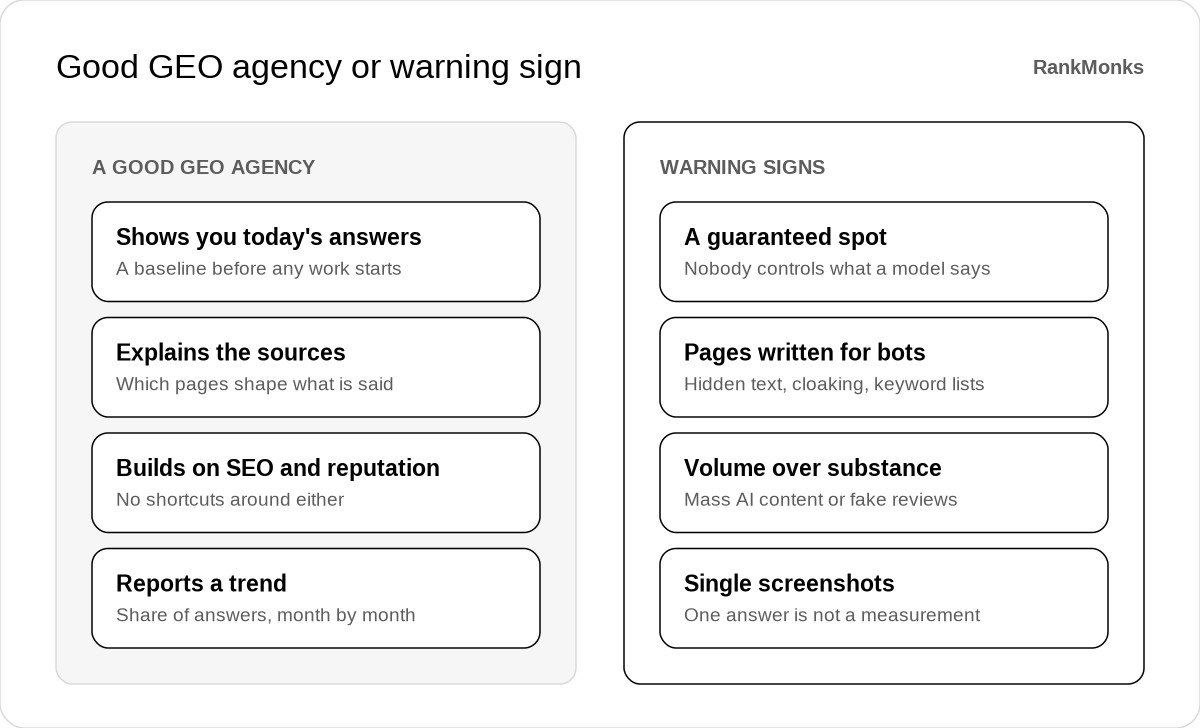
Other signs to watch for:
- Tricks aimed at bots. Hidden text, pages shown only to crawlers or keyword lists stuffed into markup. These break search engine rules and can damage the rankings GEO depends on.
- Volume over substance. Dozens of thin AI-written pages a month, or offers to "generate reviews". Fake reviews break platform rules and consumer protection law.
- Screenshots as proof. A single answer that names you proves nothing. Ask for the prompt list, the number of runs and the share of answers.
- No SEO in the plan. If the proposal ignores crawlability, listings and rankings, it ignores the material retrieval relies on.
- A secret method. GEO is ordinary work done carefully. An agency that will not explain what it changes is asking you to trust results it cannot show.
What should you ask a GEO agency before you hire it?
Ask questions that make the agency show its method, its measures and its limits. A good agency answers all of them plainly.
- What do AI tools say about my business today? A serious agency will show you a baseline, or offer to take one, before quoting.
- Which questions will you track, and can I see the list? You should own the prompt list.
- Which AI tools will you track? For most small businesses that means at least ChatGPT, Perplexity, Gemini and Google's AI features.
- How will you measure progress? Look for share of answers, citations and accuracy, measured the same way each month.
- What will you change on my site, and what will you change elsewhere? The answer should cover both.
- How does this connect to my SEO? The agency should explain how the two support each other.
- What rules apply to my industry, and how will you follow them? Listen for specifics, not reassurance.
- Who will do the work? Ask to meet them.
Many of these overlap with the questions in our guide on how to choose an SEO agency, which also covers contracts and proposals.
How does the best GEO agency adapt to your industry?
The best GEO agency changes its sources, its content and its safeguards to fit how your customers ask and what rules apply to you. Five examples show how different that can look.
Restaurants
Diners ask assistants for very specific things: a quiet place for a birthday, vegan options, somewhere open late near a theater. The answers draw on maps, review platforms, booking and delivery apps, and local food writing. For a restaurant, GEO is mostly about keeping hours and menus accurate everywhere and earning mentions from local press. Read more in best GEO agency for small restaurants.
Dental offices
Patients ask about treatments, insurance and emergencies, and health topics get extra scrutiny from search engines and AI tools alike. GEO for a dental office means dentist-reviewed treatment pages, consistent practitioner listings and review replies that never disclose patient information. See best GEO agency for dental offices.
Plumbing companies
Homeowners often ask in a hurry and from a phone. Assistants need to know your service area, your hours and the jobs you take on, and they need to find you mentioned on listings and review sites. See best GEO agency for small plumbing companies.
Realtors
Portals own the listing searches, but buyers and sellers still ask which agent knows a neighborhood. GEO for an agent builds on local knowledge, reviews and market commentary, written within fair housing rules. See best GEO agency for small realtors.
Terpene flavor houses
Product developers ask detailed technical questions, and advertising restrictions on cannabis-adjacent products make organic and AI visibility more important. GEO here means publishing specifications, documents and application guidance that models can quote accurately. See best GEO agency for small terpene flavor houses.
How does GEO fit with SEO, AEO and AI visibility?
GEO is one of four connected disciplines, and a small business gets the most from it when the other three are in place. Each answers a different question about how customers find you.
| Discipline | The question it answers | Read more |
|---|---|---|
| SEO | Do your pages rank in Google's results and map pack? | Best SEO agency for small businesses |
| AEO | Is your content the direct answer in snippets, AI Overviews and voice replies? | Best AEO agency for small businesses |
| GEO | Are you named and described correctly when AI tools write a recommendation? | This guide |
| AI visibility | What do AI tools actually say about you, and is it changing? | Best AI visibility agency for small businesses |
In practice the work overlaps. Accurate listings help all four. A clear page that answers a customer question can rank, be lifted into an AI Overview and be cited by ChatGPT. Our comparison of GEO, SEO and AEO explains the differences in more detail.
How does RankMonks approach GEO for small businesses?
RankMonks treats GEO as part of one practice with SEO and AEO, and starts every engagement by finding out what AI tools say about you now. The work follows four steps.
- Listen. We read your site, your listings, your analytics and your market, and we ask AI tools the questions your customers ask.
- Diagnose. You get a written audit covering SEO, AEO and GEO, with problems ranked by what they cost you.
- Build. We fix the foundations, then publish and earn: technical work, content, structured data and mentions, shipped in small steady releases.
- Measure. We track a fixed set of prompts across ChatGPT, Claude, Perplexity, Gemini, Grok, Google AI Overviews and AI Mode, and report rankings, citations and share of AI answers in plain language each month.
We take on a small number of clients at a time, and the person who plans your strategy is the person who does the work. We tell you what is realistic before you sign anything, and we do not guarantee a place in any AI answer.
Frequently asked questions
What is a GEO agency?
A GEO agency helps businesses get named, cited and described correctly in answers written by AI tools such as ChatGPT, Perplexity, Gemini and Claude. It works on your website, your business facts across the web and the third-party sources models rely on, then measures how often you appear in answers to your customers' questions.
Is GEO worth it for a small local business?
GEO is worth it when your customers ask AI tools for recommendations in your category, which you can check by asking those tools yourself and by asking new customers how they found you. Much of the work, such as accurate listings and good reviews, also helps your local SEO, so the effort is rarely wasted.
Can a GEO agency guarantee that ChatGPT will recommend my business?
No. AI answers vary from run to run and depend on sources no agency controls. A good agency can improve the inputs and measure your share of answers over time, but a guarantee is a warning sign.
Do I need a GEO agency if I already have an SEO agency?
Not necessarily. If your SEO agency already tracks AI answers, works on listings and third-party sources, and reports on how AI tools describe you, it is doing GEO. If it only reports rankings and traffic, ask whether it can add AI answer tracking or bring in a specialist.
GEO works best as part of the same plan as your SEO, which is how our SEO service is built, with AI visibility tracking to measure it. If you want to know what AI tools say about your business today, start a conversation.
Written by RankMonks.