
The best GEO agency for a small realtor is one that gets you named when buyers and sellers ask AI tools which agent knows their neighborhood, and builds that visibility on what portals cannot copy: your local knowledge, your track record and what your clients say about you. It also writes everything within fair housing rules, because AI tools repeat what you publish.
GEO, or generative engine optimization, is the work of shaping what tools such as ChatGPT, Perplexity, Gemini and Google AI Mode write when they answer a question. This guide is part of our look at the best GEO agency for small businesses, and it focuses on what is different for independent agents and small teams.
Key takeaways
- Portals such as Zillow, Realtor.com and Redfin dominate listing searches, but the question "which agent should I use?" is still open to a small realtor.
- AI tools build answers about agents from portal profiles, brokerage pages, an agent's own site, reviews, local news and business profiles.
- IDX listing pages are shared by many sites, so they rarely give AI tools a reason to name you. Original neighborhood and market content does.
- Fair housing rules apply to everything you publish. Describe the place, not the people you think it suits.
- The best agency measures how often you are named for buyer, seller and market questions in your area, every month.
How do buyers and sellers use AI to choose an agent?
Buyers and sellers use AI tools to ask for advice and recommendations in the same conversation. They describe their situation, name an area, and expect the answer to suggest what to do and who might help.
Typical questions include:
- "Who are the best listing agents in Decatur for a mid-century house?"
- "What is my three-bedroom in Ballard likely worth, and who should I talk to about selling?"
- "Is now a good time to buy a condo in downtown St. Petersburg?"
- "Which agents in Naperville work with first-time buyers?"
Listing questions, such as "three-bed homes for sale under a certain price", tend to be answered from portal data. The portals have the inventory, and a small agent is unlikely to beat them there. Agent and market questions are different. The answer has to judge who knows the area, and that judgment comes from what has been published about you.
What does AI read about a real estate agent?
AI tools read the same public traces a careful client would find: your portal profiles, your brokerage page, your own website, your reviews, local news that quotes you and your business profile. When those sources agree and say something specific, the tool has a reason to name you.
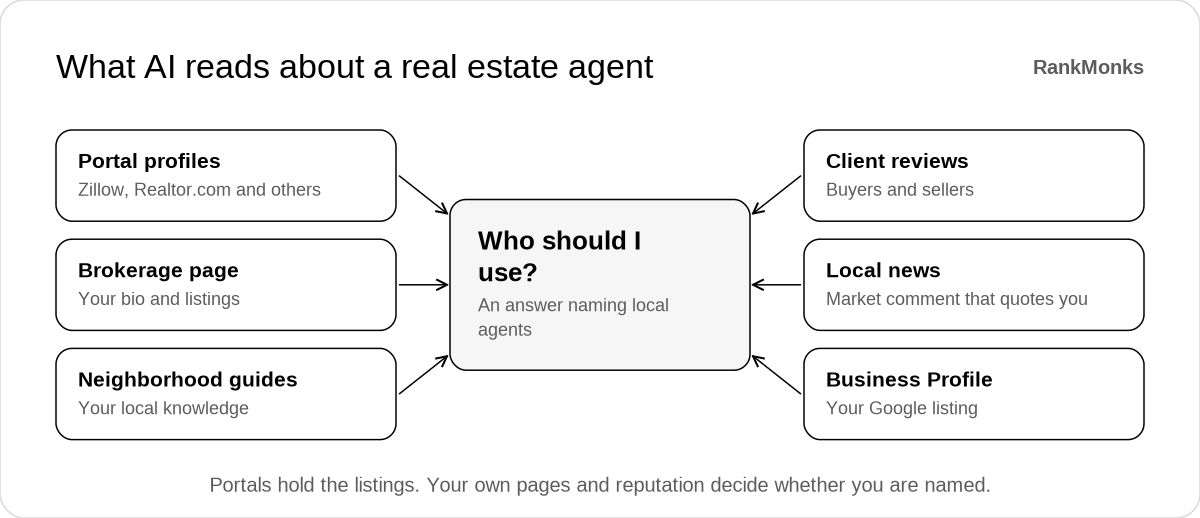
| Source | What it tells an AI tool | What to do |
|---|---|---|
| Portal profiles | Areas served, sales history, reviews | Complete them and keep areas and contact details current |
| Brokerage page | Your role, license and listings | Make sure your bio matches your other profiles |
| Your own site | Your local knowledge in your words | Publish neighborhood guides and market updates |
| Client reviews | What working with you is like | Ask every client, on more than one platform |
| Local news | Independent signal that you know the market | Offer market commentary to local reporters |
| Business profile | Name, area, contact, reviews | Keep it consistent with everything else |
Many agent websites rely on IDX feeds for their content. Those listing pages are useful to visitors, but the same listings appear on hundreds of other sites, so they rarely give an AI tool a reason to pick you. Original pages about the neighborhoods you work in are what set you apart.
What should GEO work cover for a small realtor?
GEO for a small realtor should cover consistent profiles, original local content, reviews, market commentary and a readable site. The best agency will start with whatever is keeping you out of answers today.
- Take a baseline. Ask AI tools the buyer, seller and market questions people in your area ask, and record whether you are named, how you are described and who appears instead.
- Make your profiles consistent. Your name, brokerage, license number, phone and areas served should match across portals, your brokerage site, your Google Business Profile and your own website.
- Write an agent bio with facts. Areas you work, how long you have worked them, the kinds of properties and clients you handle, and your license details, stated plainly.
- Build neighborhood guides. One page per neighborhood you know well, describing housing stock, amenities, transit and recent market activity, in factual terms.
- Publish market updates. Short, dated monthly or quarterly notes on what sold and how quickly, using MLS data in line with your MLS's rules on using its data.
- Collect reviews on more than one platform. Google, Zillow and Realtor.com reviews are read by different tools, so spread the requests.
- Add structured data. The RealEstateAgent type in schema markup can describe your business and area. See our guide to schema markup.
- Offer local press comment. Reporters covering housing need quotes. A short, accurate comment on the local market can earn the kind of mention models trust. Our guide to brand mentions in AI search explains why that matters.
- Check crawl access. Make sure AI crawlers can read your site and that important text is not locked inside scripts or images.
How do fair housing rules shape GEO content?
Fair housing rules shape GEO content because everything you publish can be repeated by an AI tool to thousands of people, and the Fair Housing Act prohibits housing advertising that indicates a preference based on race, color, religion, sex, disability, familial status or national origin. Neighborhood pages are where agents most often slip.
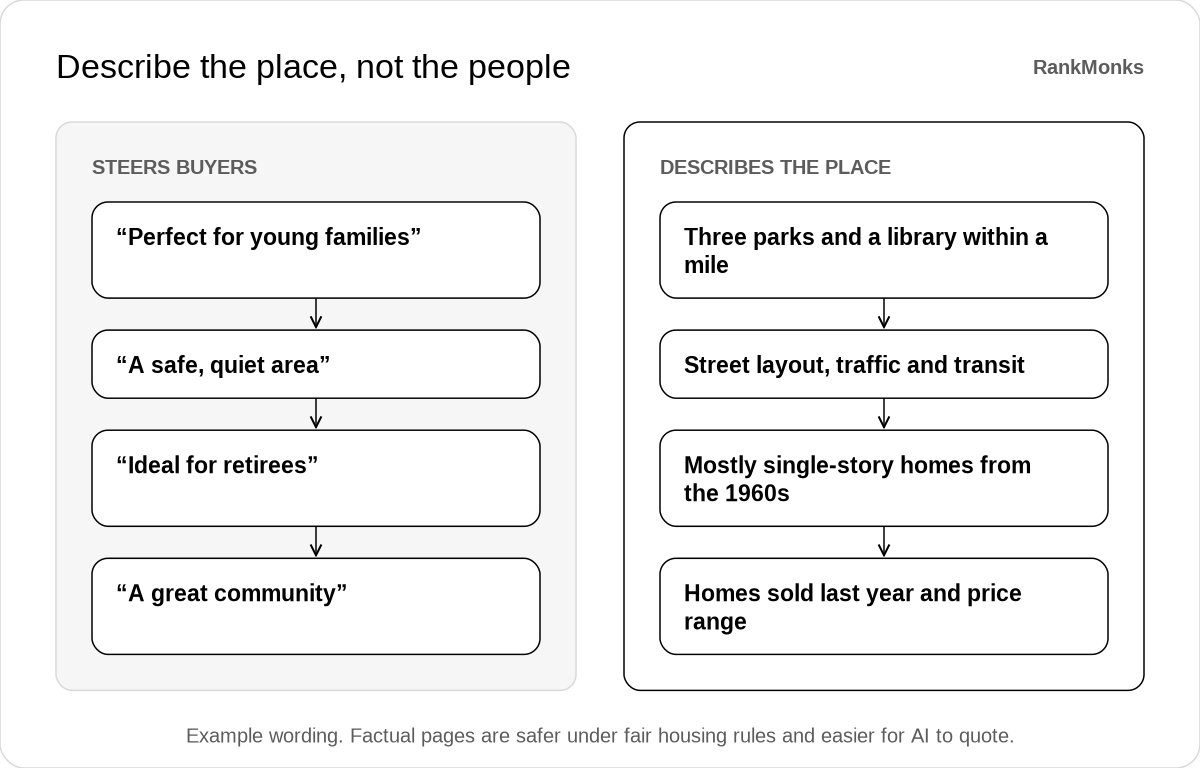
The safe approach is to describe the place, not the people you think it suits. Phrases such as "perfect for young families" suggest a preference based on familial status, even when they are meant kindly, and many state and local laws protect further characteristics, such as age. Factual descriptions are both safer and more useful.
A few habits help:
- Describe amenities, not residents. Parks, libraries, transit, shops, housing types and lot sizes.
- Link to official sources for schools. Point to the school district or state data instead of ranking schools yourself.
- Avoid words that imply who belongs. "Exclusive", "safe" and similar words can be read as coded preferences.
- Follow your brokerage and state rules. Many states require your brokerage name to appear in your advertising, and your MLS sets rules on using its data.
Factual pages are also better GEO. An AI tool asked about a neighborhood can quote "three parks and a public library within a mile" with confidence. It has little use for "a wonderful community".
How do you measure GEO for a realtor?
Measure GEO for a realtor by running the same buyer, seller and market questions for your areas in the same AI tools each month. Record whether you are named, how you are described and which sources are cited, then compare with the inquiries you receive.
- Share of answers for agent questions in each neighborhood.
- Description, such as "knows the historic district" or "focuses on condos".
- Accuracy of your brokerage, areas and contact details.
- Sources cited, especially which portal and which local news pages.
- Competitors named when you are not.
Ask new clients how they found you, and include "AI assistant" as an option. Our guide to AI share of voice explains how to turn the answers into a trend.
What warning signs should a realtor watch for?
Watch for agencies that promise guaranteed placement, publish neighborhood content without fair housing review, or lean on IDX pages and call it content.
- Guarantees of a spot in ChatGPT or any AI answer.
- Neighborhood pages written by someone who has not read fair housing guidance. Ask to see how they check wording.
- "Hundreds of pages" from IDX feeds. Duplicate listings are not a GEO strategy.
- Fake reviews or review swaps. They break platform rules and can breach real estate advertising rules.
- No baseline. If they cannot show you what AI tools say today, they cannot show you progress.
What should a realtor ask a GEO agency?
Ask questions that test the agency's grasp of your market, your compliance rules and its measurement.
- Which buyer, seller and market questions will you track, and for which neighborhoods?
- What do AI tools say about me today?
- How do you check content against fair housing rules and my brokerage's requirements?
- How will you build content that portals do not already have?
- How will you earn local press mentions?
- What will the monthly report show?
How does GEO fit with SEO, AEO and AI visibility for realtors?
GEO is one of four connected disciplines, and for a realtor they share most of the same inputs: consistent profiles, original local content and reviews.
- SEO for small realtors helps your neighborhood guides and agent pages rank in Google's results and map pack.
- AEO for small realtors structures your answers to common buyer and seller questions so they can be lifted into AI Overviews and voice replies.
- AI visibility for small realtors tracks what AI tools say about you over time and flags errors.
For how GEO works across every industry, see the best GEO agency for small businesses.
How does RankMonks approach GEO for small realtors?
RankMonks starts by asking AI tools the questions buyers and sellers in your area ask and showing you the answers, then fixes the causes in order of what they cost you. You receive a written audit covering SEO, AEO and GEO, with every problem ranked.
We fix the foundations first, such as consistent profiles, your bio and crawl access, then build neighborhood and market content and earn mentions in small steady releases, with your review of anything that touches fair housing or brokerage rules. Each month we run the same prompts across ChatGPT, Claude, Perplexity, Gemini, Grok, Google AI Overviews and AI Mode, and report share of answers, accuracy and what changed in plain language.
We take on a small number of clients at a time, the person who plans the work does it, and we do not guarantee a place in any AI answer.
Frequently asked questions
Can a solo agent compete with Zillow in AI answers?
Not for listing searches, where portals hold the inventory. For questions about which agent to use or how a local market is moving, a solo agent with original neighborhood content, consistent profiles and good reviews can be named alongside or ahead of larger teams.
Do IDX listings help a realtor's GEO?
IDX listings help visitors browse homes, but the same listings appear on many other sites, so they rarely give AI tools a reason to name you. Original neighborhood guides, market updates and a factual agent bio do much more for GEO.
Should neighborhood pages mention schools?
You can mention which school district serves an area and link to official sources for school information. Avoid ranking or judging schools yourself, since that can stray into fair housing problems and is better left to the official data.
How long does GEO take for a realtor?
Fixes to profiles and missing facts can show in AI answers within weeks, especially in tools that search the web. Neighborhood content, reviews and press mentions usually take several months to build up. Track the same questions monthly to see the trend.
For realtors, GEO is careful work on local knowledge and reputation, planned and reported as part of our SEO service. If you want to know what AI tools tell buyers and sellers about you today, start a conversation.
Written by RankMonks.