
The best AEO agency for a small realtor is one that makes you the answer to the local questions the big portals answer poorly: what homes are worth on your streets, how long they take to sell, how offers work in your market and what closing involves. Zillow, Realtor.com and Redfin will keep winning the listing searches. The questions around the listings are still open.
Answer engine optimization, or AEO, is the work of being the reply search engines and assistants choose when they answer directly. This guide covers what AEO looks like for a small realtor, which questions to answer first, how fair housing rules shape the wording and how to judge an agency. It is part of our guide to the best AEO agency for small businesses, which sets out the standards for any small company.
Key takeaways
- Portals dominate searches for homes for sale, so a small realtor's best chance is the local questions buyers and sellers ask around those listings.
- Seller questions, such as "what is my home worth?" and "how long do homes take to sell here?", are often the most valuable to answer.
- Answers should be built from dated market data and your own experience, not rewritten listing descriptions.
- Fair housing rules apply to every answer, so neighborhood pages should state checkable facts and never describe who an area suits.
- A good agency reports which answers you appear in and the enquiries that follow, not only where your pages rank.
What is AEO for a realtor?
AEO for a realtor is the work of making your pages and your details the source that search engines and assistants use when they answer questions about buying, selling and living in your area. Those answers appear as featured snippets, People Also Ask boxes, Google AI Overviews and spoken replies from voice assistants.
It sits on top of SEO. Your site and your Google Business Profile still need to rank, and our guide to the best SEO agency for small realtors covers that side. AEO focuses on the question-shaped searches where the search engine replies instead of listing pages, and on whose words it uses.
Those searches start long before anyone books a viewing. A homeowner wonders whether now is a good time to sell. A first-time buyer wants to know what closing costs cover. Whoever answers those questions well earns the trust that turns into a call months later.
What can a small realtor win in search?
A small realtor can win the local and process questions, even when the portals win the listing searches. The portals have every listing and huge authority, but they answer local questions with generic data and templates.
| Search | Who usually wins | What a small realtor can do |
|---|---|---|
| "Homes for sale in Maple Heights" | Portals | Little, beyond IDX pages on your own site |
| "How long do homes take to sell in Maple Heights?" | Often nobody clearly | Publish a dated local answer from MLS data |
| "What is my home worth?" | Portals' estimate tools | A local valuation page with your method and an offer to visit |
| "What do closing costs include?" | Large sites, AI Overviews | A clear local explainer that states what varies by state |
| "Best realtor in Maple Heights" | Map results and reviews | A complete profile, steady reviews and consistent details |
IDX listing pages help visitors search on your site, but the same listing text appears on hundreds of other sites. It is rarely chosen as the answer to anything. Your original pages are what get lifted.
Which questions should a realtor answer first?
A realtor should answer seller questions first, then buyer, neighborhood and process questions. Sellers bring listings, and their questions are very local, which is where a small realtor has the edge.
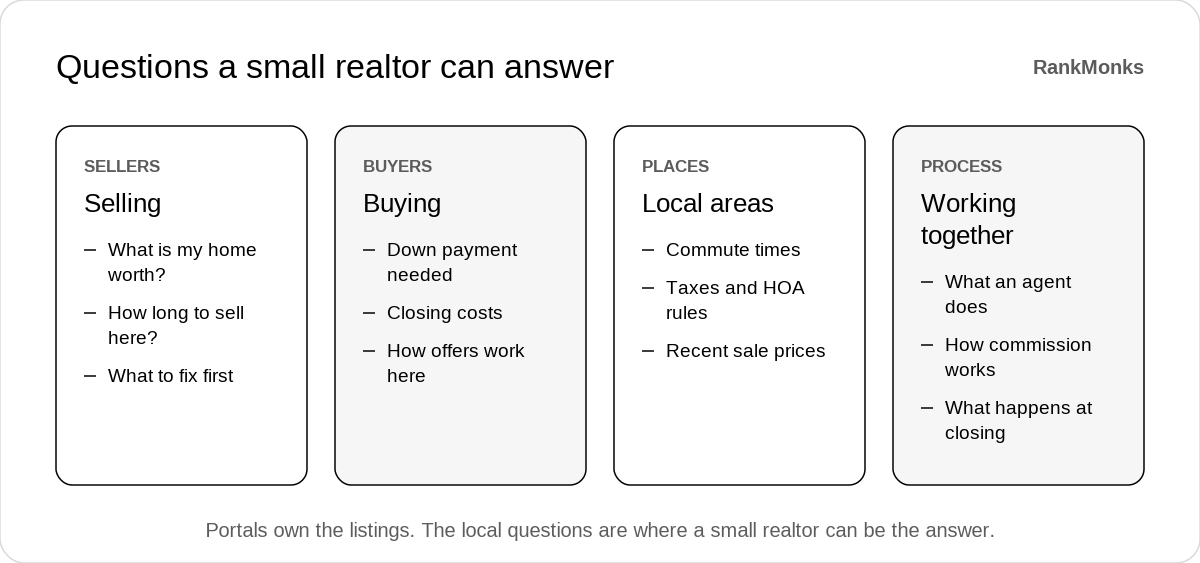
The best source for the list is your own conversations. The questions people ask at listing appointments, at open houses and in first calls are the questions they typed into search beforehand. Add questions from reviews, from the People Also Ask boxes for your town and from search tools, then group them by the page that should answer each one.
How should a realtor's pages be built to be the answer?
A realtor's pages should open each section with the question as a heading and a direct answer in two or three sentences, backed by dated local data and followed by the detail and the next step. That is the shape search engines lift into snippets and AI Overviews.
- Seller guides. "How long do homes take to sell in" your town, "what to fix before listing" and "how pricing works here". Answer with your local figures, dated, then explain what changes the answer.
- Market updates. A short monthly or quarterly page with median sale price, days on market and the number of sales, taken from the MLS and dated. Follow your MLS's rules on publishing its data. A dated, local answer is exactly what assistants need for "how is the market in" questions.
- Neighborhood guides. Facts anyone can check: commute times, transit, property tax rates, HOA rules, recent sale prices, and links to official sources for schools and crime data.
- Process explainers. Closing costs, inspections, earnest money and, since the 2024 changes to commission practices, how buyer agent pay and buyer agreements work. State which parts vary by state.
- An agent profile. Your name, brokerage, license details and areas served, matching your listings exactly. Our guide to E-E-A-T explains why showing real experience matters.
- Structured data. RealEstateAgent markup in schema.org restates your name, brokerage, contact details and service area. See our guide to schema markup.
For example, a solo agent covering three suburbs might publish one market page per suburb, updated each quarter, and a seller guide that links to all three. That is a few pages, kept current, rather than dozens left to go stale.
How do fair housing rules shape realtor answers?
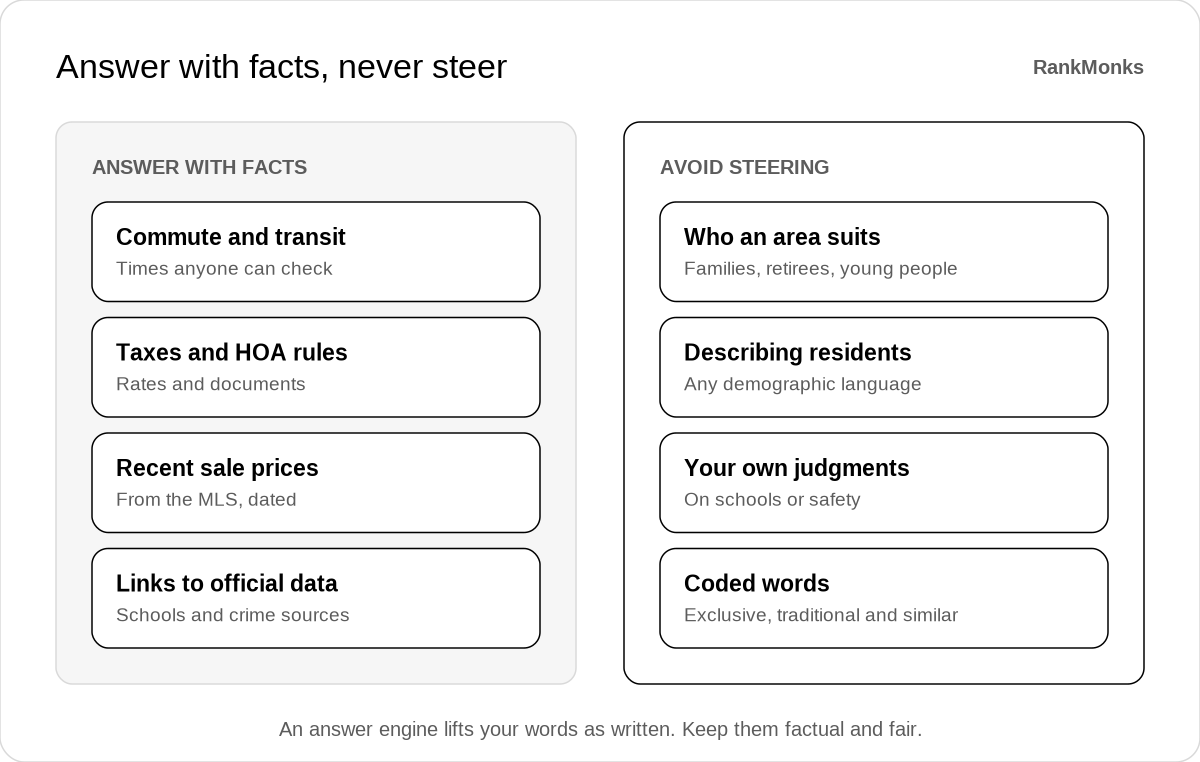
Fair housing rules shape realtor answers because the Fair Housing Act forbids steering, and an answer engine lifts your words exactly as written. A neighborhood page should give facts and let people decide for themselves.
In practice:
- State facts, not suitability. Commute times and tax rates are facts. "Perfect for young families" is steering, even when it is meant kindly.
- Do not describe residents. Avoid any language about the people who live in an area.
- Link to official data. For schools and crime, point to the official sources rather than giving your own verdict.
- Check your brokerage and state rules. Many states and brokerages also set rules on how the brokerage name and license details must appear in advertising.
A good agency builds these rules into its briefs, and has someone who understands them review neighborhood content before it goes live.
What should your listings say?
Your listings should give your name, brokerage, phone, areas served and reviews consistently everywhere they appear. Assistants answer "who is a good realtor in" questions from map listings, profiles and reviews more than from your blog.
Google allows individual practitioners, such as real estate agents, to have their own Business Profile alongside the brokerage's, within its guidelines. Keep that profile, your Apple Business Connect and Bing Places listings, and your profiles on Zillow and Realtor.com aligned. Ask clients for reviews as a routine after each closing. Our guide to local SEO covers profiles and reviews in more detail.
How do you measure AEO for a realtor?
Measure AEO by how often your pages are the answer for your question list, and by the seller and buyer enquiries that follow.
- Track the question list. Record which snippets, People Also Ask boxes and AI Overviews show or cite your pages. Our guide to featured snippets explains how they are chosen.
- Check voice and assistant answers. Ask for a realtor in each town you cover and record who is named.
- Track enquiries by page. Valuation requests and contact forms, tagged with the page they started on.
- Ask how they found you. A question on your forms and in first calls catches what analytics misses.
What warning signs should a realtor watch for?
- A guarantee of a featured snippet, an AI Overview place or "the top voice answer".
- Auto-generated neighborhood pages for every subdivision, built from the same template.
- Copy that steers, describing who an area suits or who lives there.
- Rewritten listing descriptions sold as original content.
- Reports with rankings only, and nothing about answers or enquiries.
What questions should you ask an AEO agency before hiring?
- Which local questions would you target first, and why those?
- Where will the market data come from, and how will you keep it dated and within MLS rules?
- How do you make sure neighborhood content follows fair housing rules?
- How will you keep my profile, brokerage details and reviews consistent?
- How do you track snippets, AI Overviews and voice answers?
- What will the monthly report show besides rankings?
How does AEO fit with SEO, GEO and AI visibility for a realtor?
AEO is one of four connected jobs, and they rely on the same pages and profiles.
- SEO gets your site and profile ranked in the first place. See the best SEO agency for small realtors.
- GEO gets you named when someone asks ChatGPT or Perplexity to recommend an agent, which leans on reviews and what local sites say about you. See the best GEO agency for small realtors.
- AI visibility tracking checks what those assistants actually say about you and your market. See the best AI visibility agency for small realtors.
How does RankMonks approach AEO for small realtors?
RankMonks treats AEO as one part of a single practice with SEO and GEO, built around the questions your buyers and sellers ask. We start by reading everything: your site, your profiles, your reviews, your market and what search engines and assistants currently say about you.
You get a written audit with problems ranked by what they cost you. Then the work ships in small, steady releases, usually starting with seller guides and market pages for your core areas. Neighborhood content is written to fair housing rules and goes to you for review before it is published. Each month you get a plain-language report on rankings, the answers you appear in and the enquiries that follow.
We take on a small number of clients at a time, and the person who plans your work does it. We will not promise a snippet or a voice answer. Technical fixes can show within weeks, and content work usually takes three to six months.
Frequently asked questions
Do IDX listings help a realtor's AEO?
Not much. IDX pages help visitors search listings on your site, but the same listing text appears on many other sites, so it is rarely chosen as an answer. Your original market, seller and neighborhood pages are what search engines lift.
Can an individual agent have a Google Business Profile?
Yes. Google's guidelines allow individual practitioners, including real estate agents, to have their own profile as well as the brokerage's. Keep the name, brokerage and contact details consistent with your website and other profiles.
Do AI Overviews appear for real estate questions?
They often appear for process and cost questions, such as what closing costs include or how earnest money works. They appear less for listing searches, which the portals dominate. A clear local explainer gives you a fair chance of being cited.
How long does AEO take for a small realtor?
Profile fixes and structured data can show within weeks. Market pages and guides usually take a few months to be recrawled and chosen, and they get stronger as you update them. Judge progress over three to six months.
The realtor who answers the local questions plainly, and fairly, becomes the one people call. If you want that work done alongside your SEO, start a conversation.
Written by RankMonks.