
The best SEO agency for a small realtor is one that does not try to beat Zillow at listing searches. It builds the pages the portals cannot: neighborhood guides written from real experience, market updates with your own commentary, answers to the questions sellers ask, and a profile and reviews that make your name the obvious choice. It knows the Fair Housing rules that apply to real estate content, and it reports leads rather than traffic.
This guide is part of our wider look at the best SEO agency for small businesses. It covers where a small agent can compete, what SEO work matters, how Fair Housing rules shape your content, what an agency should do first, how to measure results and what to avoid.
Key takeaways
- Large portals such as Zillow, Realtor.com and Redfin tend to win listing searches, so a small agent should compete elsewhere.
- Neighborhood guides, market updates and seller pages are where local expertise beats a national database.
- IDX listing pages help visitors but rarely rank, because many sites show the same listings.
- Real estate content must describe properties and places, never who should live there.
- A good agency measures valuation requests, calls and contact forms, and makes sure you own your website and domain.
Can a small realtor compete with Zillow in search?
A small realtor usually cannot outrank the big portals for searches like "homes for sale in [city]", but it can win many of the searches that lead to a listing appointment. Portals have enormous sites and data on every property. What they lack is a local agent's judgment and voice.
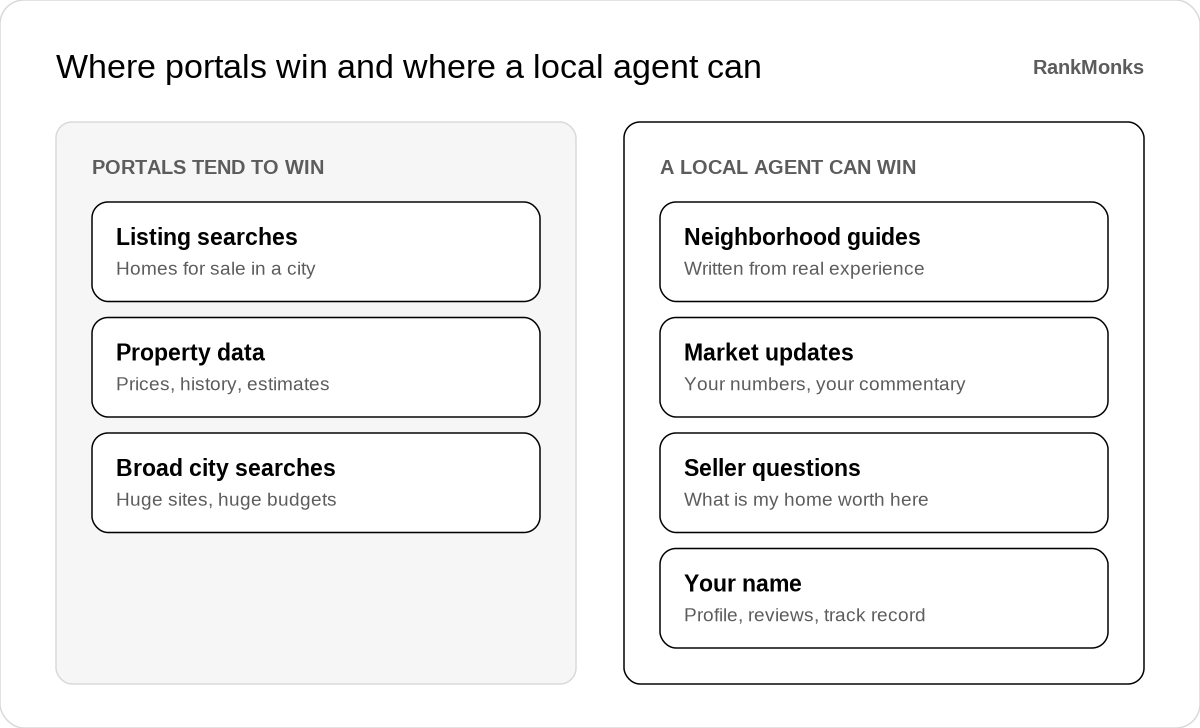
Listing pages are the hardest ground. Many agent sites display the same MLS listings through an IDX feed, so the same property appears on hundreds of sites with near-identical text. Search engines have little reason to rank yours above the others. IDX is useful for visitors who want to browse on your site, but it should not be the core of your SEO plan.
The searches you can win look different:
| Search | Example | Who usually ranks | How a small agent wins |
|---|---|---|---|
| Listings | "3 bedroom homes for sale [city]" | Portals | Rarely worth chasing |
| Neighborhood | "living in [neighborhood]" | Mixed: blogs, guides, portals | A detailed guide written from experience |
| Market | "[town] housing market" | News, portals, local agents | A monthly update with your commentary |
| Seller | "what is my home worth [town]" | Portals, agents | A valuation page and a selling guide |
| Your name | "[your name] realtor" | Your site, portal profiles | A strong about page and reviews |
What should SEO work cover for a small realtor?
SEO for a small realtor should cover an agent Business Profile, neighborhood guides, market updates, seller and buyer pages, an about page with credentials, and reviews. Each one shows local expertise that a portal cannot copy.
- Your Business Profile. Google allows individual practitioners, including real estate agents, to have their own profile, separate from the brokerage's. Choose "Real estate agent" as the category, add your service areas, photos and a booking or contact link, and follow your brokerage's naming rules.
- Neighborhood guides. One per area you know well, covering housing types, typical price ranges from your own data, commute routes, parks, shops and amenities. Write about the place, not the people.
- Market updates. A monthly or quarterly update for each area: prices, time on market and inventory, with what you think it means for buyers and sellers. Check your MLS's rules on publishing its statistics.
- Seller pages. A home valuation page, a guide to selling in your town, and pages for common questions such as costs and timing.
- Buyer guides. First-time buyer steps for your state, how offers work locally, what inspections usually cover.
- An about page. Your license number, brokerage, experience and the areas you cover. Many states require the brokerage name on advertising, so check before you publish.
- Reviews. On your Business Profile and on the portal agent profiles buyers check.
- Structured data. RealEstateAgent markup restates your name, areas and contact details for machines. See our guide to schema markup.
Our guide to local SEO covers the profile and review side in more detail.
How do Fair Housing rules affect real estate SEO?
Fair Housing rules mean your content must describe properties and places, never the kind of person who should live there. The Fair Housing Act prohibits discrimination based on race, color, religion, sex, national origin, familial status and disability, and that includes advertising that indicates a preference. Neighborhood guides are where agents most often slip.
| Avoid | Write instead |
|---|---|
| "Perfect for young families" | "Three parks within a mile and a public library on Main Street" |
| "A safe, quiet neighborhood" | "Mostly cul-de-sac streets with little through traffic" |
| "Ideal for retirees" | "Single-level homes and a community center with daily classes" |
| Your own ranking of local schools | "Served by [district]. See the district's site for boundaries" |
| Who lives in the area | What the area has: housing, transport, amenities |
This is not legal advice, and your broker should have the final word. The point for SEO is that a good agency writes useful, specific guides without steering language, and does not hand you templates that put your license at risk.
What should an SEO agency do in the first 90 days?
In the first 90 days, a good agency should fix your profiles, clean up the site, and build a small number of excellent pages for your core areas, rather than many thin ones.
- Audit your profiles and site. Your Business Profile, portal profiles, directory listings, and the site's technical health, including how many thin IDX pages are being indexed. A technical SEO audit covers the checks.
- Choose two or three core areas. The places where you list and sell most, or want to.
- Build the guides and the seller page. One excellent neighborhood guide per core area and a home valuation page.
- Publish the first market updates.
- Start a review routine with every client at closing.
- Set up lead tracking so valuation requests, calls and forms can be traced to the page that produced them.
How should a small realtor keep content fresh?
A small realtor should keep content fresh with a simple monthly cycle: update the market numbers, refresh one guide, share both with past clients, and ask recent clients for reviews. Stale market pages lose trust quickly, and a fixed routine stops that.
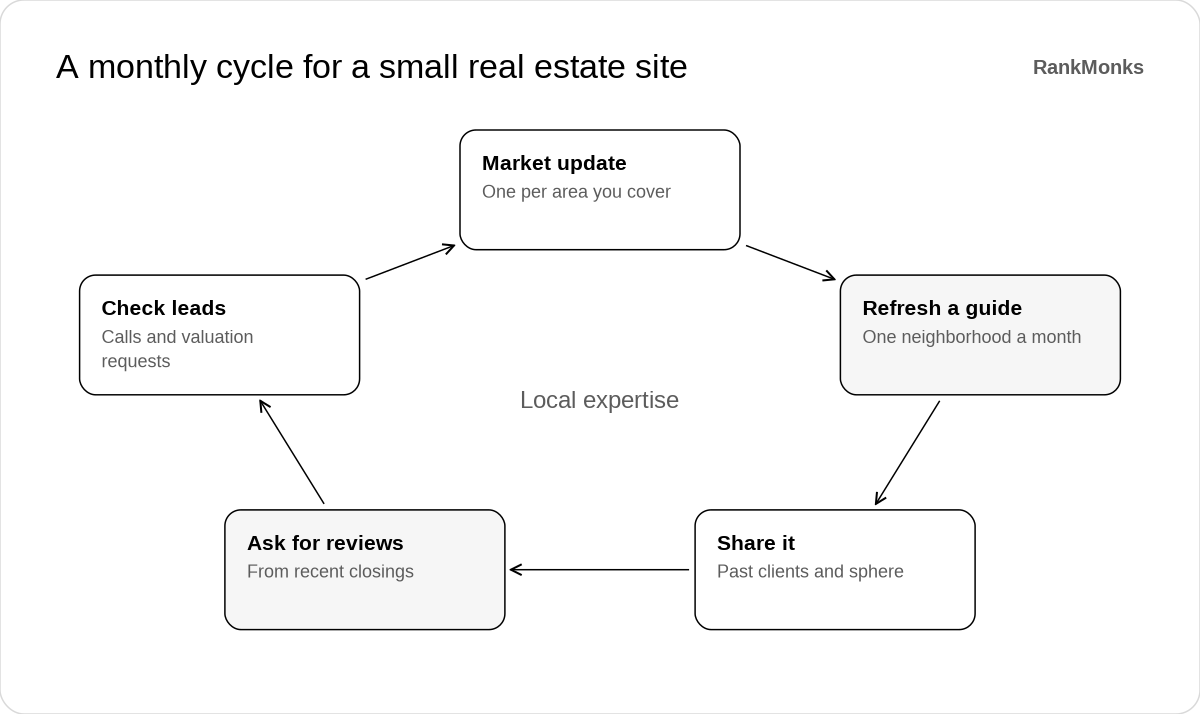
A single agent can run this cycle in a few hours a month with help from an agency. Sharing each update with your past clients and sphere does double duty: it keeps you in mind for referrals and brings early visits that help new pages get noticed. Our guide to content decay explains why pages slip when they are left alone.
How should real estate SEO be measured?
Real estate SEO should be measured in valuation requests, calls, contact forms and showing requests, traced to the pages that brought them. Traffic alone says little, because a visitor browsing listings may never contact you.
- Leads by page: which guides and seller pages bring valuation requests and calls.
- Business Profile actions: calls, website clicks and direction requests.
- Search Console: searches for your areas and for your name.
- Your CRM: the source of each lead, and which leads became listings or closed deals.
- Reviews: new reviews each month, on Google and on portal profiles.
The gap between a first visit and a closing can be months. Judge the work quarter by quarter, and keep the method the same so that the trend means something.
What are the warning signs when hiring a real estate SEO agency?
The clearest warning sign is a promise to outrank the big portals for listing searches in your city. Other signs:
- Thousands of auto-generated pages for every street or listing, with little real content.
- Steering language in neighborhood templates.
- Fake reviews, or links bought from spammy directories.
- Rankings-only reports that never mention leads.
- The agency or platform owns your domain. If your site lives on a domain you do not control, or inside a brokerage site you would leave behind if you changed firms, your work leaves with it.
Our guide on how to choose an SEO agency covers proposals and contracts in more depth.
What should a realtor ask an SEO agency before hiring?
Ask questions that test whether the agency understands real estate, compliance and local search.
- Which searches would you target for us, and which would you avoid?
- How do you handle IDX pages?
- How do you write neighborhood content without Fair Housing problems?
- How will you report valuation requests and calls?
- Who does the work, and will I speak to them directly?
- Will I own the domain, the site and all content if we part ways?
How do SEO, AEO, GEO and AI visibility fit together for a realtor?
SEO gets your pages and profile into search results, and the same local expertise feeds the three newer disciplines.
- AEO is about being the direct answer to questions like "how much are closing costs in [state]", in snippets, AI Overviews and voice results. See the best AEO agency for small realtors.
- GEO is about being named when a buyer asks ChatGPT or Perplexity for a good agent in a particular town. See the best GEO agency for small realtors.
- AI visibility checks what those tools actually say about you and your areas, and fixes what is wrong. See the best AI visibility agency for small realtors.
For how this works across every kind of small business, read the best SEO agency for small businesses.
How does RankMonks approach SEO for small realtors?
RankMonks starts by reading your site, profiles, listings, reviews and search data, plus what AI tools currently say about you. You get a written audit with every problem ranked by what it costs you in leads.
We work with a small number of clients at a time, and the person who plans your strategy does the work. We build a few excellent pages for your core areas before anything else, then ship updates in small, steady releases. Each month you get a plain-language report on leads, rankings and AI answers, with what comes next. We are honest about time too: technical fixes can show within weeks, but guides and authority usually take three to six months to move rankings.
Frequently asked questions
Is SEO worth it for a single real estate agent?
It can be, if it is aimed at the right searches. A solo agent will rarely win listing searches, but a handful of strong neighborhood guides, market updates and a seller page can bring valuation requests for years. The value of one extra listing often covers a long stretch of work.
Should a realtor use IDX for SEO?
Use IDX for visitors, not as your main SEO strategy. The same listings appear on many sites, so those pages rarely rank. Your guides, market updates and seller pages are what earn search traffic, and IDX lets those visitors browse once they arrive.
How long does real estate SEO take?
Profile and technical fixes can show within weeks. Guides and market pages usually take three to six months to rank, and leads can take longer to turn into closings. Judge progress quarter by quarter.
Should a realtor's website be separate from the brokerage site?
A site on a domain you own keeps your work with you if you ever change brokerages. Many agents keep a profile on the brokerage site and their own site for guides and market updates. Check your brokerage's rules on advertising and naming first.
Good real estate SEO puts your local knowledge where buyers and sellers can find it. That is how our SEO service works for local experts. If you want a second opinion on your site, start a conversation.
Written by RankMonks.