
The best SEO agency for a small business is one where senior people do the work, the plan starts with a written audit that ranks problems by what they cost you, and success is measured in calls, bookings, orders and inquiries rather than rankings alone. It should understand local search, be honest about how long results take, leave you owning every account, and plan for the AI answers that now sit alongside Google's results.
This guide explains what an SEO agency does for a small business, how to recognize a good one, how pricing and timelines usually work, which warning signs to take seriously, and how the right approach changes for restaurants, dental offices, plumbing companies, realtors and terpene flavor houses. It also shows how SEO fits with the three newer disciplines: AEO, GEO and AI visibility.
Key takeaways
- For a small business, the most important question is who will actually do the work, not how big the agency is.
- A good engagement starts with a ranked audit and fixes what already exists before creating anything new.
- Local search, including your Business Profile, listings and reviews, is the core of SEO for most small businesses.
- Results should be reported as calls, bookings, orders and inquiries, with rankings as a supporting measure.
- Technical fixes can show within weeks, but content and authority usually take three to six months to move rankings.
- SEO is now the foundation for being quoted and recommended by AI tools, so the best agency plans for both.
What does an SEO agency do for a small business?
An SEO agency makes it easier for the right customers to find your business in Google's results and map listings, and makes sure the pages they land on turn the visit into a call, a booking or an order. For most small businesses that means local search first, with content and links built around the services you actually sell.
The work usually falls into six areas:
| Area | What it involves | Why it matters for a small business |
|---|---|---|
| Technical health | Making sure search engines can crawl, read and index the site, and that it is fast on a phone | Problems here hold back every other page |
| Business Profile and listings | A complete, accurate Google Business Profile and consistent details on other directories | Drives the map results, where many local customers choose |
| Service and location pages | A clear page for each service and each place you serve | Matches the specific searches customers make |
| Content | Answers to the questions customers ask before they buy | Builds trust and wins searches further from the sale |
| Reviews and mentions | A routine for reviews, and coverage on local and trade sites | Feeds prominence and persuades people to choose you |
| Reporting | Monthly figures on leads, rankings and traffic, with what was done | Shows whether the money is working |
Google says local results depend mainly on relevance, distance and prominence. An agency cannot change your distance from the searcher, so the work goes into relevance and prominence. Our guides to what SEO is and local SEO explain the mechanics in more depth.
What makes an SEO agency the best fit for a small business?
The best SEO agency for a small business is the one whose experienced people will spend real time on your account, and whose plan is built around your leads rather than its own process. Size, awards and a long client list matter less than who does the work and how they report it.
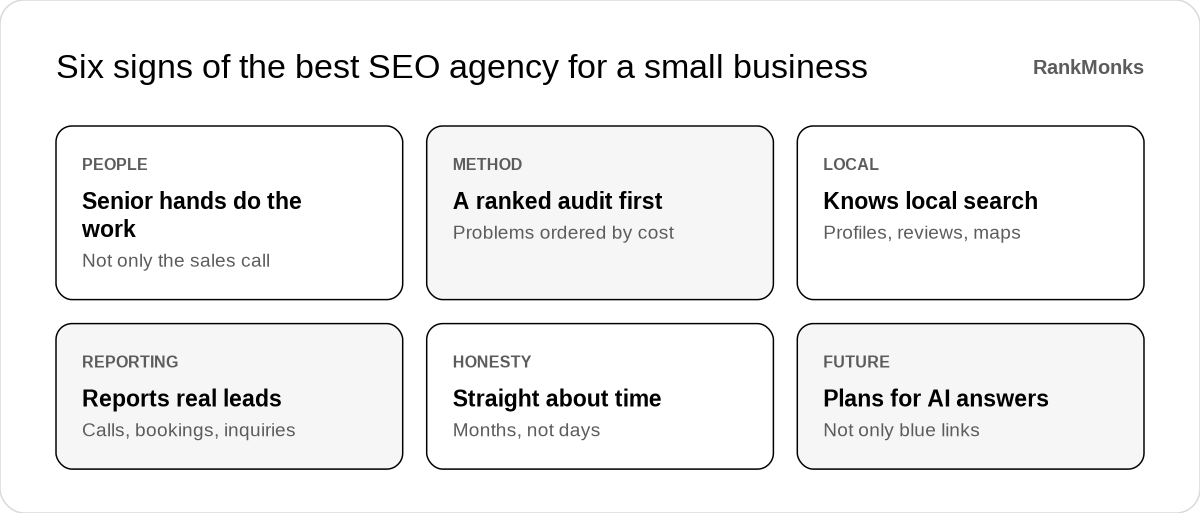
Senior people do the work. At many agencies, an experienced person runs the sales call and a junior team does the delivery. A small budget buys only so many hours, so you want those hours to come from someone who has seen your kind of problem before.
It starts with a ranked audit. Before proposing new content, a good agency reads your site, your Business Profile, your listings, your analytics and your competitors, then gives you a written list of problems ordered by what they cost you. A short, ranked list is more useful than a long report nobody opens.
It knows local search. For a business that serves a town or a region, the Business Profile, reviews, service areas and directory listings are central. An agency that only talks about blog posts and backlinks is missing the part that drives most calls.
It reports real leads. The monthly report should show calls, bookings, form submissions, orders or inquiries, alongside rankings and traffic. If it never mentions leads, it is measuring the wrong thing.
It is straight about time. Good SEO takes months. A good agency tells you what is realistic before you sign, and tells you when something is not worth your money.
It plans for AI answers. People now ask ChatGPT, Gemini and Google's AI Overviews for recommendations. Those answers lean on the same web that search engines read, so the agency should build pages and a reputation that serve both. Our guide to SEO in the AI era sets out the full playbook.
One more test sits underneath all six: you should own your website, domain, Business Profile, analytics and any tracking numbers. The agency manages them. It never owns them.
How much should a small business expect to pay for SEO?
What a small business pays for SEO depends on how many services and locations it covers, how competitive its market is, the state of its current site and how much new content it needs. Rather than chasing a price, compare what each proposal will actually do and how it will be measured.
Agencies usually charge in one of a few ways:
| Pricing model | Good for | Watch out for |
|---|---|---|
| One-off audit or project | A clear starting point, or a site that needs a cleanup | An audit with no help to act on it |
| Monthly retainer | Steady work on pages, reviews, links and reporting | Retainers that are mostly automated reports |
| Hourly consulting | Advice for a team that will do the work itself | Paying for time without agreed outcomes |
| Performance-based | Rarely a good fit | Pay-per-ranking deals that chase easy, useless keywords |
Several things drive the cost up or down:
- Number of locations and services. A single-location business with five services needs fewer pages than a multi-location one with twenty.
- Competition. A plumber in a dense metro area faces more competitors than one in a small town.
- Starting point. A site with serious technical problems needs more work up front.
- Who writes. Agency-written content costs more than editing pages your team drafts.
- Earning mentions and links. Digital PR and outreach take time, and time costs money.
A useful way to judge any proposal is to ask what each line of work is for and how you will know it worked. Our guide on how to choose an SEO agency covers comparing proposals in more detail.
How long does SEO take for a small business?
SEO for a small business usually shows its first results within weeks, from profile and technical fixes, and its larger results over three to six months, as new pages and reviews build up. Competitive markets and sites starting from scratch take longer.
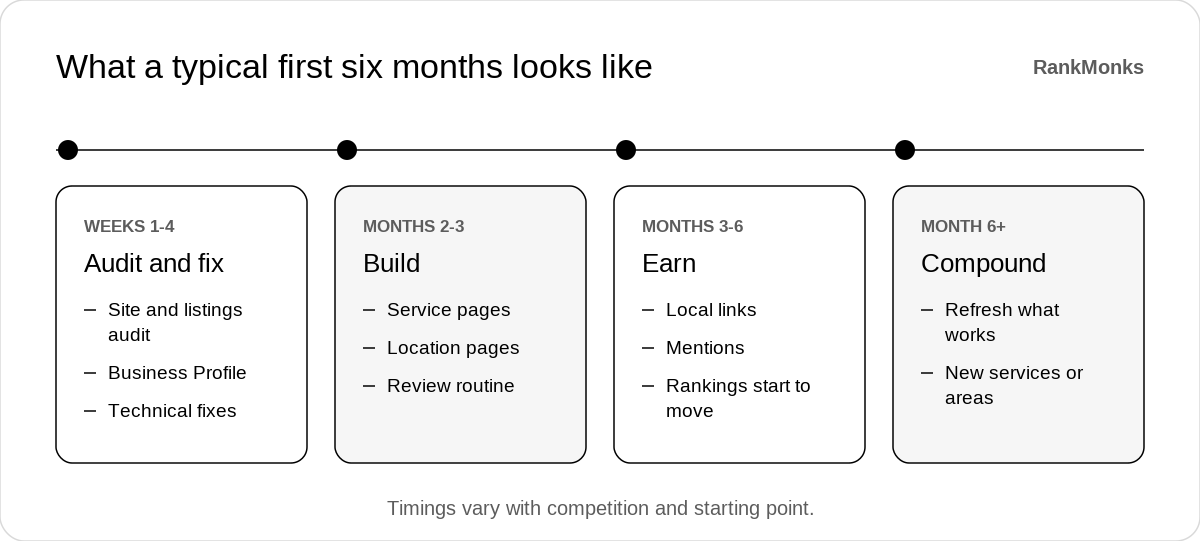
A sensible first 90 days looks like this:
- Read everything. The site, the Business Profile, listings, reviews, analytics, Search Console and the businesses that rank above you.
- Write the audit. Problems ranked by what they cost you, with the fixes in order.
- Fix the foundations. Correct the profile and listings, and fix technical problems that block crawling or slow the site on phones. A technical SEO audit lists the usual checks.
- Build the pages closest to a sale. Service pages and location pages first, then answers to common questions.
- Start a review routine. Ask every happy customer, and reply to every review.
- Set a baseline. Record calls, bookings, forms and orders before the changes land, so later months mean something.
After that, the work becomes steady: new pages where customers search, mentions and links earned through local and trade relationships, and pages refreshed before they go stale. Our guide to content decay explains why that last part matters.
What are the warning signs of a bad SEO agency?
The clearest warning sign is a guarantee of a particular ranking, or of a place in AI answers, because nobody controls either. Other warning signs are just as easy to check.
- Secret methods. A good agency explains what it does. Anything it will not describe is usually something you would not approve.
- Link packages. "500 backlinks for a fixed price" usually means links from low-quality networks, which can do harm. Our guide to link building explains what earned links look like.
- Fake or incentivized reviews, or asking only the customers who seem happy.
- Stuffed business names and fake locations on your Business Profile, which break Google's guidelines and can get a profile suspended.
- Doorway pages. Hundreds of near-identical town pages with only the place name changed.
- Mass-produced content written by a tool and published without anyone checking it.
- Long lock-in contracts with no exit if the work does not deliver.
- Agency-owned assets, such as a domain, profile or phone number registered to the agency.
- Reports with no leads in them, or reports that never say what was actually done.
What should you ask an SEO agency before you hire it?
Ask questions that show who will do the work, what they will fix first, and how you will know it is working. The answers should be specific to your business.
- Who exactly will work on our account each month, and will we speak to them directly?
- What would you fix first, and why?
- Which searches would you target, and which would you leave alone?
- How will you report calls, bookings, orders or inquiries?
- How do you earn reviews, links and mentions?
- What results are realistic in three months, and in twelve?
- How does your work account for AI answers from tools like ChatGPT and Google's AI Overviews?
- Who owns the website, domain, profile, analytics and phone numbers?
An agency that answers with a generic deck, or cannot say who will do the work, has told you what you need to know.
How does the best SEO agency adapt to your industry?
The best SEO agency adapts its plan to how your customers search, what they need to see before they choose you, and the rules your industry works under. The foundations stay the same, but the pages, the risks and the measures change a great deal from one type of business to the next. Here is how it changes for five very different small businesses.
Small restaurants
Diners mostly choose from a map on their phone, so the Business Profile, a menu published as text, accurate hours and a steady flow of reviews do most of the work. Platforms such as Yelp and the delivery apps often outrank restaurants for their own name, so the site needs to be the best answer for searches about you. Read more in our guide to the best SEO agency for small restaurants.
Dental offices
Dental content is health content, so search engines expect clear evidence of who wrote it and why they are qualified. Each treatment needs its own page reviewed by a dentist, insurance and emergency pages matter a great deal, and review replies must never reveal anything about a patient. Read more in our guide to the best SEO agency for dental offices.
Small plumbing companies
Plumbing searches are often urgent and made on phones, so the map results, reviews and a tap-to-call site come first. The work covers a service-area Business Profile, a page per service and per area served, and visible licensing, alongside any Local Services Ads you run. Read more in our guide to the best SEO agency for small plumbing companies.
Small realtors
Large portals tend to win listing searches, so a small agent wins with neighborhood guides, market updates and seller pages that show local expertise. All of it has to be written within Fair Housing rules, describing places rather than people. Read more in our guide to the best SEO agency for small realtors.
Small terpene flavor houses
Ad platforms often restrict cannabis-adjacent products, so organic search carries more of the load. The buyers are mostly technical, which calls for profile and application pages, crawlable certificates of analysis and safety data sheets, and content that never makes health claims. Read more in our guide to the best SEO agency for small terpene flavor houses.
How does SEO fit with AEO, GEO and AI visibility?
SEO is the foundation the other three disciplines build on. AEO, GEO and AI visibility all depend on pages that search engines and AI tools can read, and on accurate, consistent facts about your business across the web.
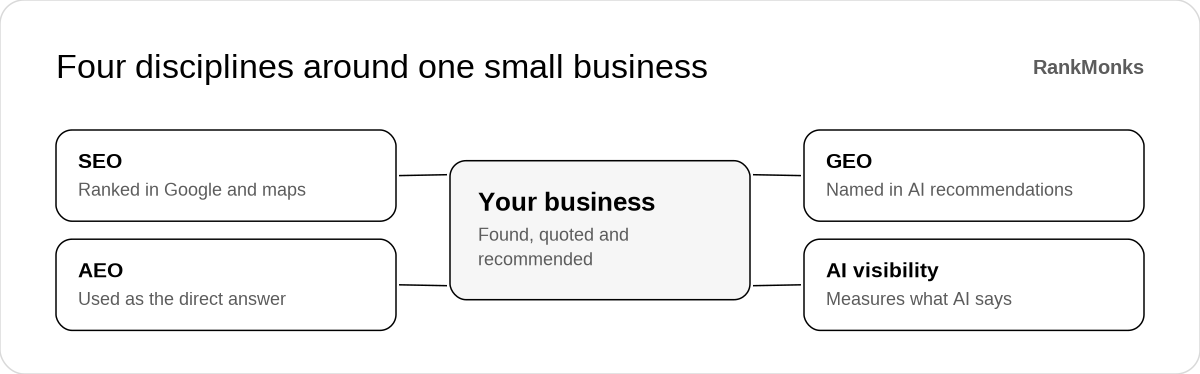
- AEO, answer engine optimization, is about being the direct answer in featured snippets, People Also Ask, Google's AI Overviews and voice assistants. Our guide to the best AEO agency for small businesses explains what that work involves.
- GEO, generative engine optimization, is about being named and cited when ChatGPT, Perplexity, Gemini or Claude write a recommendation. See the best GEO agency for small businesses.
- AI visibility is the measurement side: tracking what those tools actually say about your business and fixing what is wrong. See the best AI visibility agency for small businesses.
For a small business, there is a strong case for one agency that understands all four, because the work overlaps so much. A rewritten service page, a corrected listing or a mention in the local paper helps your rankings, your chances of being the quoted answer and your chances of being recommended at the same time. Our guide to GEO vs SEO vs AEO sets out the differences in more detail.
Should a small business hire an agency, a freelancer or do SEO itself?
A small business should do SEO itself if the owner has the time and the site is simple, hire a freelancer for specific tasks, and hire an agency when it needs a range of skills working together over months. Many small businesses move between these as they grow.
Doing it yourself works well for the basics: completing your Business Profile, asking for reviews and keeping your hours right. Those tasks need care more than expertise, and nobody knows your business better than you.
A freelancer suits a defined job, such as fixing technical problems or writing a set of service pages. The quality depends entirely on the person, and you take on the job of coordinating the work.
An agency makes sense when you need technical work, content, local search, reviews, outreach and reporting to move together. A boutique agency sits between the two: a small team, with the experienced people doing the work, but more than one set of skills.
Whichever route you take, keep ownership of every account, and keep a record of what was changed and when.
How does RankMonks approach SEO for small businesses?
RankMonks works in four steps: listen, diagnose, build and measure. We start by reading everything: your site, your Business Profile, your listings, your analytics, your market, and what search engines and AI models currently say about you. Then you get a written audit covering SEO, AEO and GEO, with problems ranked by what they cost you, not a long report nobody opens.
We take on a small number of clients at a time, because it is the only way to do the work properly, and the person who plans your strategy is the person who does the work. We fix the foundations first, then publish and earn: technical work, content, structured data and mentions, shipped in small, steady releases. Each month you get a plain-language report on rankings, traffic, leads, citations and your share of AI answers, followed by what we will do next.
We are honest about time. Technical fixes can show within weeks. Content and authority work usually takes three to six months to move rankings. AI citations can shift faster or slower, depending on the model. We set expectations for each channel before you sign anything, and we never guarantee a ranking.
Frequently asked questions
Is SEO worth it for a small business?
SEO is worth it for most small businesses whose customers search before they buy, which covers almost every local service. The basics of a complete Business Profile, accurate listings, clear service pages and a review routine cost little and can bring calls for years. Whether a larger investment pays depends on the value of a customer and how competitive your market is.
Can a small business do SEO itself?
Yes, much of the foundation can be done in-house: completing your Business Profile, keeping details consistent, asking for reviews and writing clear service pages. An agency or freelancer adds value for technical problems, competitive markets and steady work you do not have time for. Many owners start themselves and bring in help once the basics are done.
How do you know if an SEO agency is doing a good job?
A good agency reports calls, bookings, orders or inquiries alongside rankings and traffic, explains what it did each month and why, and ties the next month's work to what the numbers show. Over three to six months, you should see more searches that do not include your business name leading to visits and leads. If the reports never mention leads, ask why.
Does SEO still matter now that people use AI?
Yes. AI tools such as ChatGPT, Perplexity and Google's AI Overviews lean on the open web, and pages that rank well tend to be the ones that get read and cited. Ranking is no longer the whole job, but it is still the first part of it, which is why the best agencies plan for both.
The best SEO agency for a small business is the one that does the important work first, reports honestly and stays with the problem until it moves. That is how our SEO service is run. If you want a second opinion on where you stand in search and in AI answers, start a conversation.
Written by RankMonks.