
The best SEO agency for a dental office is one that understands it is marketing health care. It builds a clear page for each treatment you offer, shows who your dentists are and what qualifies them, keeps your Business Profile and insurance information accurate, and never puts patient privacy at risk when it replies to reviews. It should report new-patient calls and bookings, not only rankings.
This guide is part of our wider look at the best SEO agency for small businesses. It covers why dental SEO is different, what work a practice needs, how to handle reviews safely, what an agency should do first, how to measure results, and which warning signs to watch for.
Key takeaways
- Dental content is health content, so Google expects clear evidence of who wrote it and why they are qualified to.
- Each treatment you want patients for deserves its own page, written for your practice rather than copied from a template.
- Insurance and emergency searches are among the most practical searches a dental office can win.
- Replies to reviews must never confirm that someone is a patient or discuss their treatment.
- A good agency measures new-patient calls, bookings and form submissions, and leaves you owning every account.
Why is SEO for dental offices different?
SEO for dental offices is different because dental information can affect a person's health, and search engines hold that kind of content to a higher standard. Google's guidelines for its search quality raters call these "Your Money or Your Life" topics, where experience, expertise, authoritativeness and trust (E-E-A-T) weigh most heavily.
That changes several parts of the job:
| Factor | Most local businesses | Dental offices |
|---|---|---|
| Content standard | Helpful and accurate | Accurate, reviewed by a qualified dentist, clearly attributed |
| Who the reader trusts | The business | The named dentist and their credentials |
| Key searches | Service plus town | Treatment plus town, insurance plan, emergency care |
| Reviews | Reply freely | Reply without revealing anything about a patient |
| Photos and testimonials | Use with common sense | Use only with written patient permission |
| What success looks like | Calls and visits | New-patient calls, bookings and treatment inquiries |
Patients also choose differently from diners or shoppers. They compare distance, insurance, availability and how much they trust the person who will treat them. A good agency builds pages that answer those questions directly. Our guide to E-E-A-T explains how to show expertise on the page.
What should SEO work cover for a dental office?
SEO for a dental office should cover treatment pages, dentist bios, insurance and payment information, location pages, a new-patient path, and an accurate Business Profile. Together they let a search engine understand what you offer, and let a nervous patient decide to book.
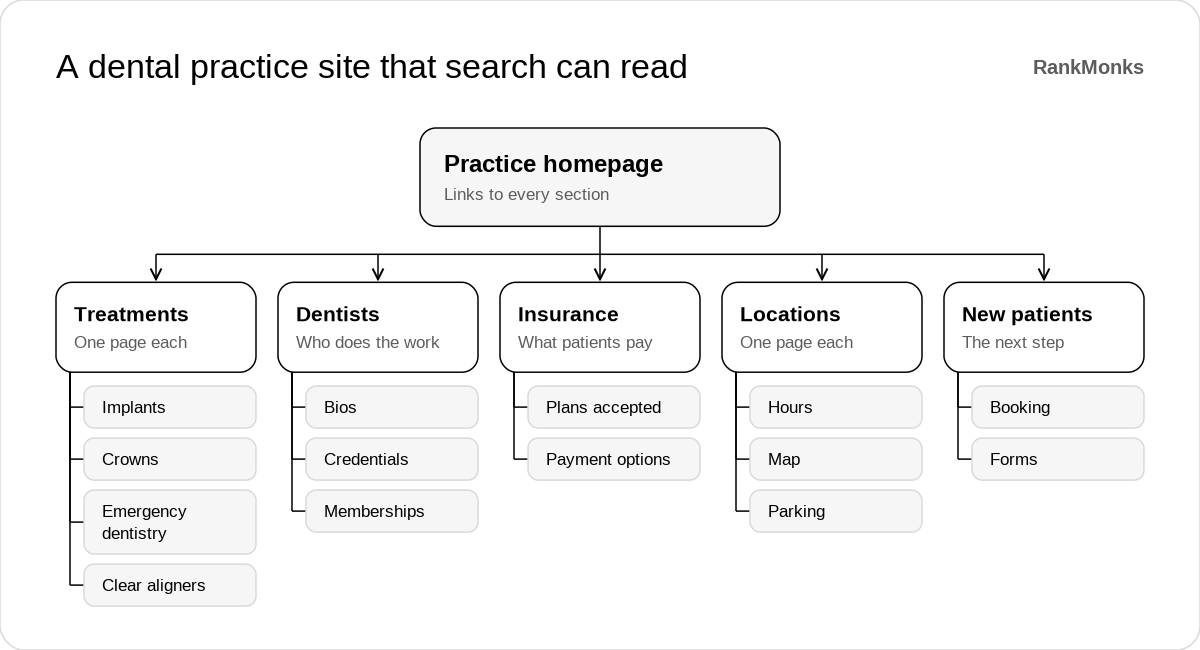
- One page per treatment. Implants, crowns, root canals, whitening, clear aligners, pediatric care and emergency dentistry each get a page that explains what the treatment is, who it suits, what happens at each visit, recovery, and what affects the cost. Name the dentist who reviewed the page.
- Dentist bios. Each dentist's degree (DDS or DMD), where they trained, their license, professional memberships, continuing education and a real photo. These pages carry much of your E-E-A-T.
- Insurance and payment. List the plans you accept and the payment options you offer. Searches such as "dentist that takes [plan] near me" come from people ready to book.
- Emergency dentistry. A page that states honestly when you can see emergency patients and how to reach you. Do not claim same-day care you cannot deliver.
- Locations. Address, hours, map, parking and accessibility for each office.
- The Business Profile. The most accurate category (such as "Dentist", or "Pediatric dentist" if that is your focus), hours, booking link, photos of the office and team, and services listed in plain words.
- Structured data. Dentist markup restates your name, address, hours and services for machines. Our guide to schema markup covers how to add it.
A small detail matters here. Brand names such as Invisalign are trademarks, so a practice should use them only if it is an approved provider, and use plain terms such as "clear aligners" otherwise.
How should a dental office handle reviews and patient privacy?
A dental office should ask for reviews routinely, but reply in general terms only, never confirming that the reviewer is a patient or mentioning their care. In the US, patient privacy rules under HIPAA apply to public replies as well as records, and regulators have penalized dental practices over review responses that disclosed patient information.
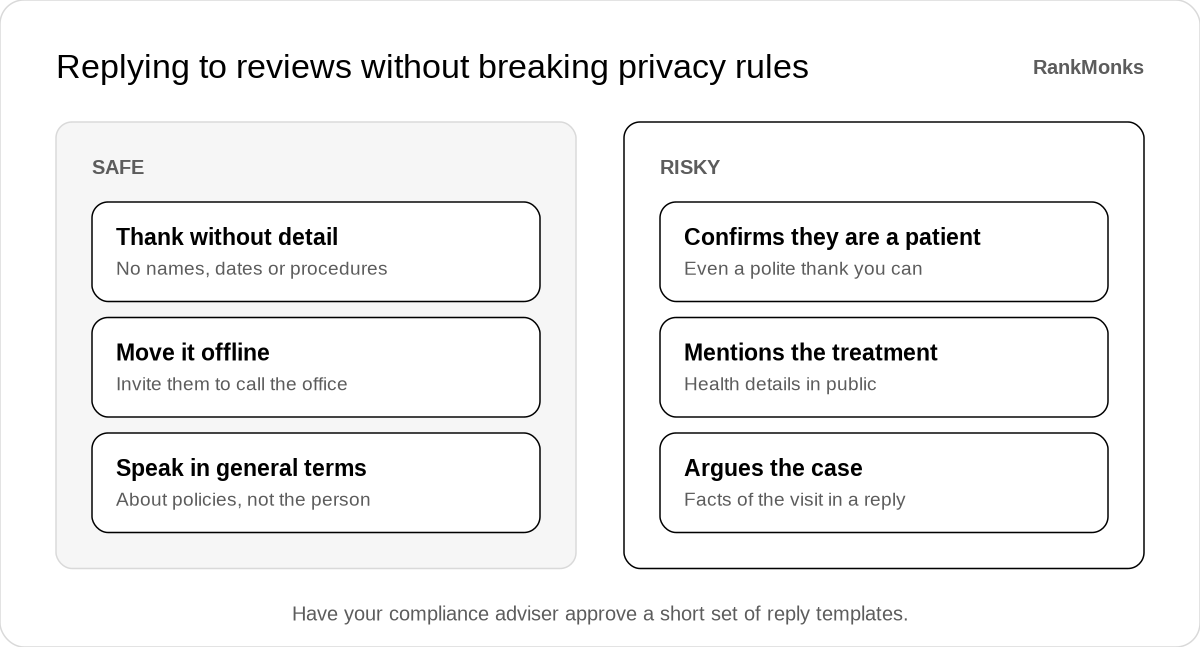
A safe reply to a critical review might read: "We are sorry to hear this. We take every concern seriously, and we would welcome a call to the office manager at [number]." It thanks, it invites contact, and it reveals nothing.
The same care applies elsewhere:
- Testimonials and before-and-after photos need written permission from the patient before they appear on your site or profile.
- Asking for reviews is fine, but do not offer discounts or gifts in return, and do not ask only the patients you expect to be happy.
- Reply templates should be agreed with whoever handles compliance at your practice, so that staff have safe wording ready.
An agency that suggests arguing a bad review point by point, with dates and treatments, does not understand the risk.
What should an SEO agency do in the first 90 days?
In the first 90 days, a good agency should fix the foundations and the pages closest to a booking before it writes anything general. For most practices, that means the profile, the top treatment pages and the dentist bios.
- Audit everything. The Business Profile, health directories such as Healthgrades, other listings, the site's technical health, and which treatment and insurance searches you already appear for. Our guide to a technical SEO audit lists what to check.
- Fix the profile and listings. Correct names, addresses, phone numbers, hours and booking links everywhere they appear.
- Rewrite the most valuable treatment pages. Start with the treatments you most want more patients for, and the ones people search for locally, such as implants, emergency care or clear aligners.
- Publish dentist bios with credentials, and add a "reviewed by" line to clinical pages.
- Agree a review routine and reply templates approved by your compliance lead.
- Set up tracking for calls, booking requests and forms by page, so the next months can be judged against a baseline.
How should dental SEO be measured?
Dental SEO should be measured by new-patient calls, online bookings and treatment inquiries, broken down by the pages that brought them. Rankings and traffic support the story, but a practice with more visits and the same number of new patients has not gained much.
- Business Profile actions: calls, direction requests, website clicks and booking clicks each month.
- Search Console: searches that do not include your practice name, such as "emergency dentist [town]", show whether new patients are finding you.
- Bookings by page: which treatment pages lead to appointment requests.
- Intake: a "how did you hear about us?" question on the new-patient form, including AI assistants as an option.
- Reviews: new reviews per month and your average rating.
Our guide to SEO reporting covers how to set out a monthly report.
What are the warning signs when hiring a dental SEO agency?
The first warning sign is any guarantee of a top ranking. Beyond that, watch for practices that put your license or your patients at risk.
- Template content. Treatment pages copied from a library used across many dental sites say nothing about your practice and add little.
- Unreviewed AI content. Clinical pages written by a tool and published without a dentist checking them.
- Overpromising claims. Words like "painless" or "permanent" can be inaccurate, and many state dental boards have rules on advertising claims.
- Fake or incentivized reviews, or asking only satisfied patients.
- Testimonials without consent.
- Rankings-only reporting, with no mention of calls or bookings.
- Owning your accounts. You should own your website, domain, Business Profile and analytics.
What should a dental office ask an SEO agency before hiring?
Ask questions that test whether the agency understands health content and privacy as well as search.
- Who will write our treatment pages, and which dentist reviews them?
- How will you reply to reviews without disclosing patient information?
- Which treatments and insurance searches would you target first, and why?
- How will you report new-patient calls and bookings?
- Who does the work each month, and will we speak to them directly?
- What happens to our pages and accounts if we part ways?
How do SEO, AEO, GEO and AI visibility fit together for a dental office?
SEO gets your practice into Google's map results and listings, and the same foundations of accurate details, credible pages and steady reviews support the other three disciplines.
- AEO is about being the direct answer to patient questions such as "how long does an implant take to heal", in snippets, AI Overviews and voice assistants. See the best AEO agency for dental offices.
- GEO is about being named when someone asks ChatGPT or Perplexity for a family dentist in their town who takes their insurance. See the best GEO agency for dental offices.
- AI visibility checks what those tools actually say about your hours, insurance and services, and fixes what is wrong. See the best AI visibility agency for dental offices.
For how all four apply to any small business, read our guide to the best SEO agency for small businesses.
How does RankMonks approach SEO for dental offices?
RankMonks starts by reading your site, profile, listings, reviews and search data, and what search engines and AI tools currently say about your practice. You then get a written audit covering SEO, AEO and GEO, with each problem ranked by what it costs you in new patients.
We work with a small number of clients at a time, and the person who plans your strategy does the work. Clinical pages are written or edited by us and reviewed by your dentists, because accuracy matters more than volume. Changes ship in small, steady releases, and each month you get a plain-language report on calls, bookings, rankings and AI answers. We will also tell you honestly what to expect: technical fixes can show within weeks, while content and authority usually take three to six months to move rankings.
Frequently asked questions
How much does SEO cost for a dental office?
It depends on how many locations and treatments you want to cover, the state of your current site, and how competitive your area is. Agencies usually charge for an initial audit and fix project, a monthly retainer, or both. Ask for a proposal that ties each line of work to the treatments and areas you care about.
How long does SEO take for a dental practice?
Profile and technical fixes can show results within weeks. New treatment pages and authority usually take three to six months to move rankings, and longer in crowded city markets. A good agency will set expectations for each type of work before you sign.
Does a dental office need a page for every treatment?
It needs a page for every treatment it wants patients to find it for. One general "services" page cannot rank for implants, aligners and emergency care at once. Each page should be specific to your practice and reviewed by one of your dentists.
Can a dental office reply to online reviews?
Yes, and it should, but only in general terms. A reply must never confirm that the reviewer is a patient or mention their treatment. Thank them, invite them to call the office, and keep any discussion of their care private.
Good dental SEO earns trust before it earns rankings. That is the standard our SEO service works to for every practice. If you want a second opinion on your site, start a conversation.
Written by RankMonks.