
SEO, AEO and GEO all help people find you, but each one works on a different surface. SEO helps you rank in a list of links. AEO helps you become the direct answer to a question. GEO helps AI tools name and cite you in the answers they write.
Search is no longer only a list of blue links. People still use Google, compare websites and click through to pages. They also ask AI tools for direct answers, summaries and shortlists, and often act on what they are told without visiting a site.
This guide explains what each term means, how the three differ, how one query looks from each angle and how to work on all of them without tripling the workload.
Key takeaways
- SEO ranks your pages in a list of links, AEO makes your content the direct answer, and GEO gets AI tools to name and cite your brand in the answers they generate.
- SEO earns clicks, AEO wins answers that are read without a click, and GEO earns mentions and citations inside AI responses.
- All three rest on the same foundation of clear, credible, well-structured content that machines can reach.
- AEO is mostly on-page work and shows results sooner, while GEO depends on authority and trust built across the web over time.
- Most brands need all three, layered in order: SEO first, then AEO, then GEO.
What do SEO, AEO and GEO stand for?
SEO stands for search engine optimization, AEO for answer engine optimization and GEO for generative engine optimization. They share one goal, being found, but they target different surfaces and count success in different ways.
- SEO, search engine optimization. The oldest of the three. It helps your pages rank in traditional search results, such as the list of links on Google.
- AEO, answer engine optimization. It helps your content become the direct answer to a question, in places such as featured snippets, voice replies and Google AI Overviews.
- GEO, generative engine optimization. It helps AI tools such as ChatGPT, Claude, Gemini and Perplexity name your brand and cite your content in the answers they write.
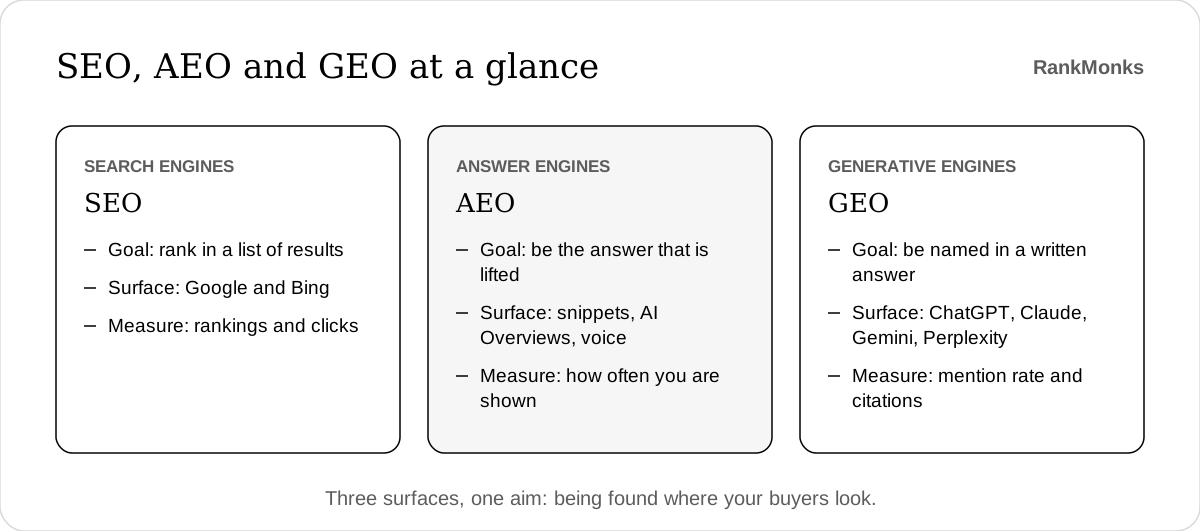
How do SEO, AEO and GEO compare at a glance?
The quickest way to tell them apart is by goal, surface and how success is measured. The table sets all three side by side.
| SEO | AEO | GEO | |
|---|---|---|---|
| Goal | Rank on a results page | Be the extracted answer | Be named inside a generated response |
| Surface | Google and Bing search results | Featured snippets, AI Overviews, voice | ChatGPT, Claude, Gemini, Perplexity |
| What decides | Ranking signals in a search algorithm | A system that lifts a passage from a top page | A language model writing from many sources |
| Core tactics | Keywords, backlinks, technical health, site structure | Direct answers up front, clear headings, structured data | Third-party mentions, consistent facts, earned citations |
| Success measure | Ranking position and organic clicks | Snippet and Overview appearances | Mention rate per AI tool and how you are described |
The line between AEO and GEO is not always sharp. Google AI Overviews, for example, both lift passages and write new text. In practice the labels matter less than knowing which result you are working towards.
What is SEO?
SEO is the practice of getting your pages to rank in traditional search results. It is the oldest and most established of the three. You work on keywords, links, page speed, site structure and helpful content to move up the results page.
The goal of SEO is a click. When your page sits near the top and someone searches, they click through to your site. Search engines remain a major source of website visits, and SEO is the foundation the other two build on. A page that cannot be crawled and indexed cannot be quoted or cited either.
If you are starting from the beginning, our guide to what SEO is covers the basics, and a technical SEO audit will show whether the foundation is sound.
What is AEO?
AEO is the practice of getting your content chosen as the direct answer to a question. An answer engine pulls one clean, short answer from a page and shows it on the spot. Google's featured snippets, People Also Ask boxes, voice assistants and AI Overviews all work this way.
AEO is answer-first. You structure content so that a machine can lift a clear passage and use it without losing the meaning. Three things help most:
- Question-based headings that match what people ask.
- A plain, direct answer in the first sentence under each heading.
- FAQ sections, short definitions and schema markup that label what the page contains.
The reader often gets the answer without clicking, a pattern we cover in our guide to zero-click searches. So AEO is about being the answer, not only ranking near it.
What is GEO?
GEO is the practice of getting AI tools to name your brand and cite your content in the answers they generate. A generative engine such as ChatGPT, Claude, Gemini or Perplexity does not pick one passage. It reads across many sources, writes a new answer and names some of those sources and brands along the way.
GEO is about being one of them. It rewards clear, specific, trustworthy content on your own site and a consistent picture of your brand across the rest of the web, because much of what a model knows about you comes from pages you do not control. Our guide to brand mentions for AI search explains why.
Specificity is what keeps you in an AI answer. A buyer rarely stops at "what are the best tools for this". They follow up with a detail: a budget, a team size, a system it has to connect to. A brand described only in broad terms, such as "a popular choice", gives the model nothing to match against that detail. A brand tied to concrete fit, such as segment, price, features or integrations, has a reason to stay on the shortlist.
For the practical side, see our guide on how to get cited in AI answers.
How does the same query change across SEO, AEO and GEO?
The same query sets a different job for each discipline. Take someone who searches for "best AI visibility tools".
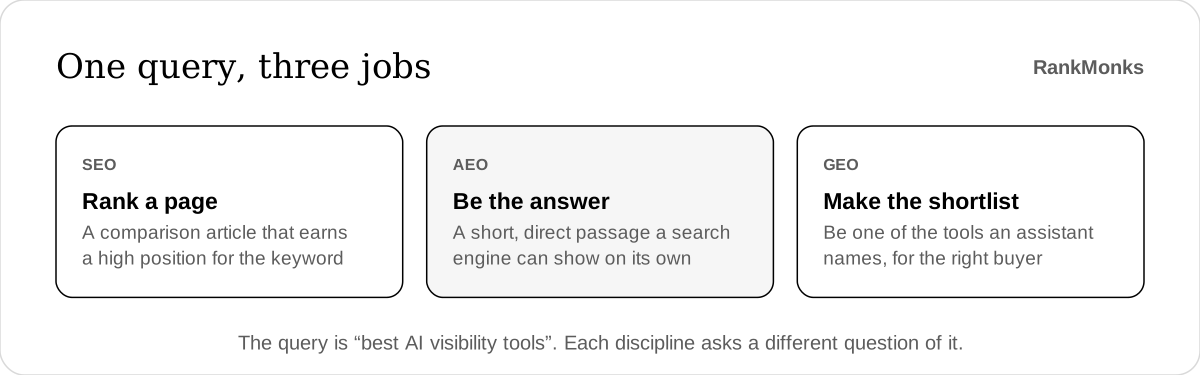
- In SEO, the goal is to rank a page for that keyword. You might write a comparison article, improve the title tag, strengthen internal links and earn backlinks.
- In AEO, the goal is to answer the question clearly. You might add a concise definition of what an AI visibility tool does, a comparison table and an FAQ section.
- In GEO, the goal is broader. You want AI tools to understand whether your product belongs in that set of recommendations, who it suits, what it offers, how it compares with alternatives and why it should be included.
That last point means your website is only part of the picture. AI tools also draw on third-party mentions, reviews, comparison pages, forums, documentation and the language customers use about you. You can see which of these shape the answers in your market with AI source analysis.
How do you optimize for SEO, AEO and GEO together?
You optimize for all three by building one body of content that works on every surface, in a set order: SEO first, then AEO, then GEO. Choosing one and ignoring the others leaves gaps in all of them.
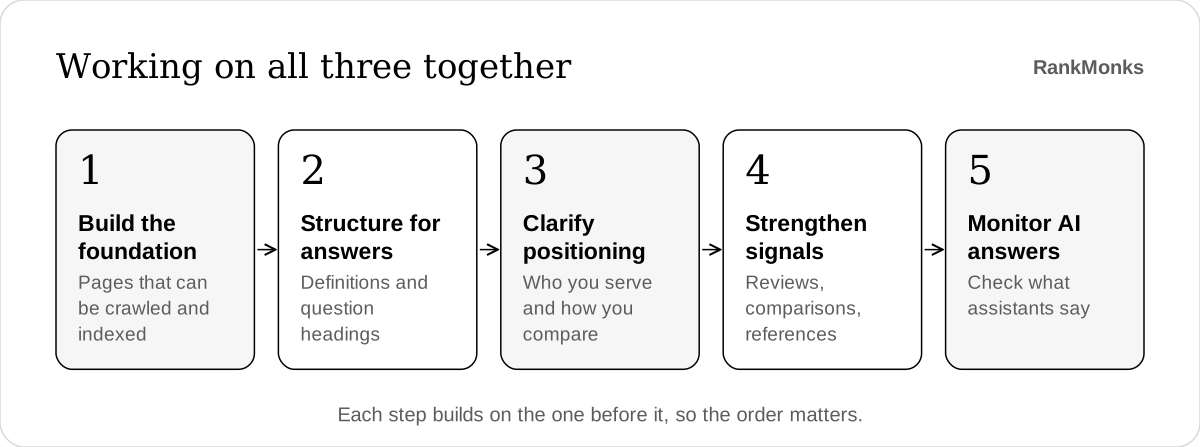
A practical workflow has five steps.
- Build the SEO foundation. Make sure your pages can be crawled, indexed and understood, and that the site is organised around the topics your buyers search for. Our guide to crawling and indexing covers the checks.
- Structure content for answers. Rewrite important sections so they answer direct questions. Use headings that match buyer questions, and add concise definitions, comparisons and FAQs.
- Clarify your positioning. Spell out who you serve, what you do, what you integrate with, which segments you fit and where your limits are. State it the same way everywhere.
- Strengthen third-party signals. Improve reviews, comparison mentions, customer stories, partner pages and other outside references. Digital PR is the most direct way to earn them.
- Monitor AI answers directly. Check whether AI tools mention your brand, describe it correctly and recommend it to the right buyer. Our guide on how to track brand mentions in AI search sets out a method.
The timing differs between the layers. AEO changes are made on your own pages and can show up within weeks of a page being recrawled. GEO depends on what the wider web says about you, and that takes months to shift.
Our longer guide to SEO in the AI era turns this into a full playbook, with a plan for the first 90 days.
Frequently asked questions
Is GEO replacing SEO?
GEO is not replacing SEO. AI tools that search the web rely on pages that search engines can find, so a site with weak SEO is unlikely to be read or cited. GEO adds a layer on top: making sure that when a model writes an answer, your brand is in it and described correctly.
Is AEO the same as GEO?
AEO and GEO overlap but are not the same. AEO is about having a passage from your page shown as the direct answer, as in a featured snippet. GEO is about being named or cited when a language model writes a new answer from many sources. Some people use the two terms interchangeably, so check which result is meant.
Which should you start with: SEO, AEO or GEO?
Start with SEO, because the other two depend on it. Once your pages can be crawled and are organised around the right topics, restructure the key ones for direct answers, and then work on how your brand is described across the web. If your SEO is already sound, AEO is usually the quickest next gain.
Do you need separate content for SEO, AEO and GEO?
You do not need separate content. One well-structured page can rank, be quoted and be cited. What changes is how it is written: a direct answer under each question heading, specific facts in place of general claims, and details that are consistent with what other sites say about you.
How do you measure GEO?
You measure GEO by running a fixed set of buyer questions through the main AI tools on a schedule and recording how often your brand is named, how it is described and which sources are cited. The result is a share of answers you can track over time, which we explain in our guide to AI visibility.
SEO, AEO and GEO are not rivals. They are layers of the same goal: being found and trusted wherever people search, whether that is a list of links, a snippet or an AI answer. The names will keep changing, and the principle will not. Be the clearest, most credible source on your topic. If you would like a read on where your brand stands across all three, start a conversation.
Written by RankMonks.