
The best GEO agency for a small plumbing company is one that gets you named when a homeowner asks an AI assistant who can fix a leak, clear a drain or replace a water heater in their town, and makes sure the answer states your service area, hours and services correctly. GEO, or generative engine optimization, is the work of shaping what AI tools write when they recommend a business.
This guide is part of our look at the best GEO agency for small businesses. It covers what is different for plumbers: urgent questions asked from a phone, service areas instead of storefronts, and a market where a handful of trusted sources decide who gets named.
Key takeaways
- Homeowners ask AI tools for a plumber in two moods: urgent ("water everywhere, who can come now?") and planned ("who installs tankless water heaters near me?").
- To name a plumbing company, an AI tool needs to know its service area, hours, services, licensing and reputation, and it needs to find those facts consistently.
- Service-area businesses depend heavily on listings and reviews, because they have no storefront for customers to discover.
- Clear pages for each service and each area you cover give AI tools specific facts to repeat, which vague "we do it all" pages do not.
- The best agency measures your share of answers for a fixed set of homeowner questions every month and ties it to calls.
How do homeowners use AI to find a plumber?
Homeowners use AI tools to describe the problem and their location in one sentence, then expect a short list of plumbers who can help. The question often arrives by voice, from a phone, in a hurry.
Typical questions look like this:
- "Who can fix a burst pipe in Mesa tonight?"
- "Plumber near me that does sewer camera inspections and gives upfront prices."
- "Best company to replace a 50-gallon water heater in Round Rock."
- "My kitchen sink is backing up into the dishwasher, do I need a plumber?"
The last one is a problem question. The answer might explain likely causes and suggest calling a plumber, and it may cite a page that explained the issue well. The first three are choosing questions, where the answer names businesses.
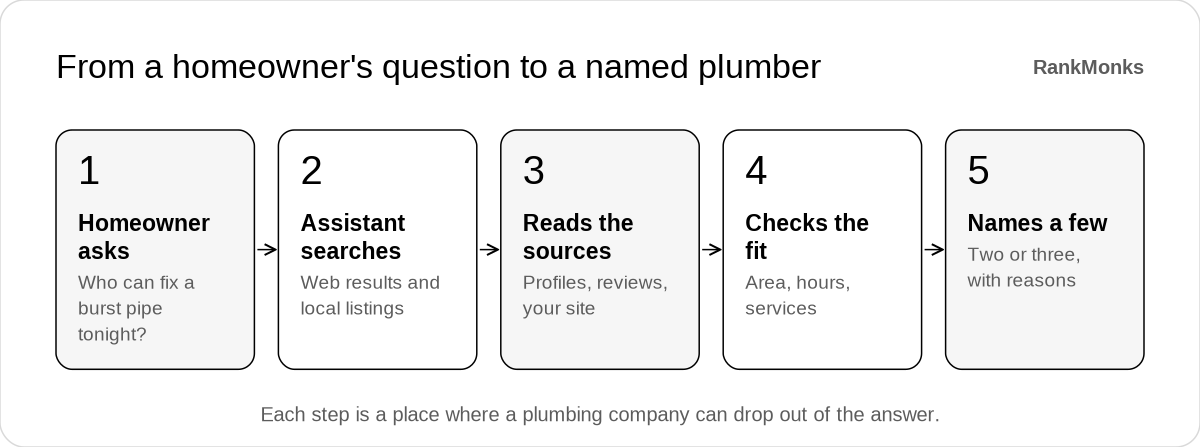
Each step in that chain is a point where a small plumbing company can drop out. If the assistant's search does not turn up your listings, if your profile does not say you cover that suburb, or if your hours are unclear about emergencies, a competitor with clearer details gets named instead.
What makes plumbing different for GEO?
Plumbing is different because most companies are service-area businesses with no storefront, much of the demand is urgent, and trust has to be established before a stranger lets you into their home. AI tools reflect all three.
| Fact | Why AI tools need it | Where to state it |
|---|---|---|
| Service area | To match you to the town the homeowner named | Business profiles, area pages, your footer |
| Hours and emergency policy | To answer "tonight" and "now" questions honestly | Every listing, an emergency service page |
| Services offered | To match the job, such as repiping or drain cleaning | One page per service |
| Licensing and insurance | To show you are a legitimate business | Your about page, your footer, your profiles |
| Pricing approach | Homeowners often ask about call-out fees | A page explaining how you quote |
| Reviews | To decide who is worth recommending | Google, Yelp and other review platforms |
There is also a paid layer in Google's own results. Local Services Ads, which carry a Google trust badge, often sit above the map pack for plumbing searches. Those are adverts in Google Search. AI assistants that write their own answers draw on web pages, listings and reviews, so a strong organic presence still matters even if you run ads.
What should GEO work cover for a small plumbing company?
GEO for a small plumbing company should cover your listings, your service and area pages, your proof of legitimacy, your reviews and your local mentions. The best agency will start with whatever is causing you to be left out or described wrongly today.
- Take a baseline. Ask AI tools the questions homeowners in your area ask, by job and by town, and record whether you are named, what is said and who appears instead.
- Fix your listings. Your business name, phone number, hours and service area should match on Google Business Profile, Bing Places, Apple Business Connect, Yelp and home services directories such as Angi or Nextdoor, where you use them. If you work from home, hide the address and set a service area.
- Build one page per service. Water heater repair and replacement, drain cleaning, leak detection, repiping, sewer lines, fixture installation, each with what the job involves and when to call.
- Build area pages with real detail. One page for each main town or suburb you cover, with genuine local information such as typical housing stock or common problems, not a template with the town name swapped.
- Show you are legitimate. Put your license number, insurance and how long you have been in business where homeowners and AI tools can read them.
- State your emergency policy precisely. If you offer 24-hour service, say so everywhere. If you do not, say what your hours are. An assistant that tells a homeowner you are open at 2am when you are not costs you a review.
- Build a review routine. Ask after every job, and encourage customers to mention the job and the town in their own words.
- Add structured data. The Plumber type in schema markup can state your area served, hours and services. See our guide to schema markup.
- Earn local mentions. Supplier dealer lists, trade association directories, local news and community sponsorships are the independent sources models tend to trust.
- Check crawl access. Make sure AI crawlers can read your site, as covered in our guide to AI crawlers and llms.txt.
Much of this overlaps with local SEO, which is a good thing. The same facts and the same reputation feed both.
Where does your plumbing company stand in AI answers?
Your position in AI answers depends on two things: how clearly your own site and listings state your facts, and how often you are mentioned elsewhere. Plotting the two shows what kind of work you need.
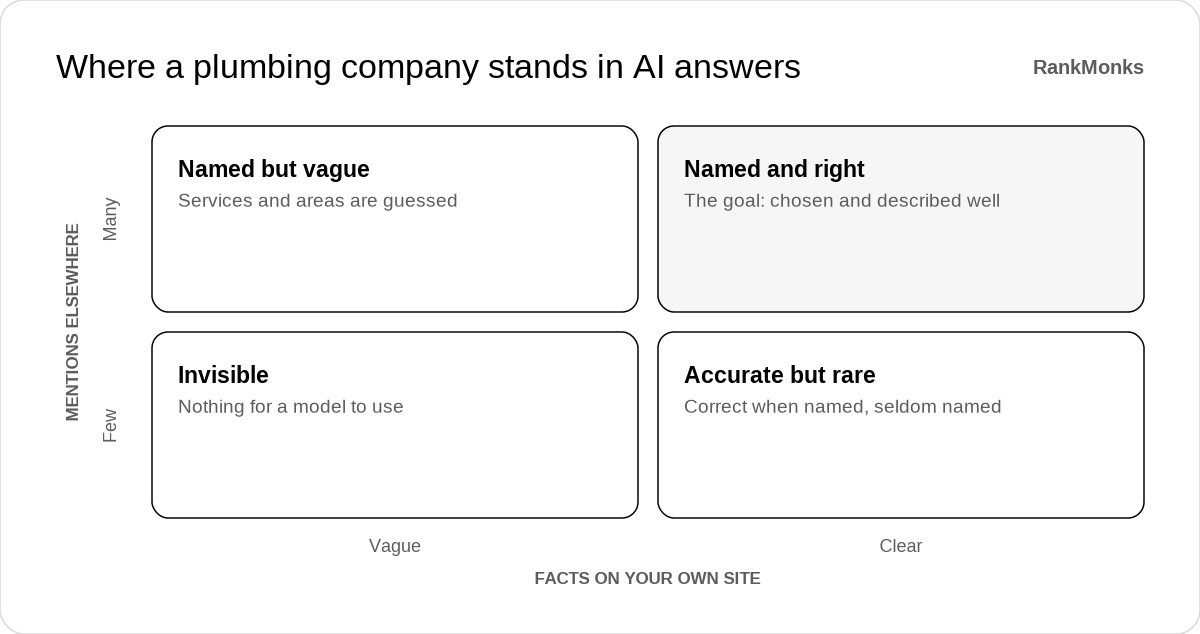
- Invisible. Vague facts and few mentions. Start with listings and service pages.
- Accurate but rare. Clear facts but little reputation. Focus on reviews and local mentions.
- Named but vague. Plenty of mentions but unclear facts, so AI tools guess your services or areas. Fix your own pages.
- Named and described correctly. The goal. Keep facts current and measure monthly.
A two-van plumbing company covering three suburbs might find it is named for its home town but never for the other two, because its profile lists only one town and its site has no page for the others. Adding area pages and updating the service area is a small job that can widen where the company appears.
How do you measure GEO for a plumbing company?
Measure GEO for a plumbing company by running the same homeowner questions, by job and by town, in the same AI tools each month. Record whether you are named, whether your details are right and who appears instead, then compare with your call volume.
- Share of answers for each service and each town.
- Accuracy of hours, emergency policy and service area.
- Reason given, such as "upfront pricing" or "fast response".
- Sources cited, which show where the answer came from.
- Calls and bookings, with "AI assistant" added as an option when you ask how customers found you.
For a fuller method, see our guide to AI visibility.
What warning signs should a plumbing company watch for?
Watch for agencies that promise guaranteed placement, cut corners on reviews, or flood your site with copied area pages.
- "We'll make ChatGPT recommend you." No one controls what an AI tool writes.
- Fake or incentivized reviews. They break platform rules and consumer protection law, and a profile suspension would remove one of your most important sources.
- Hundreds of copied town pages. Pages that only swap the town name add nothing for homeowners or AI tools, and search engines treat them as low quality.
- Claims you cannot back up. If an agency writes "24/7 emergency service" or "lowest prices in town" without checking, AI tools will repeat it to customers.
- No measurement plan. If they cannot say which questions they will track, they cannot show you progress.
What should a plumbing company ask a GEO agency?
Ask questions that show how the agency will handle your service area, your listings and your measurement.
- Which homeowner questions will you track, and for which towns?
- What do AI tools say about my company today?
- Which listings and directories will you keep consistent?
- How will you build area pages without copying them?
- How will you increase reviews within the platforms' rules?
- How will you connect AI visibility to calls?
How does GEO fit with SEO, AEO and AI visibility for plumbers?
GEO is one of four connected pieces, and for a plumbing company they share almost all their inputs. Accurate listings, clear service pages and steady reviews help all four.
- SEO for small plumbing companies gets you into the map pack and ordinary results for searches such as "emergency plumber near me".
- AEO for small plumbing companies makes your answers easy for voice assistants, AI Overviews and featured snippets to lift.
- AI visibility for small plumbing companies tracks what AI tools say about you and flags wrong hours or service areas.
For how GEO works across every industry, see the best GEO agency for small businesses.
How does RankMonks approach GEO for small plumbing companies?
RankMonks starts by asking AI tools the questions homeowners in your area ask and showing you the answers, then fixes the causes in order of what they cost you. You receive a written audit covering SEO, AEO and GEO, with every problem ranked.
We fix the foundations first, such as listings, service areas, service pages and crawl access, then build content and mentions in small steady releases. Each month we run the same prompts across ChatGPT, Claude, Perplexity, Gemini, Grok, Google AI Overviews and AI Mode, and report share of answers, accuracy and what changed in plain language.
We take on a small number of clients at a time, the person who plans the work does it, and we do not promise a place in any AI answer.
Frequently asked questions
Will an AI assistant send emergency jobs to my plumbing company?
It can, if the assistant knows you offer emergency service in the homeowner's area and finds good reasons to recommend you. State your emergency policy and hours clearly and identically everywhere, and build reviews that mention fast response. No one can guarantee it, but clear facts make it far more likely.
Do Local Services Ads help my plumbing company in AI answers?
Local Services Ads are paid placements in Google Search, and there is no documented link between running them and being named by tools such as ChatGPT or Perplexity. The reviews and accurate business details you build along the way can help, because those are inputs AI tools read.
Should a plumber who works from home hide their address?
Yes. If customers do not visit your premises, hide the address on your business profile and set a service area instead. Keep the same business name and phone number everywhere so AI tools and search engines can still connect your listings.
How long does GEO take for a plumbing company?
Fixes to listings, hours and service areas can show in AI answers within weeks, especially in tools that search the web. Building reviews and local mentions usually takes several months. Run the same questions monthly so you can see the trend rather than a single result.
For plumbing companies, GEO is careful work on facts and reputation, planned and reported as part of our SEO service. If you want to know what AI tools tell homeowners about your company today, start a conversation.
Written by RankMonks.