
AI Visibility Tracking9 min read
Best AI Visibility Agency for Small Restaurants
Published · RankMonks
The best AI visibility agency for a small restaurant is one that checks what ChatGPT, Gemini, Perplexity and Google's AI answers tell diners about you, and then helps you fix what is missing or wrong. It tracks whether you are named for the dishes, neighborhoods and occasions you are good at, and whether the answers get your hours, menu and booking details right.
That second part matters as much as the first. A diner who asks an assistant "where can we get good ramen near the stadium that's open after 10" will act on the answer. If it leaves you out, or says you close at 9, the table goes to someone else. This guide is part of our wider guide to the best AI visibility agency for small businesses, and it covers what tracking should look like for a restaurant in particular.
Key takeaways
- Diners ask AI tools for restaurants by dish, neighborhood, occasion and dietary need, so the prompt set should be built around those questions, not around your name.
- Accuracy is the first job: hours, holiday closures, menus, prices, dietary options and booking links go wrong often and cost covers directly.
- Wrong answers usually trace back to a source, such as an old listing, a PDF menu that cannot be read or a third-party page with a stale menu.
- A useful monthly report shows share of answers against nearby rivals, errors found and fixed, the sources cited and a short list of actions.
- Be wary of any agency that guarantees a spot in ChatGPT, offers to post reviews or shows a single screenshot as proof.
How do diners use AI tools to choose a restaurant?
Diners use AI tools to build a shortlist, then to check the practical details before they go. A typical conversation starts broad, such as "a good place for brunch in the Mission with outdoor seating", and narrows quickly: is it open Sunday, do they take reservations, is there anything vegan on the menu?
The answer names a few places and describes each one in a sentence or two. Where those descriptions come from varies by tool, but the usual sources include:
- Business listings, such as your Google Business Profile, Apple Maps and Yelp.
- Review sites and the themes that come up in reviews.
- Local news, food writers and "best of" lists.
- Reservation and delivery platforms.
- Your own website, if the tool can read it.
- Forums and community threads, such as Reddit.
Tracking shows which of these sources the answers draw on, which is where the fixes start.
What should an AI visibility agency track for a restaurant?
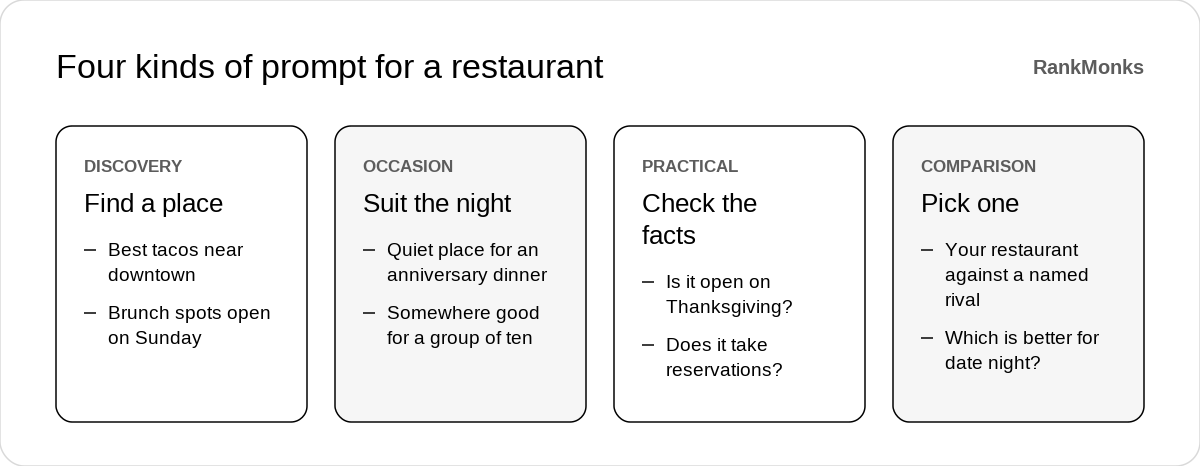
An AI visibility agency should track the questions that bring diners through the door, grouped by the reason they are asking. Prompts that only use your restaurant's name show what the tools know about you, but not whether they would ever suggest you.
| Prompt group | Example | What it shows |
|---|---|---|
| Discovery | "Best tacos near downtown Austin" | Whether you are suggested for what you are known for |
| Occasion | "Quiet restaurant for an anniversary dinner in Midtown" | Whether the tools understand the experience you offer |
| Dietary | "Restaurants with gluten-free pasta near me" | Whether your dietary options are known and stated correctly |
| Practical | "Is [your restaurant] open on Thanksgiving?" | Whether the facts about you are right |
| Comparison | "[Your restaurant] or [rival] for a birthday dinner?" | How you are described against a named competitor |
For a family-run taqueria with one location, a starting set might be 30 to 40 questions: a dozen discovery questions for its main dishes and neighborhood, a handful of occasion and dietary questions, and a set of practical checks on hours, ordering and parking.
The set should stay fixed from month to month, so that a change in the results means something. Our guide to building an AI visibility prompt set explains how to word the questions and how many to start with.
Which restaurant facts do AI answers get wrong?
AI answers most often get a restaurant's hours, open or closed status, menu, prices, dietary options and booking details wrong.
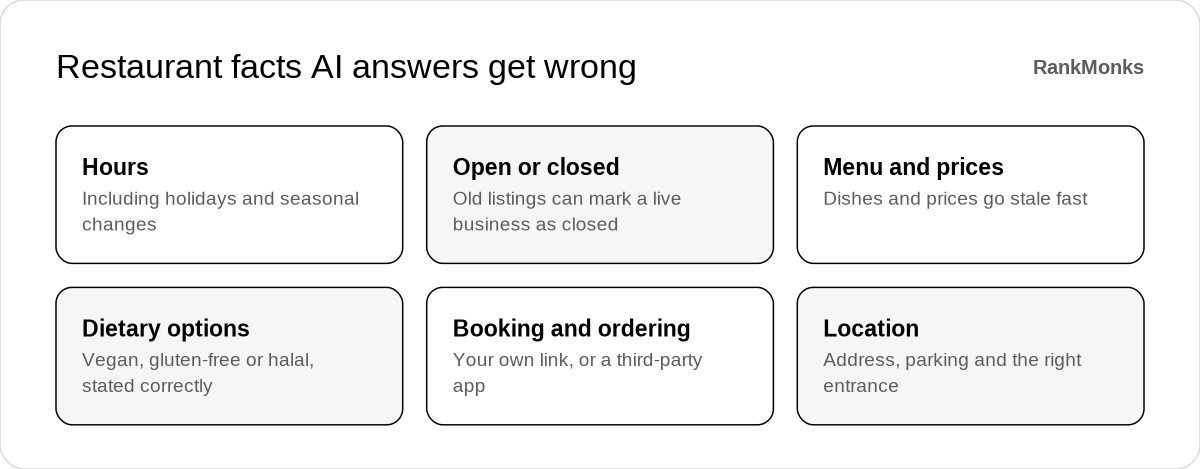
The errors usually come from somewhere specific:
- Stale listings. Holiday hours that were never updated, or a listing for an old location that still shows as active, or a current location wrongly marked as closed.
- Menus the tools cannot read. A menu published only as a PDF or a photo is hard for many tools to use, so they fall back on older or third-party versions.
- Third-party pages. Delivery and reservation platforms may show an old menu, old prices or a different set of hours.
- Old reviews and articles. A review that praises a dish you stopped serving two years ago can keep that dish attached to your name.
A good agency traces each error to its source and fixes it there. That usually means correcting your Google Business Profile, Apple Business Connect and Yelp listings, publishing the menu as plain text on your own site, adding Restaurant structured data with your hours and cuisine, and updating the third-party profiles you control. Our guide to schema markup covers the structured data, and our guide on how to fix wrong information about your brand in AI answers covers the tracing.
One practical habit helps a great deal: check the answers a week or two before the busy dates. Thanksgiving, Valentine's Day and Mother's Day are when wrong hours cost the most.
What should a restaurant's AI visibility report show?
A restaurant's AI visibility report should show, on one page, how often you are named, what was wrong, what was fixed, which sources the answers used and what to do next. If the owner cannot read it between lunch and dinner service, it is too long.
A useful monthly report includes:
- Share of answers by group. How often you are named in discovery, occasion and dietary questions, next to the two or three nearby restaurants you compete with most.
- Accuracy log. Every wrong fact found, where it came from, and whether it is fixed or still open.
- Sources cited. The pages and listings the answers drew on, such as a local food writer's list you are not on, or a delivery page with an old menu.
- Changes since last month. What moved, and the likely reason.
- Actions. Three to five specific fixes, in order.
Read the share figures as a trend, since AI answers vary between runs. Our guide to AI share of voice explains how the figure is calculated.
What warning signs should a restaurant owner watch for?
The biggest warning sign is a guarantee. No agency can promise that ChatGPT or Google's AI Overviews will recommend your restaurant, because no agency controls what those tools say.
Watch for these as well:
- A single screenshot as proof. One answer is an anecdote. Ask how many times each question is run.
- Offers to write or buy reviews. Fake reviews break the rules of the major review platforms and can lead to penalties or removed reviews.
- Name-only tracking. If every prompt includes your restaurant's name, the report cannot tell you whether you are ever suggested to new diners.
- No accuracy checks. Counting mentions without checking the facts misses the errors that cost you most.
- No actions. A report that ends with a chart and no next step will not change anything.
What should you ask an agency before you hire it?
Ask how the agency measures, what it reports and who fixes the problems it finds. Good answers will be short and specific.
- Which questions will you track, and can I see and edit the list?
- Which AI tools will you check, and how often?
- How do you check the accuracy of hours, menus and booking details?
- How do you find the source of a wrong answer?
- What will the monthly report look like?
- Who makes the fixes: you, us, or both?
Many of the questions in our guide on how to choose an SEO agency apply here too, particularly on contracts and reporting.
How does AI visibility fit with SEO, AEO and GEO for a restaurant?
AI visibility tracking measures what diners are told, while SEO, AEO and GEO change what the tools have to work with. A restaurant usually needs some of all four, in proportion to where the gaps are.
- SEO gets your website and Google Business Profile found for searches such as "pizza near me". Our guide to the best SEO agency for small restaurants covers that work.
- AEO shapes your pages so the answer is easy to lift into AI Overviews, featured snippets and voice answers, such as "does this restaurant take reservations?". See the best AEO agency for small restaurants.
- GEO works on the sources the tools trust, such as review sites, local press and best-of lists. See the best GEO agency for small restaurants.
Tracking tells you which of these to do first. If the facts are wrong, start with listings and your own site. If the facts are right but you are rarely named, the gap is usually in the sources, which is GEO and press work. The best AI visibility agency for small businesses guide explains how the four fit together for any small business.
How does RankMonks approach AI visibility for small restaurants?
RankMonks tracks a fixed set of diner questions across ChatGPT, Claude, Perplexity, Gemini, Grok and Google's AI Overviews and AI Mode, and turns each monthly report into a short list of fixes. We take on a small number of clients at a time, and the person who plans your tracking does the work.
We start by agreeing the prompts with you, so they sound like your diners rather than like a keyword tool. Then we take a baseline of where you and nearby rivals stand before anything changes, and run the same prompts on a schedule. Each report covers share of answers, wrong facts and the sources behind them, and ends with actions: listings to correct, pages to fix and sources to get onto. Because we also work on SEO, AEO and GEO, those actions can be carried out rather than left in a document.
We do not promise a place in any AI answer, and we tell you what is realistic before you sign anything.
Frequently asked questions
Does a small restaurant really need AI visibility tracking?
Not every restaurant needs a monthly program, but every restaurant benefits from at least one check. Ask the main AI tools about your hours, menu and booking details and see whether the answers are right. If they are wrong, or you are missing from questions about your own neighborhood, regular tracking is worth considering.
Why does ChatGPT show the wrong hours for my restaurant?
It is usually repeating an out-of-date source, such as an old listing, a third-party page or an article written before your hours changed. Find which sources the answer draws on, correct the ones you control, and publish your current hours as text on your own website. Then check again after a few weeks.
Can I check my restaurant's AI visibility myself?
Yes. Write 20 to 30 questions diners would ask, run them in two or three AI tools, and record whether you are named and whether the details are right. Repeat the same questions each month. An agency adds scale, more tools, source analysis and the fixing work, but the method is the same.
Will updating my Google Business Profile change what AI tools say?
It often helps, because many AI tools draw on business listings and search results when they answer local questions. It will not fix everything, since answers also draw on reviews, articles and other listings. Keep every listing you control consistent and check the answers again after the change.
Diners trust the answer they are given, so it is worth knowing what that answer says. That is the work of our AI visibility tracking service. If you want to see what AI tools tell diners about your restaurant, start a conversation.
Written by RankMonks.