
AI Visibility Tracking9 min read
How AI Visibility Tracking Improves SEO, AEO and GEO for US Trucking Companies
Published · RankMonks
AI visibility tracking improves SEO, AEO and GEO for a US trucking company by turning guesses into a list of specific problems. When you know which shipper and driver questions leave you out, which facts the answers get wrong and which pages and sources the answers are built from, you know which page to build, which question to answer and which source to get onto. Without tracking, those three disciplines work from keyword tools and assumptions.
This guide shows how tracking findings feed each discipline for a carrier, how to rank the fixes, how to tell whether they worked and what to watch for. It is part of our complete guide to AI visibility for US trucking companies.
Key takeaways
- Tracking shows the questions, facts and sources behind AI answers, which tells SEO, AEO and GEO where to work.
- Missing or weak pages found through tracking become SEO work, such as lane, equipment, terminal and careers pages.
- Questions that recur in answers become AEO work: clear, direct answers on your own pages.
- The outside sources that answers cite become GEO work: directories, associations, review sites, trade press and forums.
- Rank fixes by the value of the prompt and the effort to fix, and confirm each one by running the same prompts again.
How does AI visibility tracking connect to SEO, AEO and GEO?
AI visibility tracking connects to the other three disciplines by measuring their combined result and showing which of them is responsible for each gap. SEO, AEO and GEO change what AI tools read about your carrier. Tracking shows what the tools actually say.
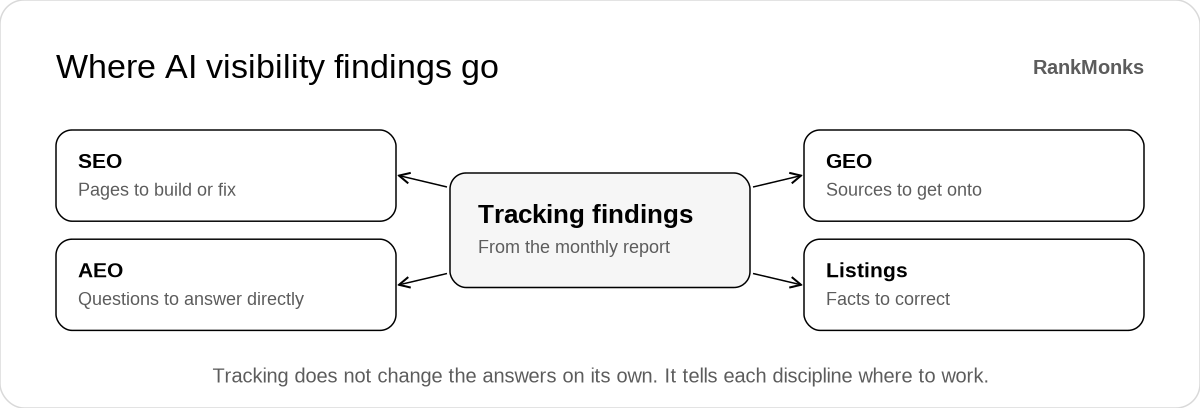
The connection runs through three things that every good tracking report records:
- The questions. Which shipper, broker and driver prompts name you, and which do not.
- The facts. What each answer says about you, and whether it is right.
- The sources. Which pages, listings and outside sites each answer cites.
Each of these points to a different discipline. A missing page is an SEO problem. A question you never answer directly is an AEO problem. A source that names competitors but not you is a GEO problem. A wrong fact may be any of the three, depending on where it comes from. Our guide to GEO vs SEO vs AEO sets out the differences in general terms.
How do tracking findings improve SEO for a carrier?
Tracking findings improve SEO by showing which pages AI tools look for and do not find on your site, and which of your pages they read and cite. That turns a long list of possible pages into a short list of the ones that matter.
Typical findings and what they mean for SEO:
- Answers cite a competitor's lane page for a lane you run. You need a page for that lane, with equipment, transit expectations and how to request a quote.
- Answers about your equipment cite an old directory, not your site. Your equipment pages are missing, thin or hard for crawlers to read.
- Driver answers cite job boards with old pay figures. Your careers pages need one clear page per driver role, with current pay structure, home time and equipment, and job posting structured data.
- Your pages are never cited, even when you are named. Check that the pages are indexed, load without scripts and rank for the related searches, because many AI tools read pages that search engines can find.
The complete SEO plan for carriers is in our guide to SEO for US trucking companies. The reverse relationship, how good SEO raises AI visibility, is covered in how good SEO boosts AI visibility for US trucking companies.
How do tracking findings improve AEO for a carrier?
Tracking findings improve AEO by showing which questions come up again and again in AI answers about your market, and whether your pages answer them in a form that is easy to lift. AEO then writes those answers.
Recurring questions in trucking often look like these:
- "Is [your company] an asset-based carrier or a broker?"
- "What is the difference between dedicated and over-the-road routes?"
- "Does [your company] haul hazmat?"
- "How does [your company] pay drivers, and how often are they home?"
- "What areas does [your company]'s Memphis terminal serve?"
If answers to these are vague, wrong or taken from someone else's site, add a short, direct answer on the relevant page: one or two plain sentences at the top of a section, followed by the detail. The same answers help with featured snippets and Google's AI Overviews, as our guides to featured snippets and AI Overviews explain. The full AEO approach for carriers is in AEO for US trucking companies, and how good AEO boosts AI visibility for US trucking companies covers the effect in the other direction.
How do tracking findings improve GEO for a carrier?
Tracking findings improve GEO by showing which outside sources AI tools rely on when they name carriers in your market, and which of those sources mention you. GEO then works on getting onto, or correcting, the sources that matter.
For US carriers, the sources that appear in answers often include:
- Industry directories and carrier lists.
- Trucking associations, including state trucking associations.
- Review and job sites where drivers discuss fleets.
- Trade press and local business news.
- Forums and Reddit threads where drivers and shippers trade recommendations.
- Public carrier records.
If the same two or three sources appear behind most answers for your lanes, those are the places to be listed accurately, mentioned or covered. Our guide to AI source analysis explains how to read this data, and digital PR covers how coverage is earned. The full GEO plan for carriers is in GEO for US trucking companies, and how good GEO boosts AI visibility for US trucking companies shows the effect on answers.
What does a finding look like once it is turned into work?
Each finding should become one specific task with a discipline, an owner and a way to check it. The table shows how common carrier findings translate.
| Finding | What it means | Where the fix goes | Example task |
|---|---|---|---|
| Not named for "reefer carriers Southern California to Texas" | No page or source ties you to that lane | SEO | Build a lane page for California to Texas reefer freight |
| Described as a freight broker | A source or your own site blurs carrier and brokerage | SEO and GEO | State carrier type on the home and about pages, correct directory entries |
| Old pay figures in driver answers | Job boards and old posts outrank your careers pages | SEO and AEO | One page per driver role, with current pay structure and job posting markup |
| "Does [company] haul hazmat?" answered vaguely | No direct answer anywhere | AEO | Add a short, direct hazmat answer to the services page |
| A competitor named in every Atlanta answer | It appears on sources you are missing from | GEO | Get listed on the directories and associations cited for Atlanta |
| Closed Memphis terminal still named | An old listing is still live | Listings | Close the old listing and update the location page |
Which tracking findings should you fix first?
Fix first the findings that affect valuable prompts and are cheap to fix, such as wrong facts on listings and pages. Plan the expensive ones, such as new lane pages or earning coverage, and leave low-value, high-effort work until something changes.
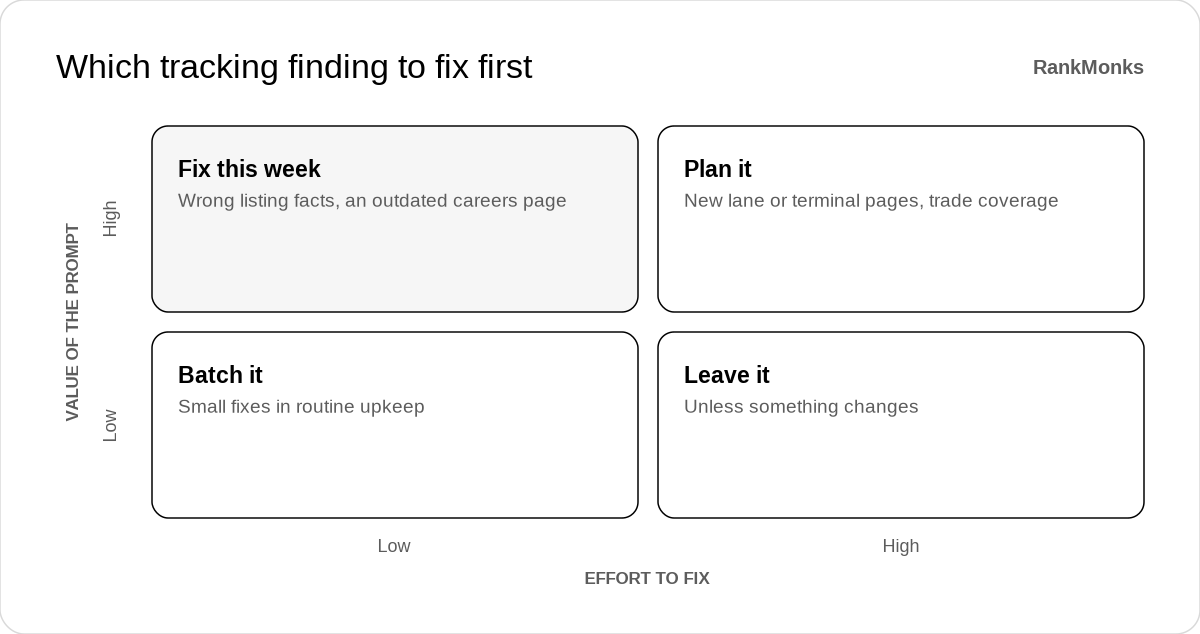
In practice, the order for most carriers is:
- Wrong facts about carrier type, equipment, locations and hiring, because they cost loads and applicants directly and are usually quick to fix at the source.
- Missing answers on pages you already have, such as a direct line on hazmat or home time.
- Missing pages for high-value lanes, equipment types and terminals.
- Missing sources, which take the longest because they depend on other people.
How do you know the changes worked?
You know a change worked when the same prompt, run in the same tool under the same conditions, gives a better answer in a later cycle, and when the business numbers you care about move in the same direction. Tracking is only fair if the method stays fixed.
- Rerun the same prompts. Compare with the baseline and with the previous month, not with a one-off check.
- Look at the sources. If an answer now cites your new lane page, the SEO work reached the answer.
- Check accuracy. A corrected fact should stop appearing in the wrong form.
- Watch the business signals. Quote requests from new shippers, driver applications by terminal and the answers to "how did you hear about us?" on forms. Our guide to SEO reporting covers how to report these alongside search data.
Some tools update quickly and others slowly, so judge over several cycles rather than one.
What warning signs suggest tracking is not feeding the work?
The main warning sign is a monthly report that nobody turns into tasks. Tracking that does not change SEO, AEO or GEO work is a cost with no return.
- Reports end with charts but no actions.
- Actions have no owner or no date.
- The same wrong fact appears month after month.
- The prompt set keeps changing, so no trend can be read.
- SEO, content and outreach plans are made without looking at the tracking results.
What should you ask an agency about using tracking to steer SEO, AEO and GEO?
Ask whether it connects each finding to a fix, and whether it can carry out those fixes or only report them.
- How do you decide whether a finding is an SEO, AEO or GEO problem?
- Do you record the sources cited in each answer?
- How do you rank fixes?
- Who carries out the fixes, and how are they checked?
- How will we see whether a fix changed the answers?
How does RankMonks use tracking to improve SEO, AEO and GEO for US trucking companies?
RankMonks treats tracking as the measurement layer for one practice rather than a separate report. We run a fixed set of shipper and driver prompts across ChatGPT, Claude, Perplexity, Gemini, Grok, Google AI Overviews and AI Mode, record the sources behind each answer and end every monthly report with actions: pages to fix, sources to get onto and claims to correct.
Because we work on SEO, AEO and GEO as well, those actions go straight into the work, ranked by what each problem costs you. The person who reads your answers is the person who plans the fixes. We do not promise placements in any AI tool, and we tell you what is realistic before you start. For the setup itself, see how to implement AI visibility tracking properly for US trucking companies, and for local answers, how US trucking companies win on local maps with AI visibility tracking. Carriers with Canadian operations can read how AI visibility tracking improves SEO, AEO and GEO for Canadian trucking companies. The full picture is in our guide to AI visibility for US trucking companies.
Frequently asked questions
Do we need AI visibility tracking if we already do SEO?
Tracking makes SEO more effective rather than replacing it. Rankings show where your pages appear in search, but not whether AI tools name you or describe you correctly. Tracking shows which pages and sources AI answers rely on, which helps you choose which SEO work to do next.
What is the difference between AI visibility tracking and GEO?
GEO is the work of changing what AI tools read about you, mainly through outside sources and clear facts. AI visibility tracking is the measurement of what the tools actually say. GEO without tracking works blind, and tracking without GEO and SEO only describes the problem.
How often should tracking findings be turned into tasks?
Every cycle. Most carriers run tracking monthly, so each monthly report should end with a short list of tasks, each with an owner and a date. A quarterly review can then look at the bigger items, such as new pages or outreach.
Can tracking show which SEO pages are worth building?
Yes, that is one of its most practical uses. If AI answers for a lane, equipment type or terminal keep citing competitors' pages and never yours, a page for that topic is likely worth building. The next tracking cycle then shows whether the new page is being read and cited.
Tracking is most useful when it decides what the rest of the work should be. Running the prompts, reading the sources and turning findings into SEO, AEO and GEO tasks is what our AI visibility tracking service does every month. If you want to see what that would look like for your carrier, start a conversation.
Written by RankMonks.