
AEO8 min read
How Good AEO Boosts AI Visibility for US Trucking Companies
Published · RankMonks
Good AEO boosts AI visibility for US trucking companies because AI tools build their answers from short, specific passages they can find and trust, and that is exactly what answer engine optimization produces. When a carrier states what it hauls, where it runs, how to verify its authority and how drivers apply, plainly and the same way everywhere, ChatGPT, Perplexity, Gemini and Google AI Mode have something safe to repeat.
The reverse is also true. A carrier whose site says "reliable solutions nationwide" and whose listings disagree with its FMCSA records gives AI tools nothing to quote and several things to get wrong. This guide explains how the two connect, which AEO work helps most and how to measure the effect. It is part of our guide to AEO for US trucking companies.
Key takeaways
- AI tools that search the web pull short passages from pages, so answer-first writing makes your facts easier to retrieve and quote.
- Specific claims, such as equipment, states, lanes and USDOT number, are more likely to be repeated than general marketing language.
- Consistent facts across your site, listings and FMCSA records reduce the chance of an AI tool describing you wrongly.
- AEO improves how AI tools read your own pages, while GEO works on what other sites say about you, so the two work together.
- Measure the effect with a fixed set of prompts, run before and after the work, rather than with a single test.
What is AI visibility for a trucking company?
AI visibility is how often, and how accurately, AI tools name a trucking company when shippers, brokers and drivers ask them questions. It covers being named, being cited as a source and being described correctly.
For a carrier, the questions might be "which carriers run flatbed from Houston to Oklahoma City?", "is [carrier] an asset-based carrier or a broker?" or "regional trucking companies in Georgia that hire drivers with six months of experience". Our guide to AI visibility for US trucking companies explains how to track it in full.
How does a clear answer reach an AI tool?
A clear answer reaches an AI tool in a series of steps, and AEO improves the first three of them.
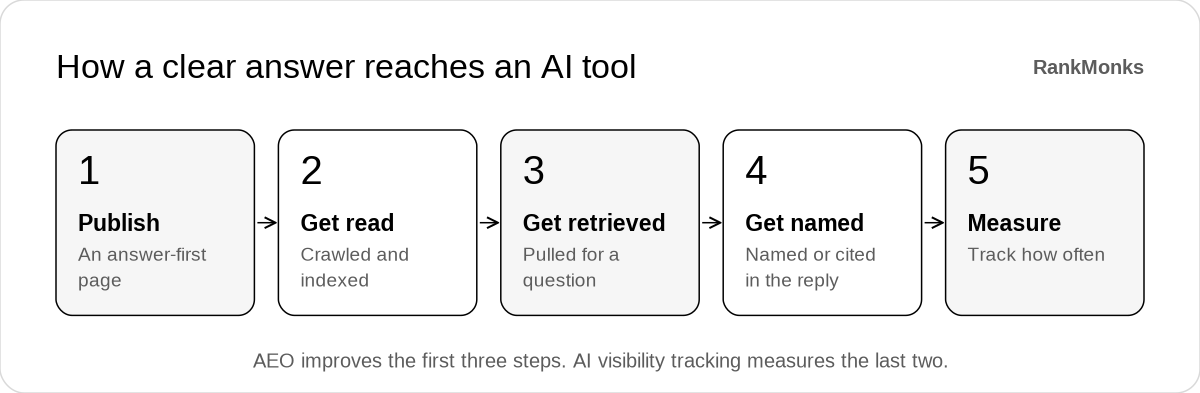
- Publish. The carrier writes a page that answers a question directly.
- Get read. Search engines and AI crawlers fetch and index the page. If your site blocks the crawlers that AI tools use to search, they cannot read it. Our guide to AI crawlers and llms.txt explains how to check.
- Get retrieved. When someone asks a related question, a tool that searches the web finds candidate pages and pulls out the passages that seem to answer it.
- Get named. The tool writes its reply and names or cites the sources it relied on.
- Measure. The carrier checks how often this happens for its key questions.
Google's AI Overviews and AI Mode draw on pages in Google's index, so pages that already rank and answer clearly start ahead. Our guide to Google AI Overviews covers how sources are chosen. Other tools use their own search methods, but they reward the same qualities: a page that can be found, and a passage that answers the question on its own.
Why do AI tools prefer answer-first pages?
AI tools prefer answer-first pages because a passage that states one fact plainly can be lifted into an answer without being misread. A page that buries facts in slogans, images or long paragraphs is harder to use safely.
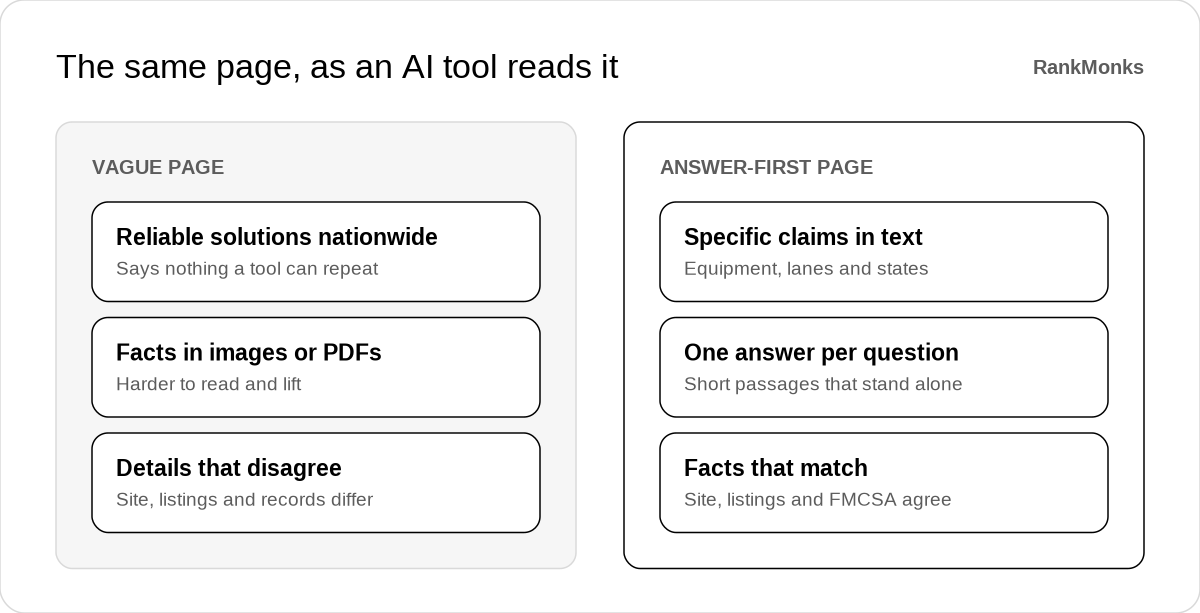
Three qualities make the difference.
Self-contained passages. A paragraph that begins "Yes, we haul hazmat in dry vans across the Southeast, with drivers who hold hazmat endorsements" makes sense on its own. A paragraph that begins "As mentioned above" does not.
Specific claims. "Reefer and dry van, mainly California to Texas on I-10" can be repeated. "Coast-to-coast solutions" cannot, so a tool looking for a reefer carrier on that lane has no reason to pick you.
Consistent facts. When your site, Google Business Profile and FMCSA registration all show the same legal name, address and USDOT number, a tool can be confident it has the right company. Trucking has many similar company names, and inconsistent details make it easier for an assistant to mix you up with another carrier, or to describe you as a broker if you hold both kinds of authority and do not say clearly which services are which.
Which AEO work does the most for AI visibility?
The AEO work that does most for AI visibility is the work that makes your facts clear, specific and consistent. Not every AEO task has the same effect.
| AEO work | Effect on AI answers |
|---|---|
| Answering each shipper question in the first lines of the right page | Gives AI tools a passage to quote when shippers ask about your freight and lanes |
| Stating equipment, states, lanes and limits in text | Lets tools match you to specific questions rather than generic ones |
| A safety and compliance page with your USDOT number and authority | Helps tools identify the right company and answer broker questions about you |
| Clear careers pages, one per driver role, with honest pay structure | Gives tools accurate material for driver questions about pay and home time |
| Organization, LocalBusiness and JobPosting markup | Restates key facts in a form machines read reliably |
| Consistent listings on Google, Apple Maps and Bing | Reduces wrong hours, phones and addresses in local AI answers |
| Moving facts out of PDFs and images into page text | Makes them easier for crawlers and tools to read |
The first three are usually where a carrier gains most.
Where does AEO stop and GEO begin?
AEO shapes what your own pages and listings say. GEO works on what the rest of the web says about you: review sites, directories, industry associations, trade press, shipper and driver forums. AI tools weigh both when they decide which carriers to recommend.
A carrier with excellent answer pages but no mentions elsewhere may be cited for its own facts yet rarely recommended by name. A carrier with plenty of mentions but vague pages may be recommended but described wrongly. The two work best together. Our guide on how good GEO boosts AI visibility for US trucking companies covers the outside sources, and how good SEO boosts AI visibility covers the ranking foundation underneath both.
How do you measure the effect of AEO on AI visibility?
Measure it with a fixed list of prompts, run across the main AI tools before the work starts and on a schedule afterwards. A single test proves little, because AI answers vary from one run to the next.
- Write 30 to 50 prompts that shippers, brokers and drivers would really ask. Our guide to building an AI visibility prompt set shows how.
- Take a baseline. Run each prompt several times in ChatGPT, Perplexity, Gemini, Claude and Google AI Mode, and record whether you are named, whether your pages are cited and whether the description is right.
- Do the AEO work on the pages that relate to those prompts.
- Run the prompts again monthly, with the same method.
- Compare. Look for more mentions, more citations of your pages and fewer wrong descriptions.
Our guide to implementing AI visibility tracking properly for US trucking companies sets out the full process.
What warning signs suggest AI tools are reading you wrongly?
- An AI tool describes your company as a broker when you are an asset-based carrier, or the other way round.
- It names equipment you sold years ago, or a terminal you closed.
- It quotes driver pay or home time that you no longer offer.
- It cites a directory or job board for your facts instead of your own site.
- It confuses you with another carrier that has a similar name.
Each of these usually traces back to a page, a listing or an outside source that says the wrong thing. Fix the source, then check again.
What should you ask an agency about AEO and AI visibility?
- How will you decide which questions matter for AI tools as well as for Google?
- Which of our pages would you rewrite first to help AI answers?
- How will you keep our site, listings and FMCSA details consistent?
- How will you measure AI mentions and citations before and after?
- What will you do if an AI tool keeps describing us wrongly?
How does RankMonks approach AEO and AI visibility for US trucking companies?
We treat AEO and AI visibility as one job. We start by reading your site, listings and analytics, and by asking the main AI tools the questions your shippers, brokers and drivers ask. That gives a baseline before anything changes.
You get a written audit covering SEO, AEO and GEO, with problems ranked by what they cost you. We fix the foundations, rewrite pages answer-first and publish in small, steady releases, with the person who plans the work doing it. AI citations can shift faster or slower depending on the model, and we do not promise any placement. Each month you get a plain-language report on rankings, traffic, citations and share of AI answers, with what we did and what comes next.
What should you read next?
If you have not yet set up the AEO work itself, start with how to implement AEO properly for US trucking companies. For terminals and voice answers, read how US trucking companies win on local maps with AEO. If you also run lanes into Canada, see how good AEO boosts AI visibility for Canadian trucking companies. And for the full practice, our guide to AEO for US trucking companies ties it together.
Frequently asked questions
Does AEO help with ChatGPT, or only with Google?
It helps with both. Google's AI Overviews and AI Mode draw on pages in Google's index, and tools like ChatGPT and Perplexity search the web and pull passages from pages too. Clear, specific answers are easier for all of them to find and quote.
Can a small carrier appear in AI answers next to large fleets?
Yes, especially for specific questions. A tool answering a question about a particular lane, freight type or region looks for a passage that answers it, and a small carrier that states those facts plainly can be the best match.
How long before AEO changes what AI tools say about us?
It varies by tool. Tools that search the web can pick up rewritten pages once they are recrawled, which can take weeks. Answers that rely on a model's training data change more slowly. Track a fixed set of prompts each month to see the trend.
What if an AI tool says something wrong about our company?
Find where the wrong fact comes from, which is often an old page, a listing or an outside directory, and correct it there. Then state the right fact clearly on your own site and check again. Our guide to fixing wrong AI answers about your brand covers the process in more detail.
Clear answers are the cheapest way to be described correctly by AI tools. That is how our SEO service approaches AEO for carriers. If you want to know what AI tools say about your fleet today, start a conversation.
Written by RankMonks.