
AI Visibility Tracking9 min read
How AI Visibility Tracking Improves SEO, AEO and GEO for Canadian Trucking Companies
Published · RankMonks
AI visibility tracking improves SEO, AEO and GEO for Canadian trucking companies by replacing guesswork with a list of specific problems. It shows which questions from shippers, brokers and drivers you lose, which pages and sources the AI answers lean on, and which facts about your carrier are wrong. Each of those findings points at a piece of SEO, AEO or GEO work, and the next tracking cycle shows whether it worked.
This guide explains how tracking findings become work in each discipline, how to decide what to do first, and how to tell whether the changes paid off. It is part of our guide to AI visibility for Canadian trucking companies.
Key takeaways
- Tracking findings fall into three kinds of work: pages and technical fixes (SEO), clearer answers and structured data (AEO), and outside sources and listings (GEO).
- Canadian findings often point to gaps that general SEO plans miss, such as French pages, cross-border details and province-specific terminal pages.
- Source analysis shows which trade publications, association listings and directories shape answers about your lanes, which tells GEO work where to aim.
- Prioritize findings by business value and effort, starting with wrong facts and high-value lanes.
- Rerun the same prompts after each change and compare segment by segment to see what worked.
How does tracking turn into work?
Tracking turns into work when every finding in a report is tied to a cause and a fix. A finding on its own, such as "we are missing from cross-border reefer answers", is a fact. A finding with a cause, such as "the answers cite three directories we are not listed in and we have no cross-border reefer page", is a job.
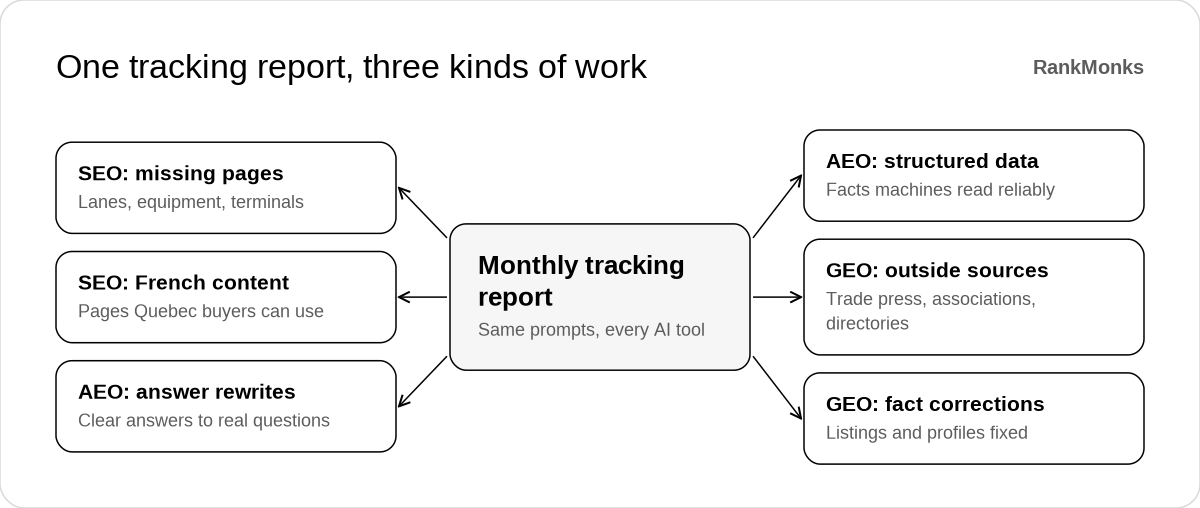
Each monthly report should sort its findings into the three disciplines, because each one is fixed by different people with different tools. Your web developer fixes pages and structured data. Whoever writes your content rewrites answers. Your owner, sales lead or an outside partner works on listings, associations and press.
| Finding from tracking | Likely cause | Discipline | Example fix |
|---|---|---|---|
| Missing from "Toronto to Chicago reefer" answers | No lane page; competitors' lane pages cited | SEO | Build a lane page with equipment, transit and border details |
| Answer quotes a competitor's definition of PARS | Your page explains it badly or not at all | AEO | Add a clear, short answer near the top of your customs page |
| Named in English answers but not French ones | No French pages, no French listings | SEO and GEO | Publish French versions and correct French listings |
| Described as "US-based" | Directory entries list a US mailing address | GEO | Correct the directory entries and your business profiles |
| Not named for Alberta flatbed prompts | Answers cite association member lists you are not on | GEO | Join or update the relevant member listings |
| Driver answers give the wrong licence class | Old job posts still live on job boards | GEO | Close old posts and update current ones |
How do tracking findings improve SEO?
Tracking findings improve SEO by showing which pages are missing, which pages exist but are not being read, and which technical problems keep AI tools and search engines from using your site. Many AI tools search the web before they answer, and they lean on pages that search engines can find and read.
Typical SEO work from Canadian tracking reports:
- Missing lane and equipment pages. If answers for your best lanes cite competitors' lane pages and you have none, that is the gap.
- Terminal pages by province. A single contact page for terminals in Ontario, Alberta and BC gives nothing to cite for local questions.
- French versions. If French answers leave you out, French pages with proper hreflang tags for en-CA and fr-CA are usually part of the fix.
- Crawl access. If your pages are never cited, check that AI crawlers are not blocked and that key content does not depend on scripts to load. Our guide to AI crawlers and llms.txt covers the settings.
The full SEO program for a Canadian carrier, from site structure to technical basics, is in our guide to SEO for Canadian trucking companies.
How do tracking findings improve AEO?
Tracking findings improve AEO by showing which questions AI answers and Google's AI Overviews take from someone else's page when they could take them from yours. Those are the questions worth rewriting your content for.
Canadian carriers are well placed to answer a lot of practical questions that shippers and drivers ask:
- "What is the difference between PARS and PAPS?"
- "What does a CVOR show?"
- "What is ACI eManifest and who files it?"
- "What licence do you need to drive a tractor-trailer in Ontario?"
- "Can a Canadian carrier haul domestic loads inside the US?"
When tracking shows an answer to one of these quoting a broker, a government page or a competitor, check your own page. Usually the answer is buried in a long paragraph, split across pages, or missing. The AEO fix is to answer the question in the first sentence under a clear heading, add a short list or table where it helps, and mark up the facts with structured data. Our guide to schema markup explains which types are worth adding. Accuracy matters more than usual here: answers about customs and licensing must be correct and current, so have your compliance manager check them.
Our guide to AEO for Canadian trucking companies covers the full method.
How do tracking findings improve GEO?
Tracking findings improve GEO by showing which outside sources AI tools rely on for your lanes and region, and whether those sources mention you correctly. GEO is the work of shaping that wider picture, and tracking tells it where to aim.
Source analysis is the key. For every tracked answer, log the sources cited. Over a few cycles, a pattern appears: the same directories, association member lists, review sites, job boards and trade publications keep showing up for your prompts. Our guide to AI source analysis explains how to build that list.
For Canadian carriers, the list often includes:
- Industry associations. The Canadian Trucking Alliance and provincial associations such as the Ontario Trucking Association, whose member listings can confirm who you are and what you do.
- Trade press. Publications such as Truck News and Today's Trucking, where a story about your fleet, safety program or a new lane gives AI tools a trusted mention.
- Directories and job boards. Carrier directories, Indeed Canada and Job Bank, where wrong details can feed straight into driver answers.
- Review sites and business profiles. Google, Apple and Bing listings with reviews from shippers and customers, plus employer reviews from drivers on job sites such as Indeed and Glassdoor.
GEO work then fills the gaps: correcting wrong details, getting listed where you are missing and earning mentions where competitors are cited and you are not. Our guide to how to get cited in AI answers covers the tactics, and our guide to GEO for Canadian trucking companies applies them to carriers.
How do you decide which findings to act on first?
Decide by weighing each finding's business value against the effort to fix it. Wrong facts and high-value lanes come first, because they cost you the most and are often quick to correct.
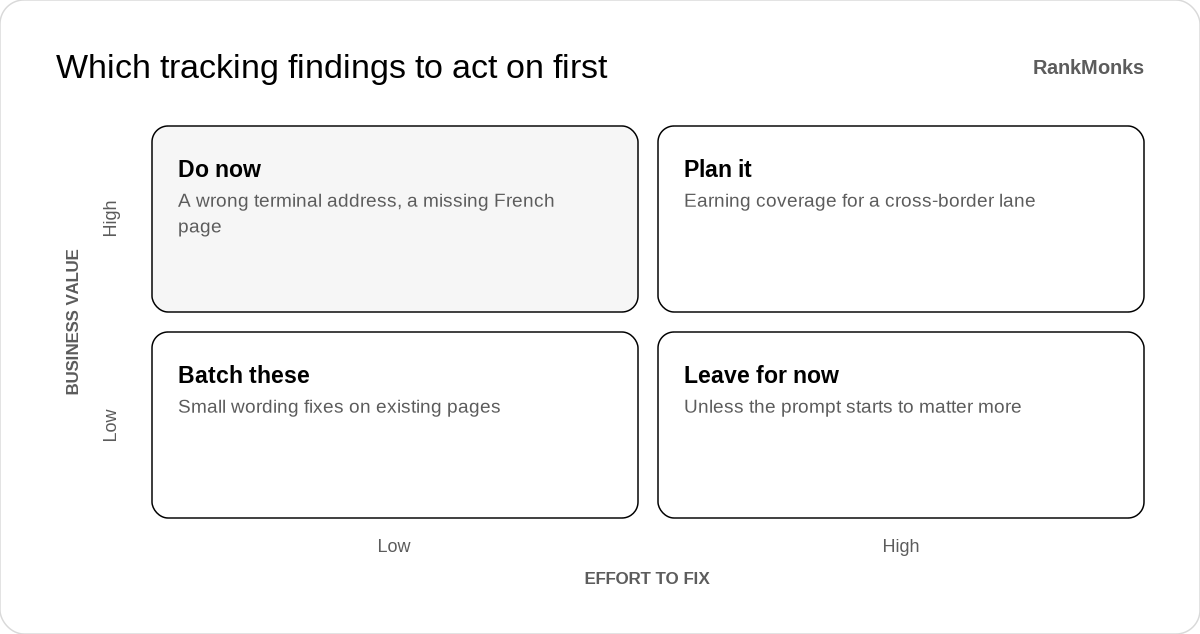
- Do now: high value, low effort. A wrong terminal address, a wrong cross-border claim, a missing French careers page, an old job post with the wrong licence class.
- Plan it: high value, high effort. A set of lane pages for your main cross-border routes, or earning trade press coverage for a new service.
- Batch these: low value, low effort. Small wording fixes, minor listing tidy-ups.
- Leave for now: low value, high effort. Prompts that rarely matter to your business, until something changes.
Value should come from your business, not the tracking tool. Ask your owner and sales lead which lanes and driver roles matter most, and weight those findings higher.
How do you know the changes worked?
You know the changes worked when the same prompts, run the same way, show you named more often and described more accurately in the segments you worked on. Compare segment by segment against the baseline, not the overall total.
A good before-and-after check looks like this:
- Note the change and the date. "French lane pages for Montreal to Toronto published on this date."
- Name the prompts it should affect. The French shipper prompts for that lane.
- Compare those prompts over the next cycles. Share of answers, accuracy and sources cited.
- Check the other signals. Search Console impressions and clicks for the new pages, inquiries that mention the lane, and answers to "how did you hear about us?"
Some changes show quickly and others take months, because AI tools refresh at different speeds. Report what moved, what did not and what you will try next. Our guide to SEO reporting shows how to present it so owners and dispatchers can follow it.
What warning signs suggest tracking is not improving anything?
The main warning sign is reports that look the same every month, with no fixes made in between. Tracking without action only measures decline more precisely. Watch for:
- Findings that never get assigned to anyone.
- Reports that list numbers but no causes or sources.
- SEO, content and listings work planned without looking at the tracking at all.
- The prompt set changing so often that nothing can be compared.
- Success claimed from a single good answer rather than a trend.
What should you ask before you rely on tracking to guide your search work?
Ask whether each report will tell you what to fix, why, and who should fix it.
- Will each finding come with a likely cause and the sources behind it?
- Will findings be sorted into SEO, AEO and GEO work?
- Will you help us prioritize by business value, not just by count?
- Will you track the effect of each change on the prompts it should affect?
- Will you cover French answers and cross-border prompts, not just English domestic ones?
For the setup itself, see our guide to implementing AI visibility tracking properly for Canadian trucking companies. For the terminal-level version of this loop, see how Canadian trucking companies win on local maps with AI visibility tracking. If you also operate south of the border, our guide on how AI visibility tracking improves SEO, AEO and GEO for US trucking companies covers the American side.
How does RankMonks connect AI visibility tracking to SEO, AEO and GEO?
RankMonks treats SEO, AEO and GEO as one practice, and tracking is how we keep the three honest. Each monthly report covers your share of answers, how you are described and what changed, and ends with work: pages to fix, sources to get onto and claims to correct.
Because we also do the work, the findings do not sit in a slide deck. Technical fixes ship as short tickets your developers can pick up, or as changes we make ourselves. Content is briefed, written or rewritten so the answer comes first. Then we rerun the same prompts and report what moved. We are a boutique agency with a small number of clients, the person who plans your work does the work, and we are honest that some changes show in weeks and others take months. The wider picture is in our guide to AI visibility for Canadian trucking companies.
Frequently asked questions
Can AI visibility tracking replace keyword rank tracking?
No. The two measure different things. Rank tracking shows where your pages sit in search results, while AI visibility tracking shows whether AI answers name and describe you. Because many AI tools read pages that rank, the two numbers are related, and the most useful reports show both.
Which discipline usually benefits most from tracking?
It depends on the carrier. Carriers with thin websites usually find SEO gaps first, such as missing lane or terminal pages. Carriers with good sites often find that GEO, the outside sources and listings, is where answers go wrong. Tracking tells you which applies to you instead of leaving you to guess.
How do we handle a finding we cannot fix ourselves?
Some sources, such as a trade publication's old article or a third-party directory, are not yours to edit. Contact the publisher or directory owner with the correct facts and evidence, and publish the correct information clearly on your own site. If a source cannot be changed, outweigh it with more accurate, current sources over time.
Do French findings need a separate plan?
Usually, yes. French answers can draw on different sources and leave out carriers that are well known in English answers. Treat French as its own segment in tracking, with its own pages, listings and outreach, and report it separately so progress in one language does not hide a gap in the other.
Tracking is most valuable when it directs the work that follows. Our AI visibility tracking service ends every monthly report with that work, and we can do it with you. If you want to see what your carrier's first report would show, start a conversation.
Written by RankMonks.