
GEO for Canadian trucking companies is the work of making sure that when a shipper, a broker or a driver asks an AI tool for a carrier, your company is one of the names in the answer, and what the answer says about you is right. GEO stands for generative engine optimization. It targets the written answers produced by ChatGPT, Perplexity, Gemini, Claude, Grok and Google AI Mode, rather than a page of search results.
For a Canadian carrier, that work has its own shape. Your customers ask in English and in French. Much of your freight crosses the US border, and the questions about it are precise. Your safety regulation is provincial, your freight is concentrated in a few hubs, and your drivers search by licence class. This guide covers what GEO means for a Canadian trucking company, who asks AI tools about carriers, which sources those tools read, what your own site should publish, how to earn the mentions that count and how to measure the result. For how GEO relates to search and answer engine optimization, see GEO vs SEO vs AEO.
Key takeaways
- GEO shapes what AI tools write when shippers, brokers and drivers ask them to recommend a carrier, and whether those tools describe your company correctly.
- AI tools build their answers from your website, your map listings, reviews, directories, associations, trade press and public records, so most of the inputs sit beyond your own site.
- Canadian carriers need GEO that handles French, cross-border facts, provincial regulation and licence classes, because those details appear in the questions people ask.
- The core of the work is a single fact sheet repeated accurately everywhere, specific pages that can be quoted, and independent mentions earned honestly.
- Measure with a fixed prompt set, grouped by audience and language, run across the main AI tools every month.
What is GEO, and how is it different for a Canadian carrier?
GEO is the practice of influencing what AI tools write about your company by improving the material they read. There is no form to submit and no setting to switch on. The tools draw on what they learned in training and, increasingly, on pages they fetch from the web as they answer, so the work is about those pages and sources.
The principles are the same everywhere. The details are not. For a Canadian carrier, five factors change the work:
| Factor | What it means for GEO |
|---|---|
| Two languages | French questions get answers built from French-language sources, so you need French pages and French mentions where you serve French-speaking customers |
| Cross-border freight | Shippers ask about US authority, USDOT numbers, PIP, C-TPAT, FAST and eManifest, and expect exact answers |
| Provincial regulation | Your safety credentials vary by province, such as an NSC safety certificate or a CVOR certificate in Ontario, and must be stated correctly |
| Concentrated hubs | Freight clusters around the Greater Toronto Area, Montreal, the Calgary and Edmonton corridor, Winnipeg and Metro Vancouver, so local answers in those areas are crowded |
| Licence classes | Drivers search for AZ jobs in Ontario and Class 1 jobs in most other provinces, and an answer with the wrong class sends them elsewhere |
None of this changes what GEO is. It changes what a complete job looks like. A Canadian carrier with no French pages, a vague cross-border page and a job section that never mentions the licence class has gaps that a US carrier would not.
Who asks AI tools about carriers, and what do they ask?
Shippers, brokers, drivers and owner-operators all ask AI tools about carriers, and each asks for different facts. Your site and your sources need to answer all of them.
| Who asks | An example prompt | What the answer needs from you |
|---|---|---|
| Domestic shipper | "Dry van carriers in Winnipeg that run to Calgary twice a week" | Lanes, frequency and equipment |
| Cross-border shipper | "Ontario carrier with US authority and FAST drivers for Detroit runs" | Authority, USDOT number, FAST and crossings |
| Broker | "Heavy haul carriers in Alberta for oversize loads" | Services, equipment and permit experience |
| Quebec shipper | "Transporteurs frigorifiques à Québec qui livrent dans les Maritimes" | French pages and French-language sources |
| Driver | "Class 1 jobs in Surrey with home time every night" | Role pages with licence class, routes and home time |
| Owner-operator | "Owner-operator opportunities with Ontario carriers running to the US" | Program details and how pay works |
Notice how much each prompt packs in. A model can only name you for "Ontario carrier with US authority and FAST drivers" if all three facts are published somewhere it trusts. That is why GEO for carriers is mostly about specifics, and why our article on why GEO is important for Canadian trucking companies argues that bilingual and cross-border carriers have the most to gain.
Which sources do AI tools draw on when they describe a Canadian carrier?
AI tools draw on six kinds of source when they describe a carrier: your own website, map listings, reviews, associations and trade press, directories and job boards, and public records. Which tool uses which source is not always disclosed, so treat them all as inputs.
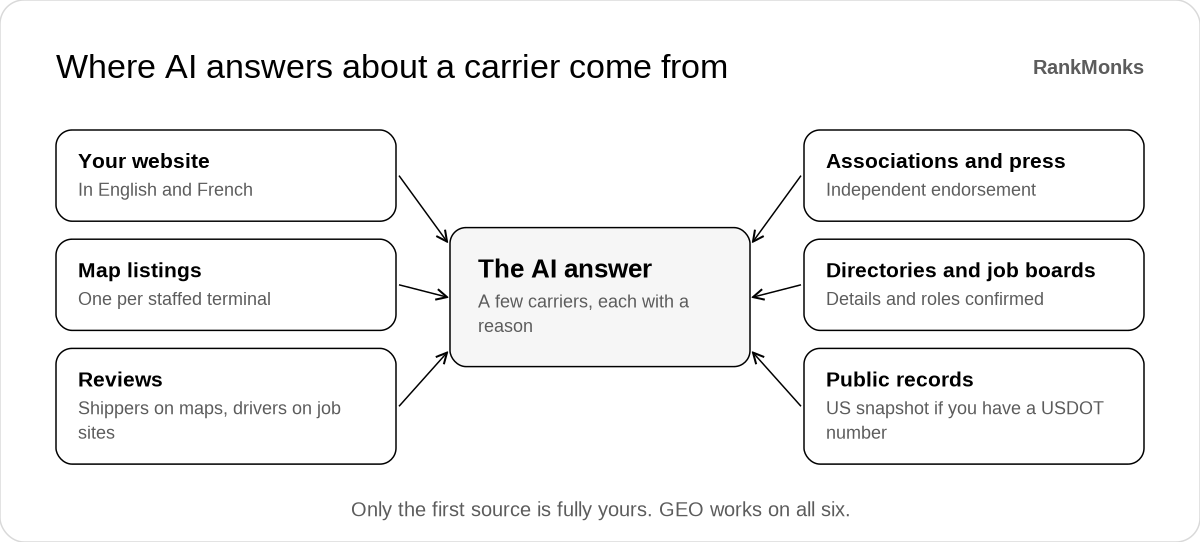
- Your website, in English and French. The only source you control completely.
- Map listings, such as Google Business Profile, Apple Business Connect and Bing Places, for each staffed terminal.
- Reviews from shippers and customers on your listings, and from drivers on employer review sites such as Indeed and Glassdoor.
- Associations and trade press, such as your provincial trucking association and Canadian trucking publications in English and French.
- Directories and job boards, including general business directories, Job Bank and Indeed.
- Public records, such as the US carrier snapshot that exists for any carrier with a USDOT number.
Third-party sources carry particular weight because they are independent. A model is more comfortable repeating that you run FAST-approved drivers when an association profile and a news story say so too. Our guide to brand mentions in AI search explains the pattern, and how to get cited in AI answers covers the on-site side.
What should a Canadian carrier's website publish for AI tools to quote?
A Canadian carrier's website should publish one clear page for each thing a shipper or driver asks about: each service, each regular lane or region, each staffed terminal, cross-border work, safety and compliance, and each driver role, with French versions where you serve French-speaking customers.
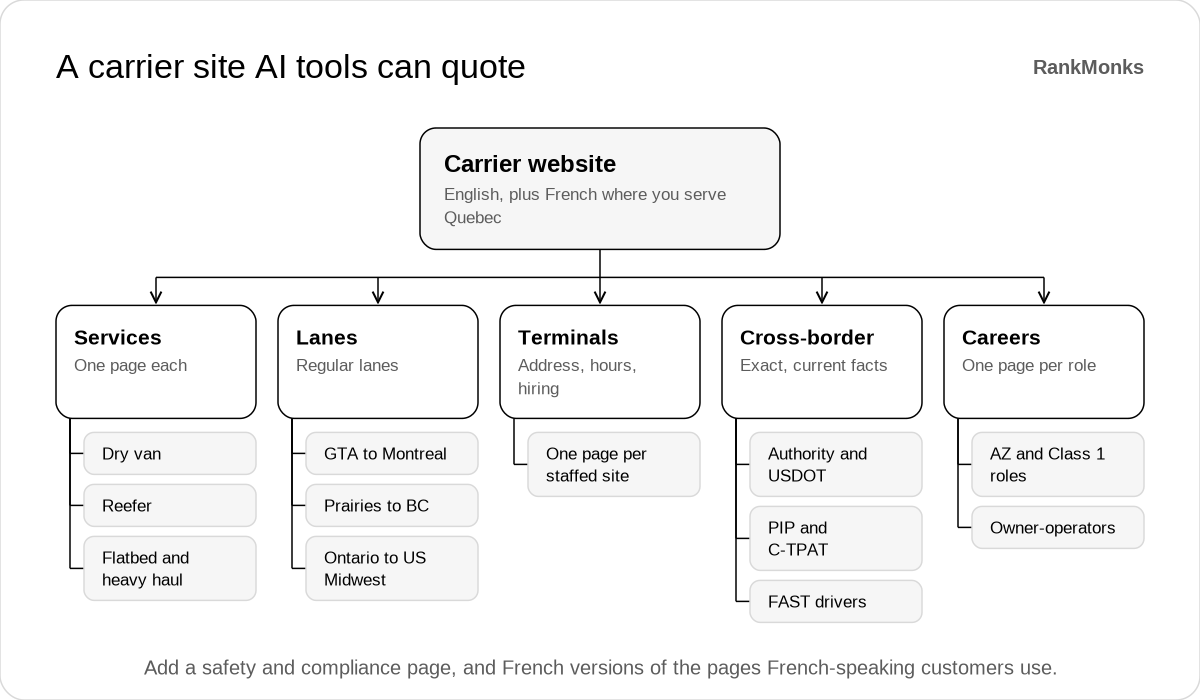
A few rules make those pages quotable:
- Answer first. Open each page with the sentence a model would lift: "We run temperature-controlled freight between the GTA and Montreal five days a week."
- Use text, not PDFs or images. Certificates, service maps and rate sheets locked in files are hard for tools to read.
- Be exact about regulated facts. State your safety certificate, US authority and border programs only where they are current, and update them when they change.
- Write French properly. Give French pages their own URLs, link each pair with hreflang for en-CA and fr-CA, and have a person write or review them. Quebec's Charter of the French Language also sets rules for commercial content aimed at Quebec, so check the current requirements with an advisor.
- Let the right crawlers in. Check that robots.txt and bot protection do not block the search engines and AI crawlers you want reading your site. Our guide to AI crawlers and llms.txt explains the choices.
- Add structured data. Organization and LocalBusiness markup restate your name, terminals and contact details in a form machines read reliably.
How do you earn the third-party mentions that AI tools trust?
You earn third-party mentions by giving independent sources something accurate and useful to say about you. Buying them, or writing them yourself under another name, tends to backfire and can break platform rules.
The sources that matter most for Canadian carriers:
- Provincial trucking associations and national bodies. Complete member profiles, committee work, safety awards and event appearances all put your name on trusted pages.
- Trade press. Canadian trucking publications in English and French cover new terminals, training programs, technology and safety. A clear, accurate story is more useful to an editor than a press release.
- Customers and partners. With permission, shippers, equipment dealers and technology partners often list or describe the carriers they work with.
- Local news and community. A new terminal, a driver training program or a hiring event in a smaller town is often local news.
- Reviews. Ask shippers and customers for Google reviews. Point drivers to employer review sites such as Indeed and Glassdoor rather than your Google listing, since Google treats reviews from a company's own staff as a conflict of interest.
This is the work of digital PR, applied to an industry where trust is earned on safety and reliability.
How do you measure GEO for a Canadian carrier?
Measure GEO with a fixed set of prompts, grouped by audience and language, run in the same AI tools on a schedule, with the answers recorded and compared with a baseline. One answer tells you little, because answers vary between runs. Many answers, taken the same way each month, give a trend.
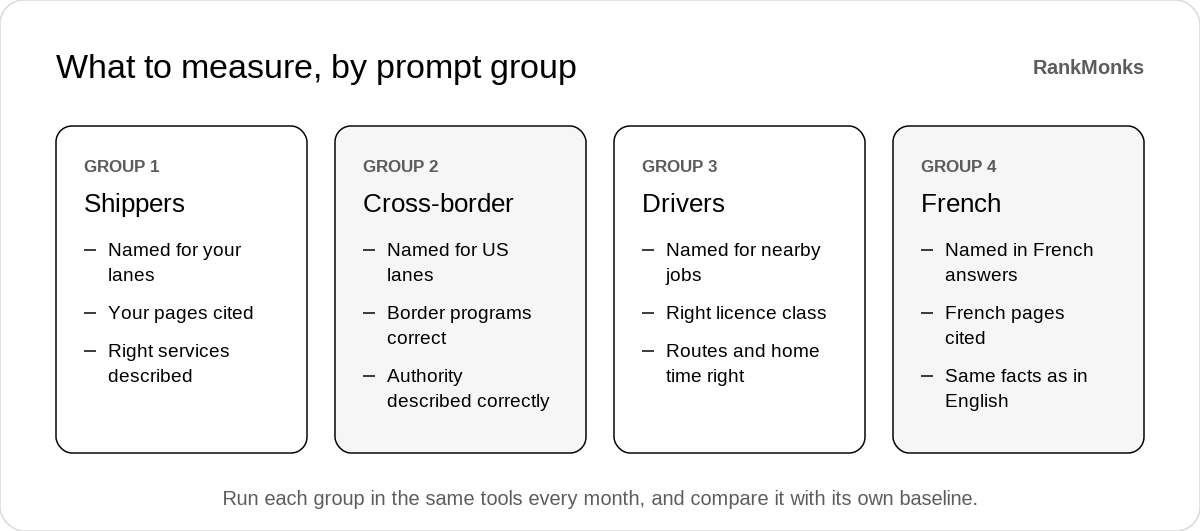
For each prompt, record whether you are named, whether your site is cited, how you are described, whether the facts are right and who is named instead. From those records come share of answers, citation rate and an accuracy rate for each group. Our guide to AI visibility explains the measures in detail.
What results should you expect from GEO, and when?
Expect fixes to facts and listings to show first, and authority to build more slowly. Listing and page fixes can appear within weeks in tools that search the web live. Content and authority work usually takes three to six months to move rankings, and AI citations can shift faster or slower depending on the model. Knowledge built into a model during training changes more slowly still.
Early progress usually looks like fewer wrong descriptions, then appearances in answers to your most specific prompts, such as your niche lanes or your French questions. Broad prompts like "best trucking companies in Ontario" are the most crowded and the slowest to move.
What are the warning signs of bad GEO?
The warning signs of bad GEO are promises nobody can keep and shortcuts that damage trust:
- a guaranteed place in ChatGPT or any other tool;
- offers to "submit" your company to AI models;
- hundreds of near-identical city and lane pages;
- unreviewed machine translation offered as a French strategy;
- fake, bought or staff-written reviews;
- reports built from screenshots of single answers, with no baseline.
What should you ask before you hire help with GEO?
Ask how the work will be measured, how your regulated facts will be protected and how French will be handled.
- Which prompts will you track, and will they cover shippers, brokers, drivers, cross-border work and French?
- Which AI tools, how often, and how many runs per prompt?
- Who checks our safety, authority and border facts before anything is published?
- Who writes or reviews our French pages?
- Which third-party sources will you target, and how?
- What will the monthly report show, and what happens if a prompt group does not move?
Our guide to the best GEO agency for small businesses covers how to judge the answers, and how to choose an SEO agency covers contracts.
Where should a Canadian trucking company go from here?
Start with the part of GEO that matches where you are. Each of the four guides below goes deeper on one step.
Make the case for GEO
If you need to explain the work to an owner or a board, why GEO is important for Canadian trucking companies sets out what a carrier loses when AI answers leave it out, and why brokers, load boards and job boards do not fill the gap.
Put GEO in place
How to implement GEO properly for Canadian trucking companies turns this guide into a 90-day plan, with a carrier fact sheet, an order of work, owners for each task and checks for each step.
Win local map answers
Terminals, yards and offices need their own attention. How Canadian trucking companies win on local maps with GEO covers listings, terminal pages, reviews and city-level prompts in English and French.
Turn GEO into measurable AI visibility
How good GEO boosts AI visibility for Canadian trucking companies explains how the work shows up in share of answers and accuracy, and which changes tend to move the numbers most.
How does GEO fit with SEO, AEO and AI visibility?
GEO is one of four connected disciplines, and it depends on the others. Many AI tools search the web as they answer, so pages that rank and can be read are the ones they quote.
- SEO for Canadian trucking companies builds the foundation: crawlable pages, rankings and the map pack.
- AEO for Canadian trucking companies shapes pages so their answers can be lifted into snippets, AI Overviews and voice results.
- AI visibility for Canadian trucking companies measures what the tools actually say, and turns the gaps into work.
Our guide to SEO in the AI era explains how the four fit together. Carriers with significant US operations should also read GEO for US trucking companies, which covers the American regulators, identifiers and sources.
How does RankMonks approach GEO for Canadian trucking companies?
RankMonks treats GEO as part of one practice with SEO and AEO, because each makes the others work harder. We listen first: your site, your analytics, your lanes and your hiring, and what search engines and AI models say about you today. Then we write an audit covering SEO, AEO and GEO, with every problem ranked by what it costs you.
The build ships in small, steady releases: technical fixes, the fact sheet, pages in English and French, structured data, listings and the sources that matter in your segment. We track a fixed prompt set, drafted by us and corrected by you, across ChatGPT, Claude, Perplexity, Gemini, Grok, Google AI Overviews and AI Mode. Each month you get a plain-language report on rankings, traffic, citations and share of AI answers, ending with what to do next.
We take on a small number of clients at a time, the person who plans your strategy does the work, and we tell you what is realistic before you sign anything. We will not guarantee a place in any AI answer.
Frequently asked questions
What does GEO stand for?
GEO stands for generative engine optimization. It is the work of influencing what AI tools such as ChatGPT, Perplexity, Gemini and Google AI Mode write when they answer questions, so that your company is named and described correctly.
How is GEO different from SEO for a trucking company?
SEO aims to rank your pages in search results and the map pack. GEO aims to get your company named in the written answers AI tools produce, which draw on your pages and on many sources beyond them. The two overlap heavily, and GEO works best on top of sound SEO.
Does GEO work in French?
Yes. AI tools answer French questions largely from French-language sources, so a carrier with good French pages and French-language mentions can be named in French answers even if its English visibility is modest. Without them, it is unlikely to appear.
How much does GEO cost for a trucking company?
It depends on the size of the job rather than a fixed fee. The main drivers are the number of terminals, the number of languages, how many lanes and services need pages, the state of your current site and listings, and how much outreach your segment needs. Most agencies price it as an audit followed by a monthly program.
GEO gives a Canadian carrier a say in the answers that now decide who gets the load and who gets the driver. Our SEO service covers GEO alongside search and answer engines, and if you want to know what AI tools say about your company today, start a conversation.
Written by RankMonks.