
GEO8 min read
How Good GEO Boosts AI Visibility for Canadian Trucking Companies
Published · RankMonks
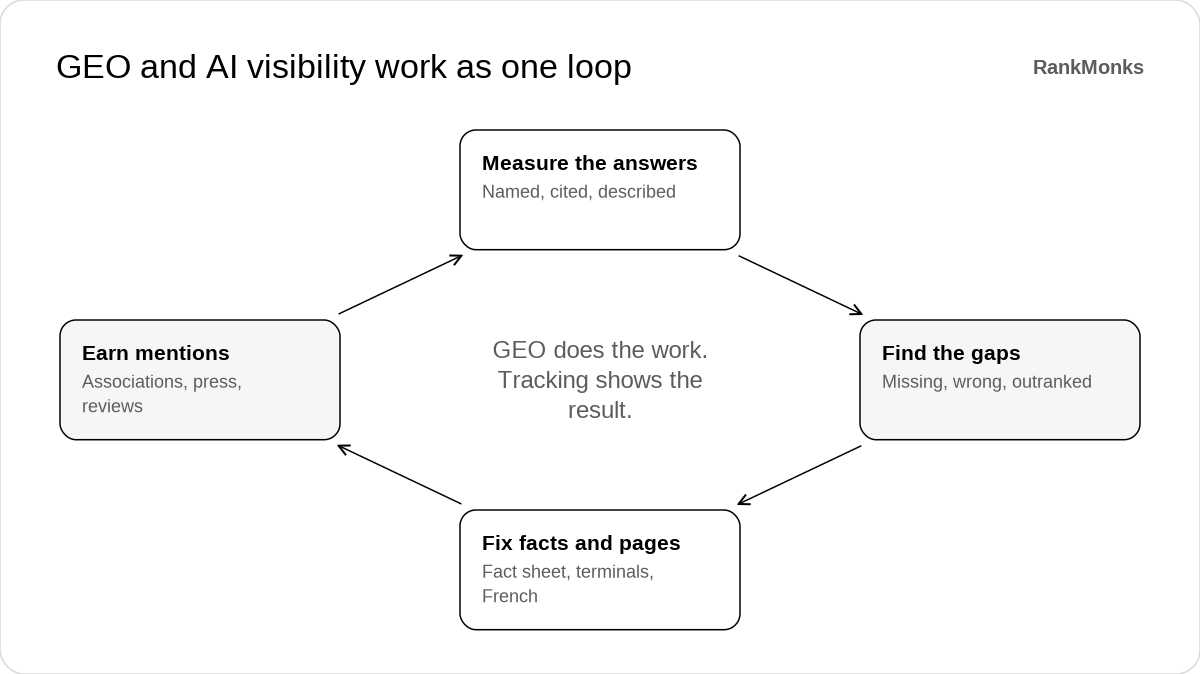
Good GEO boosts AI visibility for Canadian trucking companies because it changes what AI tools have to work with. When a carrier's pages are readable, its facts agree everywhere and independent sources confirm what it says, tools such as ChatGPT, Perplexity, Gemini and Google AI Mode name it more often and describe it more accurately. GEO is the work. AI visibility is the measure of whether the work landed.
This article explains that relationship, the mechanisms behind it, which GEO work tends to move the numbers most for Canadian carriers, and how to measure the result. It belongs to our guide to GEO for Canadian trucking companies. The measurement side is covered in full in AI visibility for Canadian trucking companies.
Key takeaways
- GEO changes the inputs to AI answers. AI visibility measures the outputs: how often you are named, cited and described correctly.
- Good GEO raises visibility through five mechanisms: retrieval, corroboration, specificity, consistency and language coverage.
- It also improves accuracy, which matters as much as frequency for a carrier whose terminals, certifications and hiring needs change.
- For most Canadian carriers, aligning facts everywhere and earning association and trade press mentions do more than publishing large volumes of new pages.
- Measure by prompt group, such as shipper, driver, cross-border and French-language questions, so you can see which part of the work moved.
What is the difference between GEO and AI visibility?
GEO is what you do, and AI visibility is what you measure. One is a set of changes to pages, facts and sources. The other is a record of how AI answers treat you before and after those changes.
| GEO | AI visibility | |
|---|---|---|
| What it is | Work on your pages, business facts and third-party sources | How often, and how accurately, AI answers name you |
| Who does it | Website, compliance, recruiting and outreach | Whoever runs the prompt tracking |
| What you count | Changes shipped | Share of answers, citation rate, accuracy |
| Time frame | Weeks to months per change | A trend, month to month |
The two only make sense together. GEO without measurement is guesswork, and measurement without GEO is a report that never changes.
How does GEO raise the number of answers that name a carrier?
GEO raises the number of answers that name a carrier by giving AI tools more reasons, and more safe material, to include it. Five mechanisms do most of the work.
- Retrieval. Tools that search the web while answering can only use pages they can find and read. Crawlable, indexed, answer-first pages get retrieved more often, which is why good SEO boosts AI visibility too.
- Corroboration. A claim confirmed by an association listing, a trade press article and customer reviews is safer for a model to repeat than a claim made only on your own site. Our guide to brand mentions in AI search explains why.
- Specificity. Prompts are specific: "reefer, Toronto to Montreal, food-grade, twice a week". A carrier that states its lanes, equipment and certifications in plain text can be matched to them. A carrier that says "we haul everything, everywhere" cannot.
- Consistency. When your legal name, operating name, terminals and USDOT number agree across every source, a model can tell all of them describe one company. Conflicts lead to hedged answers, or to two similar carriers being merged into one.
- Language coverage. French pages and French-language mentions give a tool something to cite when a shipper or driver asks in French.
Cross-border carriers get an extra lift from the same work. A carrier that clearly states its US authority and border programs can be named in answers to American shippers as well; our article on how good GEO boosts AI visibility for US trucking companies covers that side.
How does GEO improve the accuracy of what AI tools say?
GEO improves accuracy by fixing wrong facts where they start, so the tools stop finding them. For a carrier, accuracy can matter as much as being named, because a wrong fact can rule you out even when you appear.
Typical errors in AI answers about Canadian carriers include:
- a terminal that closed or moved still listed as open;
- a certification described that has lapsed, or that you never held;
- the wrong licence class for driving jobs;
- "does not cross the border" when you run US lanes every day;
- an old company name still in use after a rebrand or merger.
The fix follows the same pattern each time. Find the sources that state the error, correct them, publish the correct fact clearly on your own site, then give the tools time to pick it up. Our guide to fixing wrong AI answers about your brand sets out the process. Clear, answer-first pages help here as well, which is the subject of how good AEO boosts AI visibility for Canadian trucking companies.
Which GEO work moves AI visibility most for Canadian carriers?
For most Canadian carriers, the work that moves AI visibility most is the unglamorous kind: getting the same facts onto every source, then earning mentions from independent ones. Large volumes of new content usually come last.
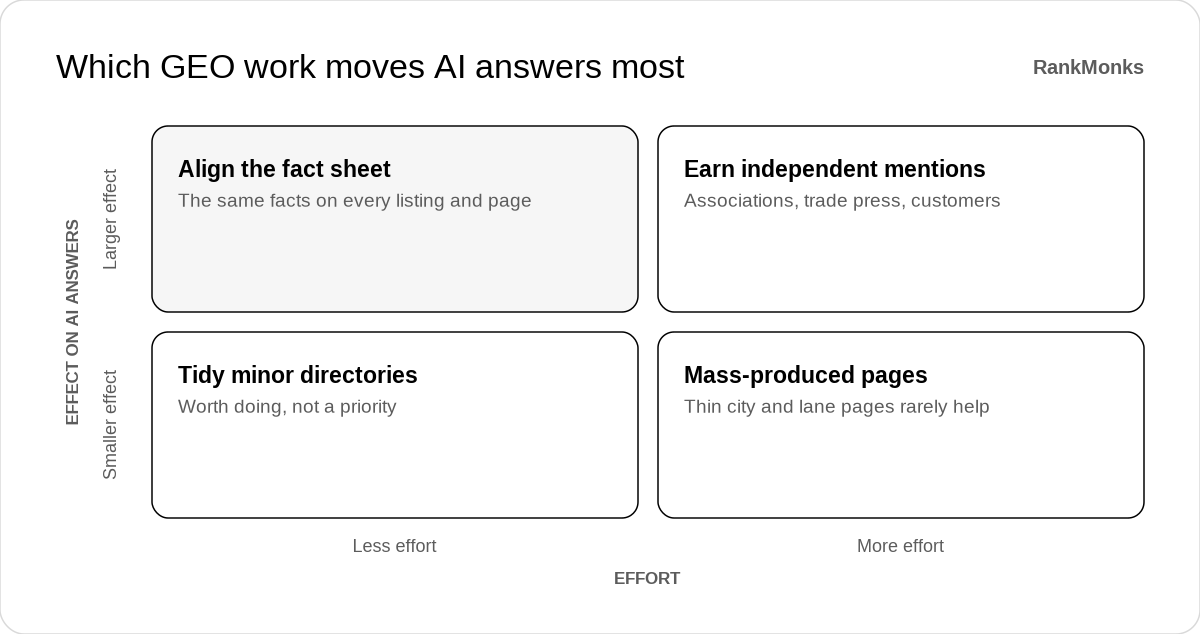
- Align the fact sheet everywhere. Lower effort, often a large effect, because it removes the conflicts that make tools hedge.
- Earn independent mentions. More effort, also a large effect: your provincial trucking association, trade press, customers who will name you, local news about a new terminal.
- Tidy minor directories. Worth doing once the main sources agree, but rarely decisive.
- Mass-produced pages. A thin page for every city and lane takes effort and seldom helps. Tools favour pages with real detail.
Our plan for implementing GEO properly puts these in order over 90 days.
What does this look like for a typical carrier?
Take a hypothetical carrier with a head office and terminal in Mississauga, a second terminal in Laval, and daily freight to Ohio and Michigan. Its baseline shows a familiar pattern: it is named in some English shipper answers about Ontario lanes, it is absent from every French answer, and two tools describe it as a domestic-only carrier because an old directory listing says so.
The GEO work follows from that baseline, not from a generic checklist:
- Correct the directory listing and every other source that repeats "domestic only", and publish a cross-border page stating its US authority, USDOT number, FAST drivers and usual crossings.
- Publish French pages for the Laval terminal, the Quebec lanes and the driving jobs based there, reviewed by a French-speaking dispatcher.
- Bring the Laval listing, its association entry and its job posts into line with the fact sheet.
- Pitch a short story to French-language trade press about the Laval terminal's new service.
The re-run then checks the same prompts. The questions to answer are whether the "domestic only" description has gone, whether French answers now name the carrier, and whether cross-border prompts mention it at all. Each answer points to the next piece of work.
How do you measure whether GEO is working?
Measure GEO by tracking a fixed set of prompts, grouped by audience and language, across the main AI tools every month, then comparing each group with its baseline. Answers vary from run to run, so repeat each prompt and read the trend.
| Prompt group | Example | What progress looks like |
|---|---|---|
| Shippers, English | "Reefer carriers in Ontario that run to Quebec" | Named in more answers, with the right lanes |
| Shippers, French | "Transporteurs frigorifiques au Québec vers l'Ontario" | Named in French answers, citing French pages |
| Cross-border | "Canadian carriers with FAST drivers for Detroit runs" | Border programs described correctly |
| Drivers | "AZ jobs in Brampton with home time every night" | Named, with the right licence class and routes |
| Local terminals | "Flatbed carriers near Nisku" | Terminal named, with the right address and hours |
Record share of answers, citation rate, accuracy and the competitors named instead. Our guide to AI share of voice explains the calculation. The local terminal prompts connect to winning local map answers with GEO.
What are the warning signs that GEO is not improving visibility?
The main warning sign is reporting that cannot be compared month to month. Watch for:
- visibility "reports" made of screenshots, with no fixed prompt set;
- counts of AI mentions with no idea which questions produced them;
- claims of "training the model" on your brand;
- no tracking of accuracy, only of mentions;
- no French prompts for a carrier that serves Quebec.
What should you ask about GEO and AI visibility?
- Which prompts are in the set, and who agreed them?
- How many times is each prompt run, and in which tools?
- Will the report show accuracy as well as mentions?
- Can you show which GEO change preceded each movement?
- What will you do if a prompt group does not move after three months?
How does RankMonks approach GEO for Canadian trucking companies?
RankMonks runs GEO and AI visibility tracking as one program. We agree a fixed prompt set with you, take a baseline across ChatGPT, Claude, Perplexity, Gemini, Grok, Google AI Overviews and AI Mode, and only then start changing pages, facts and sources.
Each monthly report shows your share of answers, how you are described, what changed and a short list of things to do about it. AI citations can shift faster or slower depending on the model, and content and authority work usually takes three to six months, so we set those expectations before we start. The full approach is laid out in our GEO guide for Canadian carriers.
Frequently asked questions
Is AI visibility the same as GEO?
No. GEO is the work of improving what AI tools read about you, and AI visibility is the measure of how often and how accurately they name you. You need both: the work, and a fixed way to tell whether it worked.
How long before GEO shows up in AI visibility numbers?
Fixes to listings and pages can show within weeks in tools that search the web live. Changes that depend on new mentions and authority usually take months. Knowledge built into a model during training updates more slowly still.
Can a small carrier compete with large fleets in AI answers?
Yes, especially for specific questions. A small carrier that clearly states a niche, such as heavy haul in northern Alberta, can be named ahead of a large fleet that describes itself in general terms.
Do we need to track French-language prompts?
If you serve Quebec or other French-speaking customers, yes. French answers draw on French-language sources, so your share of answers in French can differ a great deal from your share in English.
Good GEO is the reason AI visibility moves, and tracking is how you know it did. Our SEO service covers both for Canadian carriers, and if you want a baseline for your own company, start a conversation.
Written by RankMonks.