
GEO9 min read
How Canadian Trucking Companies Win on Local Maps With GEO
Published · RankMonks
Canadian trucking companies win on local maps with GEO by making every staffed terminal easy for AI tools to find, confirm and describe. When a driver asks an assistant for "trucking companies in Brampton hiring AZ drivers", or a shipper asks for "a flatbed carrier near Nisku", the answer often arrives with a map and two or three names drawn from listings, reviews and websites. The carriers whose facts agree across all of those sources are the ones the tool can recommend.
This article covers how AI tools answer local trucking questions, which sources feed them in Canada, and how to set up each terminal so it is named and described correctly. It is part of our guide to GEO for Canadian trucking companies. The classic map-pack side of the same work is covered in how Canadian trucking companies win on local maps with SEO.
Key takeaways
- AI tools answer local trucking questions by combining map listings, reviews and website content, then naming a few businesses.
- Only real, staffed locations belong on a map. Listings for drop yards or virtual offices break Google's rules and confuse AI answers.
- Each terminal needs matching facts on Google Business Profile, Apple Business Connect, Bing Places, your own terminal page and the directories and associations that list you.
- Map reviews should come from shippers and customers, because AI tools summarize what reviewers say. Drivers belong on job review sites, not your Google listing.
- Check what AI tools say about each terminal with city-level prompts, in French as well as English where you operate in Quebec.
How do AI tools answer local trucking questions?
AI tools answer local trucking questions by finding businesses near the place in the question, reading what their listings, reviews and websites say, and writing a short recommendation. Some show a map beside the answer. Others give names and addresses in the text.
The products change often, so treat this as a snapshot. Google's AI Mode can return local results with map listings, Google has been adding Gemini-powered answers to Google Maps, and ChatGPT and Perplexity can show local businesses for location-based questions. What they share matters more than how they differ: each needs a reliable record of where you are, what you do there and what people think of you.
A local trucking question usually carries three kinds of detail:
- A place: "near Mississauga", "in Delta", "off the 401 in Milton".
- A service or role: "reefer", "heavy haul", "AZ drivers", "dispatcher jobs".
- A condition: "hiring now", "open Saturdays", "takes partial loads", "French-speaking dispatch".
An answer can only meet those conditions if the facts are published somewhere. A listing with no services, no hours and no hiring information gives the tool nothing to match.
Which listings and sources feed AI map answers in Canada?
AI map answers draw on the major map listings, your own site, reviews and the directories that confirm your details. Which tool uses which source is not always disclosed, so the safe approach is to make every one of them accurate.
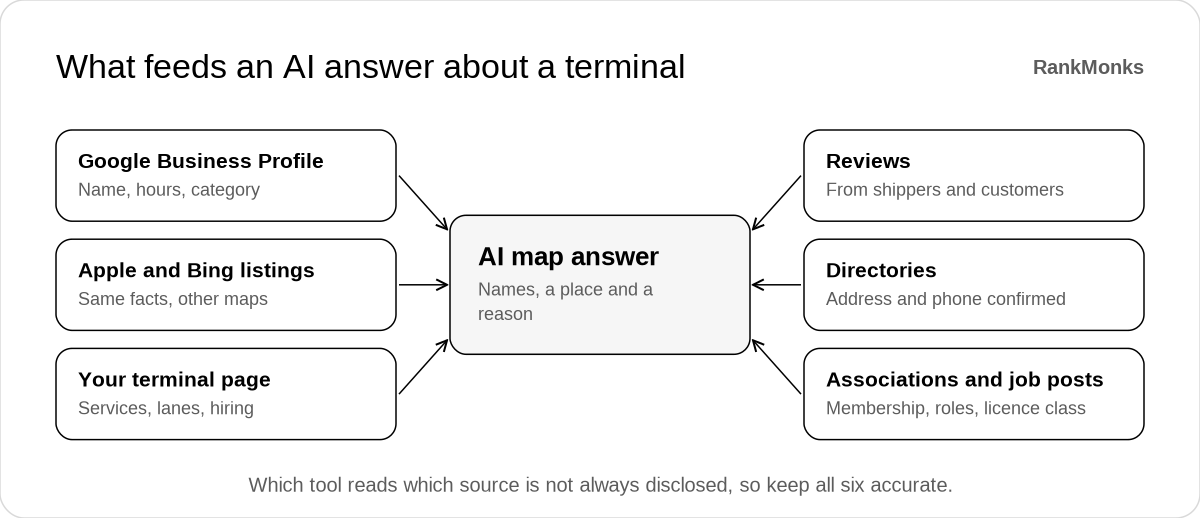
| Source | What to get right | Notes |
|---|---|---|
| Google Business Profile | Name, address, category, hours, services, photos, reviews | The most widely used map listing in Canada |
| Apple Business Connect | Name, address, hours, category | Manages your place card in Apple Maps |
| Bing Places for Business | Name, address, hours, category | Feeds Bing's maps and local results |
| Your terminal page | Address, hours, services, lanes, hiring, photos | The source you control completely |
| Canadian directories | Name, address, phone | For example Yellow Pages Canada and trade directories |
| Association member lists | Name, location, services | Your provincial trucking association and any national bodies |
| Job posts | Location, role, licence class | Job Bank, Indeed and your careers page should agree |
How should each terminal be set up on the map?
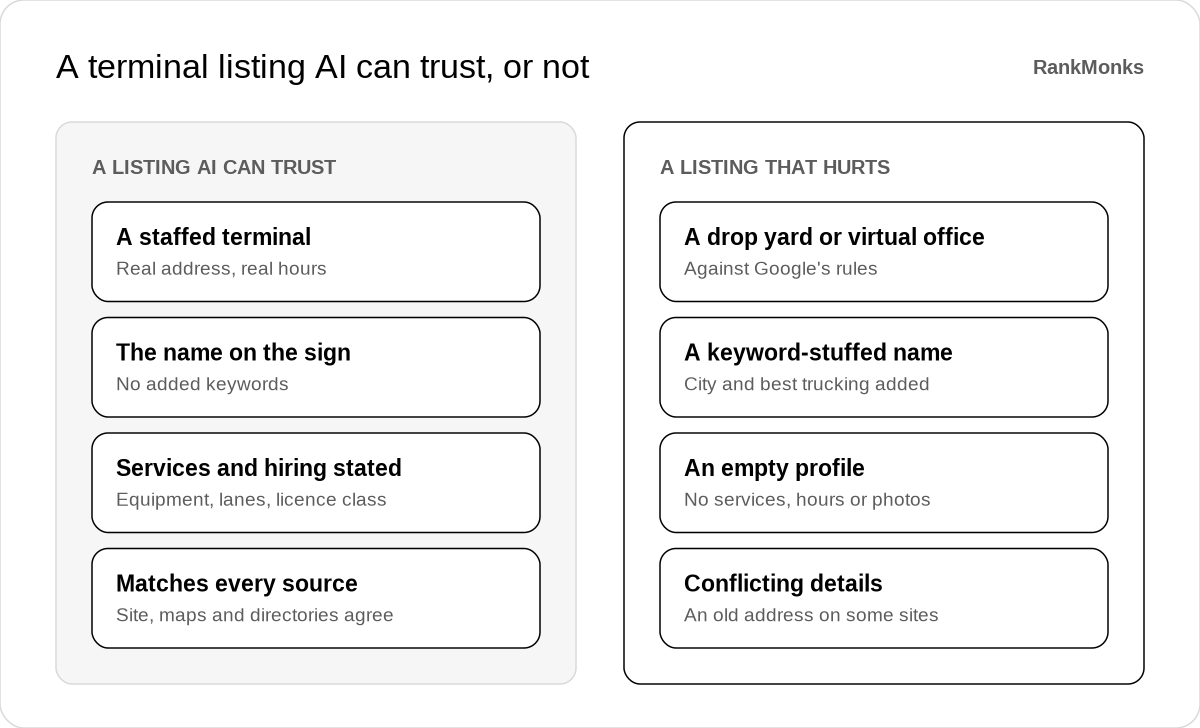
Each terminal should have its own listing only if it is a real location where staff deal with customers or drivers during the stated hours. Google's guidelines do not allow listings for unstaffed places, such as unattended drop yards, or for virtual offices. A listing that breaks the rules can be suspended, and a suspended listing drops out of AI answers as well.
For each eligible terminal:
- Use the real name. Use the name on your signage, with no added keywords. In Quebec, that may be a French name.
- Choose the most specific category. "Trucking company" is the usual primary category. Add others only for services that terminal really offers.
- State hours precisely. If the office and dispatch keep different hours, say so in the description and on the terminal page.
- List services and hiring. Name the freight types and equipment based there, and whether the terminal hires drivers.
- Add real photos. The yard, the trucks, the office and the people.
- Link to the terminal page, not your home page.
If you only ever meet customers at their own sites, set a service area and hide the address instead of listing a yard.
What should a terminal page on your site say?
A terminal page should state, in plain text, everything a shipper or driver would ask about that location, so an AI tool can quote it without guessing. Include:
- the full address with postal code, plus the nearest highway or interchange;
- office and dispatch hours;
- the services and equipment based there;
- the regular lanes served from it;
- whether it is hiring, which roles, and which licence class;
- a phone number or contact for that terminal;
- photos of the site;
- a French version for terminals in Quebec or terminals that serve French-speaking customers.
Write it in sentences, not fragments. For example: "Our Milton terminal runs dry van and reefer freight to Quebec and the US Midwest, and hires AZ drivers for regional routes." That one sentence answers a shipper's question and a driver's question at once.
Add LocalBusiness structured data with the same details, as our guide to schema markup explains. Carriers with US terminals as well should compare notes with how US trucking companies win on local maps with GEO, since the listings and sources differ south of the border.
How do reviews shape AI map answers for a carrier?
Reviews shape map answers in two ways: they affect whether a listing appears, and their wording gives AI tools the language they use to describe you. An assistant asked for "a reliable carrier near Winnipeg" may lean on reviews that talk about reliability.
A carrier's reviews come from two groups, and they belong in different places:
- Shippers and customers on your map listing. Ask satisfied shippers, consignees and other customers for a Google review after a good run of loads. They write about on-time pickups, communication and damage-free delivery, which is exactly what freight questions ask about.
- Drivers on job review sites. Google's review policies treat reviews of a business by its own current or former staff as a conflict of interest, so do not ask your drivers to review you on Google. Point them to employer review sites such as Indeed or Glassdoor instead, where drivers compare carriers and where AI tools asked about driving jobs may also look.
Then:
- Reply to every review professionally, including critical ones.
- If a Google review comes from a current or former employee, you can report it under that conflict-of-interest policy.
- Never buy, script or reward reviews. Canada's Competition Bureau treats fake reviews as misleading advertising, and AI tools are getting better at discounting them.
Our general guide to local SEO covers review requests in more detail.
How do you check what AI tools say about each terminal?
Check by running city-level prompts for each terminal on a schedule and recording the answers. For a carrier with terminals in Milton, Laval and Nisku, that might include "trucking companies hiring AZ drivers in Milton", "transporteurs frigorifiques à Laval" and "flatbed trucking companies in Nisku".
For each answer, record whether the terminal is named, whether the address, hours and services are right, and which competitors are named instead. When something is wrong, trace it to the source that says it and fix it there. Our guide to fixing wrong AI answers about your brand explains how. Running these checks as a standing program is covered in how Canadian trucking companies win on local maps with AI visibility tracking, and how good GEO boosts AI visibility explains how these fixes show up in the numbers.
What warning signs should you watch for?
Watch for anything that adds listings or reviews faster than the facts justify. Common examples:
- Listings created for drop yards, parking lots or virtual offices.
- Business names stuffed with keywords, such as a city and "best trucking".
- Duplicate listings for the same terminal.
- Review gating, where only happy customers are asked, bought reviews, or asking your own staff to review you.
- Terminal pages copied from one city to the next with only the name changed.
- A provider who promises "the top spot in AI maps".
What should you ask a provider about local GEO?
- How will you check whether each of our locations is eligible for a listing?
- Which directories and associations will you align with our fact sheet?
- Will you test city-level prompts in English and French?
- How will you handle reviews, given that staff and former staff should not review us on Google?
- Will you report accuracy, not just how often we are named?
The steps before and after this one, from the fact sheet to the re-run, are set out in how to implement GEO properly for Canadian trucking companies.
How does RankMonks approach local GEO for Canadian trucking companies?
RankMonks treats each terminal as its own small entity that has to be right everywhere. We start by reading your listings, your site and what AI tools say about each location now, then rank the problems by what they cost you, such as a suspended listing or a closed terminal that still appears in answers.
Fixes ship in small, steady releases: listing corrections, terminal pages in English and French, structured data and directory alignment. We track city-level prompts across ChatGPT, Claude, Perplexity, Gemini, Grok, Google AI Overviews and AI Mode, and report monthly, in plain language, what each terminal's answers say and what to do next. We do not create listings for locations that are not eligible, and we do not guarantee any position. Our GEO guide for Canadian carriers shows where this local work fits in the wider program.
Frequently asked questions
Can a trucking company have a Google Business Profile for a drop yard?
Not if the yard is unstaffed. Google's guidelines require a listed location to be a real place where staff deal with customers during the stated hours. List your staffed terminals and offices, and describe drop yards on your own site instead.
Do AI map answers use the same data as Google Maps?
Google's own AI features draw on Google's place information, which includes Google Business Profile. Other tools use their own mix of sources, and they do not always say which. Keeping every listing and your own pages identical is the only reliable approach.
Should a Quebec terminal have a French listing?
Each location should have one listing under its real name, which may be French. Publish a French terminal page on your site, and welcome reviews in either language, since French-speaking shippers will write in French.
How many terminals should have their own page?
Every staffed terminal should have its own page, written about that location and nothing else. Unstaffed yards can be described on the nearest terminal's page or on a general locations page.
Winning local AI answers is mostly a matter of being accurate in more places than your competitors. Our SEO service covers local GEO for multi-terminal carriers, and if you want to see what AI tools say about your terminals today, start a conversation.
Written by RankMonks.