
SEO8 min read
How Canadian Trucking Companies Win on Local Maps With SEO
Published · RankMonks
Canadian trucking companies win on local maps by giving each staffed terminal a verified Google Business Profile with the right category, an accurate pin, real hours and photos, linking it to a matching page on the website, and building a steady flow of reviews. The map is where drivers find carriers hiring near them and where local shippers find capacity close to their dock.
Map results work differently from the ordinary results, so they need their own approach. This guide covers which locations deserve a profile, how to set each one up, what the matching terminal page needs, how reviews work for a carrier and the other maps that matter in Canada. It is part of our complete guide to SEO for Canadian trucking companies.
Key takeaways
- Map results come from business profiles, so a carrier can win them even with a modest website.
- Only staffed locations where people deal with your team during stated hours should have a profile.
- Each profile needs the real business name, the most accurate category, a correct pin and real hours.
- A terminal page on your site should confirm and extend everything the profile says.
- Google reviews should come from shippers, consignees and other customers, not from your own drivers or staff.
Who searches the map for a trucking company?
Drivers, local shippers, owner-operators and visitors all search the map for carriers, and each wants something different from the profile.
| Who | Example search | What they want from the profile |
|---|---|---|
| Driver | "trucking companies near me hiring", "AZ jobs Mississauga" | Location, reputation, a link to jobs |
| Local shipper | "flatbed trucking near Hamilton" | Services, phone, hours |
| Owner-operator | "trucking company Brampton owner operator" | Whom to call, reputation |
| Visitor or new hire | "[carrier name] Milton terminal" | The right gate, hours, directions for a truck |
Google says local results depend on relevance, distance and prominence. You cannot change distance, but you can make each profile relevant and build its prominence. The general principles are in our guide to local SEO. This article applies them to carriers.
Which locations deserve a Business Profile?
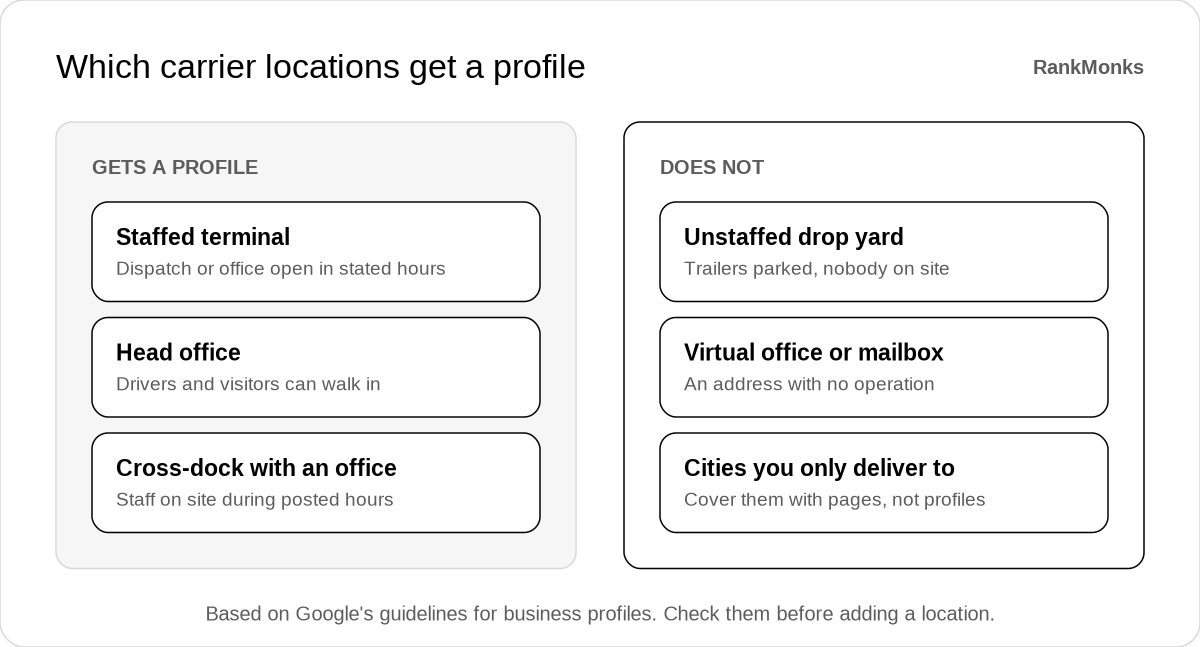
A location deserves a Business Profile when it is a real place where your staff deal with people in person during the hours you list. Google's guidelines are written for that kind of location, and profiles for anything else risk suspension.
For most carriers, that means:
- Yes: each staffed terminal with an office or dispatch on site, and a head office that receives drivers and visitors.
- No: unstaffed drop yards and trailer pools, virtual offices, mailboxes and cities you only deliver to.
If you serve a city without a staffed site, cover it with a lane or regional page on your website instead. If a terminal is staffed only some hours, list only those hours. Check Google's current guidelines before adding any new location, because the rules are enforced and a suspended profile can take time to reinstate.
How do you set up each terminal profile properly?
Set up each terminal profile with the real business name, the most accurate category, a correct pin, real hours, a link to that terminal's page and photos of the site. Most weak profiles are simply incomplete or inaccurate.
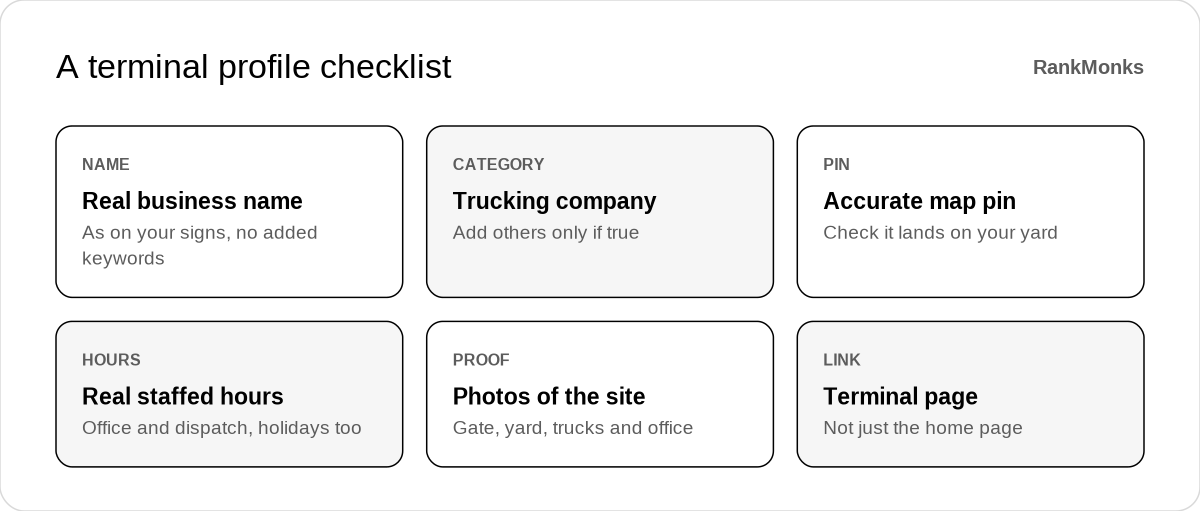
- Name. Use the name on your signs and documents. Adding "AZ Jobs" or "Best Trucking Toronto" to the name breaks Google's guidelines and can get the profile suspended. If a Quebec terminal trades under a French name, use that name.
- Primary category. "Trucking company" suits most carriers. Add secondary categories only for what that location really does.
- Address and pin. Check that the pin lands on your yard, ideally near the entrance trucks use. Large industrial parks confuse map pins, and a driver sent to the wrong gate is a poor first impression.
- Hours. List the hours when someone is there to deal with people. If dispatch runs around the clock from that site, say so. If it does not, do not.
- Phone. Use a number that reaches someone at or for that terminal.
- Website link. Link to the terminal's own page, not the home page.
- Services and description. Describe what is run from that site in plain words: freight types, equipment, lanes and whether you are hiring there.
- Photos. Show the gate, the yard, trucks in your colours, the office and the team. Real photos help people recognize the place when they arrive.
Then keep it current. Update holiday hours, add new photos and reply to reviews.
What should each terminal page on your site include?
Each terminal page should confirm everything the profile says and add the detail that does not fit on a profile. Google reads the page to understand the location, and people use it to plan a visit.
- The address and phone, written exactly as on the profile.
- Directions for trucks: which entrance, where to check in, where to park and any height or turning limits nearby.
- Hours for the office, dispatch, and shipping and receiving if they differ.
- Services, equipment and lanes run from that terminal.
- Jobs based at that terminal, linking to each careers page.
- Photos and an embedded map.
- LocalBusiness structured data with the same name, address and phone. Our guide to schema markup shows how.
- A French version for terminals in Quebec, linked with hreflang.
How do reviews work for a trucking company?
Reviews help a carrier's profiles rank and help people decide, so ask customers for them routinely and reply to every one. The question for a carrier is whom to ask, because the people who know you best are often your own drivers, and they are the wrong people to ask.
- Ask shippers, consignees, brokers and other customers. A short message after a successful delivery or at the end of a busy season, with a direct link to the profile, works well.
- Visitors who deal with a terminal, such as customers collecting freight, can review it too.
- Do not ask your own drivers or staff. Google's policies treat reviews of a business by its current or former employees as a conflict of interest. Point drivers to job review sites such as Indeed or Glassdoor for employer reviews, and make sure your careers pages reflect what they say.
Never pay for reviews, never offer rewards and never ask only the customers you expect to be happy. All three break Google's rules. When a review is critical, reply calmly and specifically, without arguing, and offer to talk offline. Other shippers and drivers read the replies.
Which other maps matter for Canadian carriers?
Apple Maps and Bing Maps matter alongside Google, and so do the directories that confirm your details. Drivers on iPhones and people asking Siri see Apple Maps results, and Bing users see Bing's.
- Apple Business Connect. Claim and update each terminal on Apple Maps.
- Bing Places for Business. You can often import details from Google, then check them.
- Directories. Keep your details identical on major Canadian directories such as Yellow Pages, on association member listings and on the industry directories you use.
Consistency is the goal. The name, address and phone for each terminal should match everywhere, starting with your own website. Small differences, such as "St." in one place and "Street" in another, matter less than outright conflicts, such as an old address still live on a directory.
What warning signs should you watch for?
Watch for anything that adds visibility by inventing or inflating facts, because map spam is policed and the profile is yours to lose.
- A profile for every city you deliver to.
- Keywords stuffed into the business name.
- Bought or swapped reviews, or reviews requested from your own staff.
- A provider that creates profiles under its own account rather than yours.
- Hours listed as 24/7 when nobody is on site.
You may also find competitors doing these things. You can suggest an edit or report a listing to Google through Maps. Do not copy them.
What should you ask a provider about local maps?
- Which of our locations qualify for a profile, and why?
- How will you check and fix our pins, hours and categories?
- Who will own and manage the profiles?
- How will you ask customers for reviews without breaking Google's policies?
- How will you report calls, direction requests and website clicks for each terminal?
Local maps are one part of a wider plan, set out in our complete guide to SEO for Canadian trucking companies. How to implement SEO properly for Canadian trucking companies shows where the profiles fit in the first 90 days, and why SEO is important for Canadian trucking companies makes the case. AI tools now answer local questions too: see how Canadian trucking companies win on local maps with GEO, and with AEO for voice and assistant answers. If you have US terminals, the American version is how US trucking companies win on local maps with SEO.
How does RankMonks approach local maps for Canadian trucking companies?
RankMonks reads every terminal's profile, listings, reviews and page, along with what search engines and AI models say about each location. You get a written audit with problems ranked by what they cost you, so the terminals where you are losing drivers or shippers come first.
Fixes ship in small, steady releases, and the person who plans the work does it. Each month you get a plain-language report on rankings, traffic, citations and share of AI answers. Profile corrections can show within weeks, while reviews and terminal pages build more slowly, usually over three to six months.
Frequently asked questions
Can a trucking company list a drop yard on Google Maps?
Not as a Business Profile unless it is staffed during the hours you list and people deal with your staff there. An unstaffed yard or trailer pool does not meet Google's guidelines. Mention it on the relevant terminal or lane page instead.
Should each terminal have its own profile?
Yes, each staffed terminal should have its own verified profile, linked to its own page on your site. That lets each location rank for searches near it and gives drivers and visitors the right address and phone.
Can our drivers leave Google reviews for the company?
They should not be asked to. Google's policies treat reviews of a business by its current or former employees as a conflict of interest, and such reviews can be removed. Ask shippers and other customers for Google reviews, and point drivers to job review sites such as Indeed or Glassdoor.
Why does our terminal not show up in the map pack?
Usually because the profile is incomplete or unverified, the category is wrong, the location is far from where people search, or nearby competitors have more and better reviews. Check the profile against the checklist above, then work on reviews and the terminal page. Results vary with the searcher's location, so a single check from your own office tells you little.
A terminal that is easy to find and easy to reach wins drivers and shippers before your phone rings. That is where our SEO service starts for businesses with physical locations. If you want us to look at your terminal profiles, start a conversation.
Written by RankMonks.