
SEO10 min read
How US Trucking Companies Win on Local Maps With SEO
Published · RankMonks
US trucking companies win on local maps by giving every real, staffed terminal an accurate Google Business Profile, backing each one with a useful location page, and earning steady reviews and local mentions. The carriers that show up first for "trucking companies near me" are rarely the biggest. They are the ones whose listings are complete, correct and trusted.
Map results matter to carriers more than many realize. Local drivers use them to find employers, local shippers use them to find nearby capacity, and every new driver uses them to find your gate. This guide is part of our guide to SEO for US trucking companies, and it covers which locations qualify, how to set them up, how to earn reviews and how to measure the results.
Key takeaways
- Local map results drive driver recruiting, local freight inquiries and directions to your terminals.
- Only real locations staffed during their stated hours should have a Business Profile, which rules out unstaffed drop yards, virtual offices and remote staff homes.
- Each profile needs the right primary category, your real business name, accurate hours and a pin on the truck entrance.
- Reviews on your profile should come from customers and visitors, while drivers' views of you as an employer belong on job review sites.
- Measure calls, direction requests and website clicks per terminal, not just where you rank.
Why do local map results matter to a trucking company?
Local map results matter because the people who search with local intent are exactly the people a carrier needs: drivers looking for work nearby, shippers looking for local capacity, and drivers, visitors and vendors trying to find the right gate.
| Who searches | Example search | What they need from your listing |
|---|---|---|
| Local driver | "trucking companies near me hiring" | Hiring status, phone, reviews, location |
| Local shipper | "flatbed trucking company Fort Worth" | Services, phone, website, reviews |
| New hire or visitor | Your company name plus "terminal" | Correct pin, entrance, hours |
| Vendor or delivery | Your company name | Address, receiving hours |
| Broker checking you out | Your company name | Proof you are real and established |
A carrier with a missing or wrong listing loses on every row. A pin that drops a new hire at the office car park instead of the truck gate costs them time and costs you a first impression.
Which carrier locations can have a Google Business Profile?
A carrier location can have a Google Business Profile if it is a real place where staff meet drivers, customers or visitors during its stated hours. Google's guidelines exclude locations that are not staffed, virtual offices and mailbox addresses.
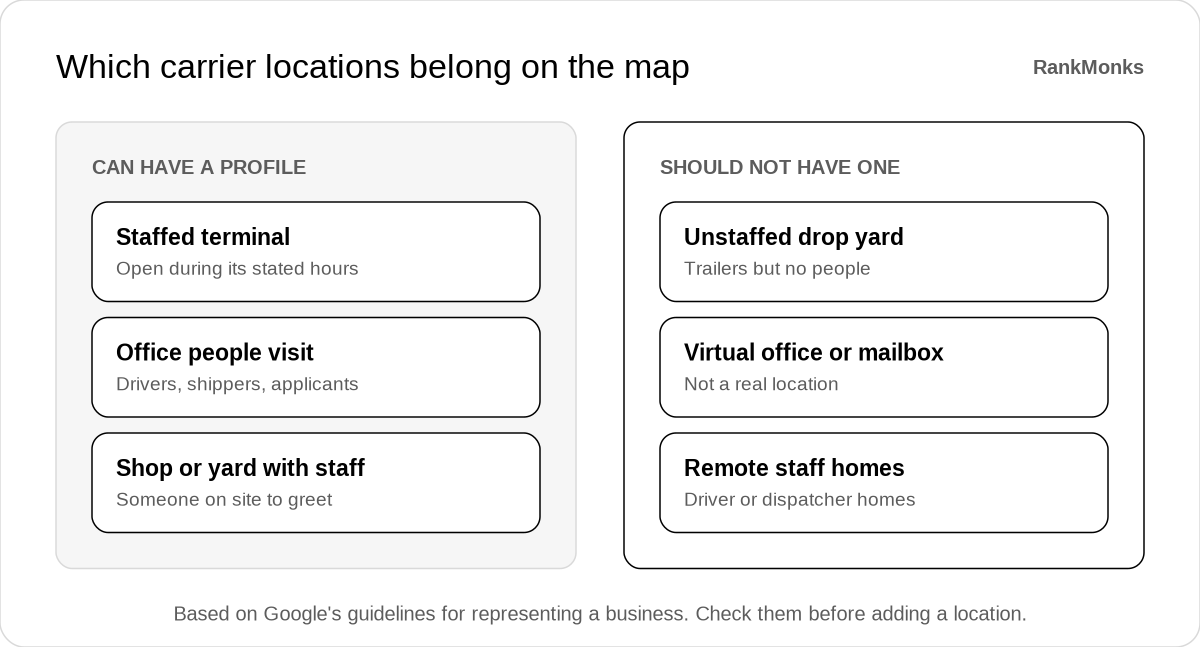
For most carriers, that means:
- Main terminal or headquarters. Almost always qualifies.
- Other staffed terminals. Each can have its own profile, with its own phone number and hours.
- Maintenance shops. Qualify for their own profile only if they serve outside customers under a separate category, such as a truck repair shop open to the public. Otherwise they are part of the terminal.
- Drop yards and trailer pools. Do not qualify if nobody works there.
- Dispatchers or recruiters working from home. Do not qualify.
If your business serves customers at their locations and nobody visits you, Google lets you hide the address and set a service area instead. Most carriers with a terminal will want the address shown, because drivers need to find it.
How should a trucking company set up each Business Profile?
Set up each Business Profile with your real name, the most accurate category, a correct pin and true hours, then fill in every field that applies. Most weak carrier profiles are simply incomplete or out of date.
- Claim or find the profile. Search for your company name and each terminal address first. Claim existing listings instead of creating duplicates.
- Use your real business name. Exactly as it appears on your signs and paperwork. Adding keywords such as "CDL Jobs" or "Flatbed Trucking Texas" to the name breaks Google's guidelines and can get the profile suspended.
- Choose the primary category. "Trucking company" fits most carriers. Add secondary categories only for services you really provide.
- Place the pin carefully. Put it on the entrance trucks and visitors should use, and say in the description if the truck gate differs from the office entrance.
- Set true hours. Use the hours someone is there to answer. If dispatch runs around the clock but the office does not, choose the hours that match what a visitor will find.
- Add a local phone number. Use the terminal's number, or a tracking number that forwards to it, kept consistent everywhere.
- Link to the location page. Point the website link at the page for that terminal, not the home page.
- Describe the location. What runs from here, the equipment based here, whether you are hiring here.
- Add real photos. Trucks, trailers, the terminal, the shop and the team. Update them as the fleet changes.
Our general guide to local SEO covers profile basics that apply to every business.
What moves a terminal up the map?
A terminal moves up the map by being relevant to the search, close to the searcher and prominent. Google names relevance, distance and prominence as the main factors in local results. You cannot change distance, so the work is on the other two.
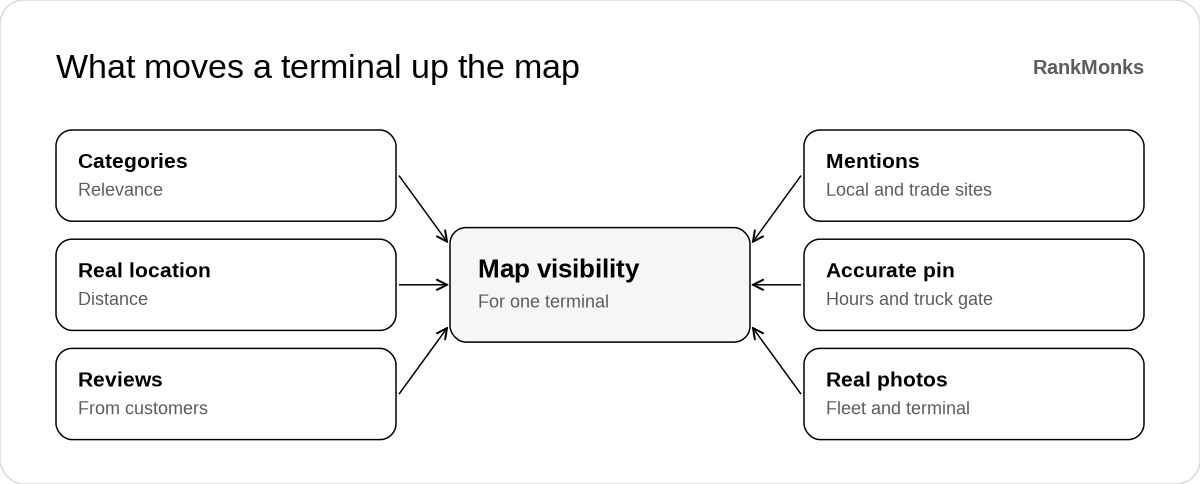
- Relevance comes from the right categories, a clear description, the services listed and a location page that matches what people search for.
- Prominence comes from reviews, links and mentions on other sites, and how well your website ranks in ordinary results.
- Accuracy helps both. Wrong hours, a misplaced pin or a phone that rings out all lead to poor experiences that work against you.
A terminal in an industrial park on the edge of town will not appear for every search in the city center. It can still win searches near it, and searches where its reviews and relevance outweigh distance.
How should a carrier earn reviews?
A carrier should earn Google reviews from customers and visitors who dealt with a terminal, such as shippers, receivers, brokers and vendors, by asking routinely and making it easy. Driver feedback about working for you is better directed to job review sites.
Google's review policies treat reviews written by a business's own staff as a conflict of interest, and they rule out paying for reviews or offering rewards. So:
- Ask customers. Send a short note with a direct review link after a good first load, or when a shipper renews a lane.
- Ask visitors. Vendors and partners who visit the terminal can review the experience.
- Point drivers to job review sites. Encourage honest reviews of you as an employer on the job sites drivers use, and respond to them there.
- Reply to every Google review. Thank people for good ones and answer critical ones calmly, with a way to follow up offline.
- Never buy or swap reviews. Google removes fake reviews and can restrict profiles that receive them.
A steady flow of recent reviews matters more than one burst. Build the request into a routine someone owns.
How should location pages support each profile?
Each Business Profile should link to a location page on your site that confirms and expands on what the profile says. Google reads the site to understand where you are and what you do there.
A good terminal page includes:
- The address, phone number and hours, written exactly as on the profile.
- An embedded map, directions and truck entrance notes, including truck parking if you offer it.
- What runs from this terminal: equipment, services and regions.
- Open driver roles based here, linked to the careers pages.
- A named contact for freight inquiries.
- LocalBusiness structured data, as described in our guide to schema markup.
Link each terminal page from the main navigation or a locations page, and from the service and lane pages that run from it.
Should carriers list on Apple Maps and Bing too?
Yes. Many drivers use Apple Maps on iPhones and in-dash systems, and Bing's local results feed several other services. Claim and complete your listings through Apple Business Connect and Bing Places, with the same name, address, phone and hours as your Google profile.
Keep your details consistent in the other places they appear too: industry directories, association member lists and your FMCSA registration. Consistency does not guarantee rankings, but mismatched details confuse searchers and the systems that read them.
What should you do about fake or spammy competitor listings?
If a competitor has listings at addresses where they have no staffed location, or names stuffed with keywords, you can suggest an edit on the listing or report it through Google's business redress complaint form. Keep evidence, such as photos of an empty lot, and be accurate.
Spam listings can push real terminals down the map. Reporting them is legitimate. Copying them is not, because the same rules apply to you, and a suspended profile can take weeks to restore.
How do you measure map results for each terminal?
Measure map results by the actions people take on each profile, read alongside what happens next in your CRM and applicant tracking system. Map rankings change with the searcher's location, so one ranking check tells you little.
- Profile performance. Calls, direction requests and website clicks, per terminal, each month.
- Tagged website links. Add tracking parameters to each profile's website link so analytics can show visits from the map.
- Calls. Use call tracking to see which profile calls became quotes or applications.
- Reviews. Count and average rating per terminal, over time.
- Applications by terminal. Recruiters should record which terminal an applicant is near and how they found you.
What are the warning signs in local map work?
The warning signs are tactics that put your profiles at risk: profiles for unstaffed locations, keywords added to your business name, bought reviews, and frequent unexplained changes to categories or names. Any of these can lead to suspension.
Be wary of anyone offering "a listing in every city you serve", review packages, or software that generates profiles in bulk. Ask instead how they will improve the profiles you already qualify for.
What should you ask before handing over your listings?
- Which of our locations qualify for a profile, and why?
- What will you change on each profile, and will you tell us before you do?
- How will you get reviews without breaking Google's rules?
- Will we stay the owner of every profile?
- How will you report calls and applications from each terminal?
How do AEO, GEO and AI visibility apply to local maps?
Map listings also feed voice assistants and AI tools. When someone asks an assistant for carriers or trucking jobs nearby, the answer often draws on map data and reviews. How US trucking companies win on local maps with GEO covers how AI tools choose which local carriers to name, and how US trucking companies win on local maps with AEO covers voice answers. Accurate listings are also one of the inputs described in how good SEO boosts AI visibility for US trucking companies.
For the order in which to tackle profiles alongside the rest of the site, see how to implement SEO properly for US trucking companies. And if you have terminals in Canada, how Canadian trucking companies win on local maps with SEO covers bilingual listings and the Canadian details that differ.
How does RankMonks approach local maps for US trucking companies?
RankMonks starts by checking every listing you have, and every one you should have, against Google's guidelines. You get a written audit, with problems ranked by what they cost you in calls and applications, and the fixes go out in small, steady releases.
The person who plans the work is the person who does it. We keep you as owner of every profile, ask before changing anything, and report calls, direction requests, website clicks and reviews per terminal each month in plain language. Profile fixes can show within weeks. Reviews, links and location pages build over months.
Frequently asked questions
Can a trucking company rank on the map in cities where it has no terminal?
Rarely. Distance from the searcher is one of the main factors in map results, so a terminal will struggle to appear in cities far from it. Organic results are different: well-built region and lane pages can rank for searches about places you serve without a terminal there.
Should each terminal have its own phone number?
Yes, where possible. A local number per terminal makes each profile more useful to drivers and shippers nearby, and it lets you measure calls per location. If you use call tracking, keep the tracking number consistent on that profile rather than changing it often.
Can drivers leave Google reviews for their employer?
Google's policies treat reviews from a business's own staff as a conflict of interest, so a carrier should not ask its drivers to review it on Google. Encourage drivers to share honest experiences on job review sites instead, and focus Google review requests on customers and visitors.
What category should a trucking company choose on Google?
"Trucking company" is the right primary category for most carriers. Add secondary categories only for services you really provide to the public, such as a truck repair shop that serves outside customers. Adding categories you do not fit will not help and can mislead searchers.
Winning on local maps is mostly accuracy and upkeep, done terminal by terminal. It is part of how our SEO service works for carriers. If you want your listings checked, start a conversation.
Written by RankMonks.