
GEO9 min read
How US Trucking Companies Win on Local Maps With GEO
Published · RankMonks
US trucking companies win on local maps with GEO by making each staffed terminal easy for AI tools to find, describe and recommend, and by checking what those tools actually say about it. Local questions are common in trucking. Drivers ask which companies near them are hiring, and shippers ask for carriers with a terminal close to their plant or port.
AI tools now answer many of these questions with places, not just links. Google AI Mode can return local results with a map, Google has been adding Gemini features to Maps that let people ask questions about places, and ChatGPT and Perplexity can answer with local businesses too. This article explains which sources shape those answers for a carrier, how to set up each terminal, and how to check the result. It is part of our guide to GEO for US trucking companies.
Key takeaways
- AI tools answer local trucking questions from business listings, reviews, your terminal pages and local mentions, so all of them need to agree.
- Each real, staffed terminal deserves its own Google Business Profile, matching listings on Apple Maps and Bing Places, and its own page on your site.
- Drop yards, unstaffed lots and virtual offices should not be listed as locations. Google's rules require a real place with staff during stated hours.
- Reviews shape how AI tools describe a terminal, so ask shippers and customers for Google reviews, and point drivers to job review sites rather than your map listing.
- Checking local prompts city by city each month shows which terminals are named, which facts are wrong and who is named instead.
How do AI tools answer local questions about trucking companies?
AI tools answer local trucking questions by combining place data, such as business listings and reviews, with pages they find on the web. The answer usually names a few companies and may show them on a map with a short description.
A driver in South Texas might ask, "Which trucking companies in Laredo are hiring CDL-A drivers for regional routes?" A shipper in the Inland Empire might ask, "Is there a flatbed carrier with a yard near Ontario, California that can pick up tomorrow?" A broker might ask for "reefer carriers with a terminal in the Atlanta area".
For each one, the tool looks for businesses that match the place and the need. It weighs what the listings say, what reviews say and what websites say. When those sources agree and are specific, the tool can describe a terminal with confidence. When they disagree or say little, the terminal is left out or described vaguely.
The local map pack in ordinary Google search still matters too, and many of the same inputs drive it. Our guide on how US trucking companies win on local maps with SEO covers that side.
Which sources shape a carrier's AI map answer?
A carrier's AI map answer is shaped by six kinds of source, and only one of them is your own website.
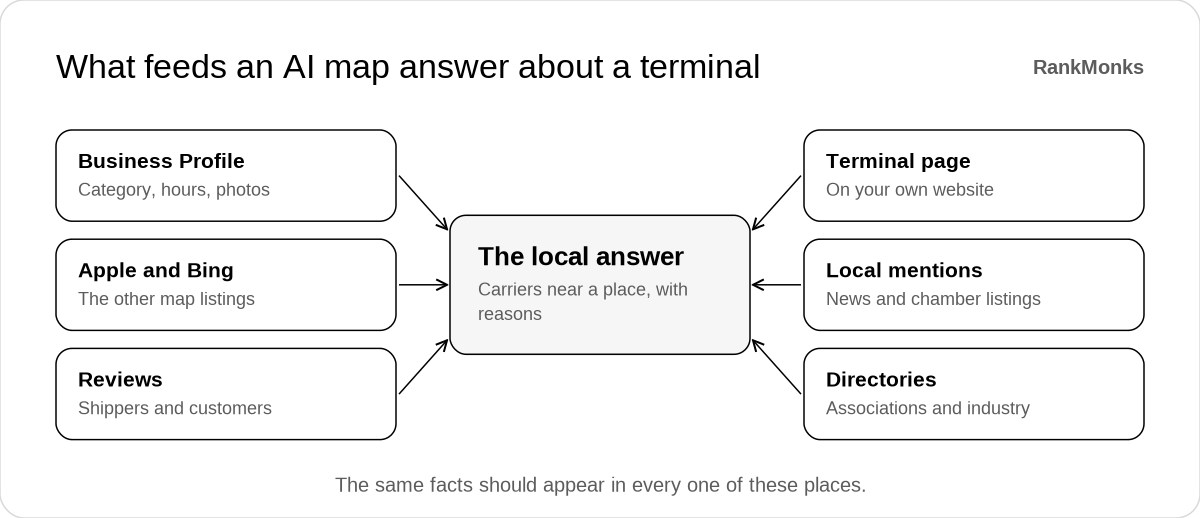
| Source | What it tells AI tools | What to check |
|---|---|---|
| Google Business Profile | Category, address, hours, photos, reviews | One profile per staffed terminal, accurate category and hours |
| Apple Maps and Bing Places | The same facts for other assistants and maps | Claimed, matching your Google details |
| Reviews | What shippers and customers say about the location | Recent, honest, with professional replies |
| Your terminal page | What runs from the location and what it hires for | Address, hours, equipment, jobs, photos |
| Local mentions | That the business is real and active locally | News, chamber of commerce, community involvement |
| Directories | Industry and association confirmation | State trucking association and industry listings |
Apple Business Connect lets you manage how your business appears in Apple Maps, and Bing Places does the same for Microsoft's maps. Claiming both takes little time and removes a common source of conflicting details.
How should each terminal be set up for AI map answers?
Each terminal should have one accurate listing per platform, a matching page on your site and photos that show it is a working location. Consistency between them matters more than any single field.
- Only list real, staffed locations. Google requires a business to make in-person contact with customers during its stated hours at the address it lists. A staffed terminal with a dispatch office qualifies. A drop yard, an unstaffed parking lot or a virtual office does not, and listing them risks suspension.
- Use your real business name. Keep the name the same as on your trucks, your registration and your site. Adding keywords such as "Best Flatbed Trucking Dallas" breaks Google's guidelines.
- Choose the most specific category. "Trucking company" fits most carriers. Add secondary categories only for services the terminal really provides.
- Set hours that match reality. List the hours when someone is there to meet visitors or drivers. If dispatch runs around the clock, say so in the description and on the terminal page.
- Write a plain description. What runs from this terminal, which freight and equipment, and that it hires drivers if it does.
- Add real photos. The terminal, the yard, the trucks and trailers, the shop and the team. They show the location is real and help tools describe it.
- Link each profile to its own terminal page. Not to your homepage.
- Build the terminal page. Address, hours, a map, equipment based there, lanes served, the jobs it hires for and a contact route for drivers and shippers. Our guide to local SEO covers location pages in more depth.
A carrier with terminals in Dallas, Memphis and Atlanta would have three profiles, three terminal pages and three matching sets of Apple and Bing listings, each linked to the right page.
How do reviews affect AI map answers for a terminal?
Reviews affect AI map answers because tools summarize what people say about a place, and Google has begun showing AI-written summaries of reviews for some places. If shippers keep mentioning missed pickups or slow communication, that can become part of how your terminal is described.
The review routine needs to follow Google's rules on who may review you:
- Shippers. Ask after a delivery that went well, with a direct link to the terminal's review form.
- Not your drivers or staff. Google treats reviews of a business by its current or former employees as a conflict of interest, so do not ask drivers, dispatchers or office staff to review your terminal on Google. Drivers can review you as an employer on job review sites such as Indeed and Glassdoor, which tools may also read.
- Replies. Reply to every review, including critical ones, briefly and professionally. Do not argue or share private details.
- Rules. Never offer rewards for reviews and never ask only the people likely to be happy. Both break Google's policies.
The most useful reviews are specific. "Picked up on time, kept us updated and delivered without damage" tells a tool more than five stars with no text.
How do you check what AI tools say about each terminal?
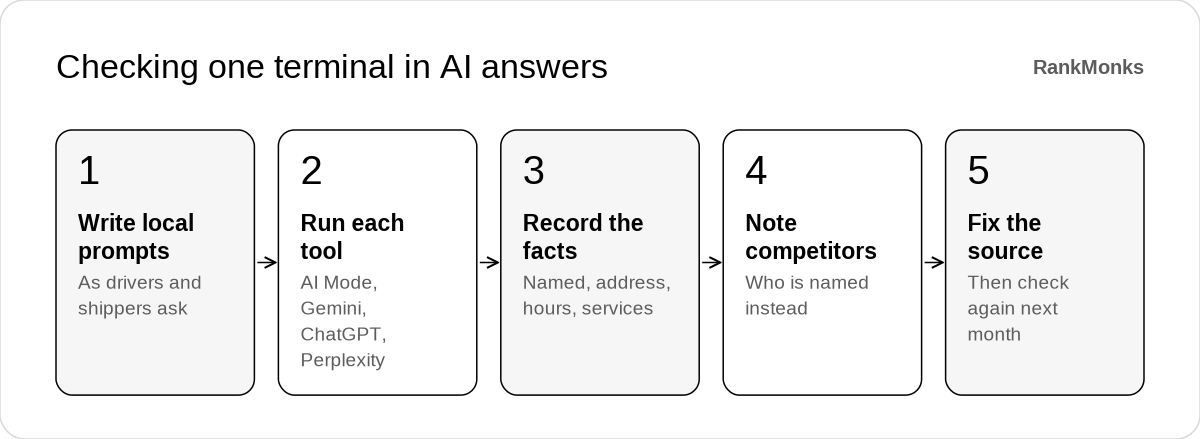
You check each terminal by running a short set of local prompts for its city in the main AI tools every month, then recording what they say. Write the prompts the way drivers and shippers would ask them.
| Terminal city | Driver prompt | Shipper prompt |
|---|---|---|
| Laredo, TX | "Trucking companies in Laredo hiring for regional routes" | "Carriers with a Laredo yard for cross-border dry van freight" |
| Memphis, TN | "Memphis trucking jobs with home time every week" | "Reefer carriers based near Memphis for the Southeast" |
| Ontario, CA | "Inland Empire trucking companies hiring local drivers" | "Flatbed carrier near Ontario, California for next-day pickup" |
For each answer, record whether the terminal is named, whether its address, hours and services are right, and which competitors are named instead. When a fact is wrong, trace it to the source the tool most likely used, fix it there, and check again next month. Our guide to fixing wrong AI answers about your brand sets out that process.
For a full tracking method across every terminal, see how US trucking companies win on local maps with AI visibility tracking.
What warning signs should a carrier watch for in local GEO?
The warning signs in local GEO are fake locations, keyword-stuffed names and review shortcuts. Each can get listings suspended, which removes you from maps and from the AI answers that draw on them.
- Listings for places you are not. Profiles at drop yards, virtual offices or a dispatcher's home address.
- Stuffed business names. Adding services or cities to your name on the listing.
- Review gating or rewards. Asking only happy customers, or paying for reviews.
- Duplicate listings. Two profiles for the same terminal, often left over from a move or a rebrand.
- No checking. Listings set up once and never compared with what AI tools actually say.
What should you ask an agency about local GEO?
Ask how they would handle your specific terminals and how they will show you what changed.
- Which of our locations qualify for a listing under Google's rules, and which do not?
- How will you make our Google, Apple and Bing listings match our site and registration?
- Which local prompts will you track for each terminal, for drivers and for shippers?
- How will you trace a wrong answer back to its source?
- How will the monthly report show terminal-by-terminal changes?
How does local GEO fit with your other work?
Local GEO is one part of a wider plan. The same terminal listings also drive the ordinary map pack, and voice assistants read them too. How US trucking companies win on local maps with AEO covers voice and assistant answers, and how to implement GEO properly for US trucking companies puts the terminal work into a 90-day plan. Once listings are fixed, how good GEO boosts AI visibility for US trucking companies explains how to read the effect.
If you have terminals in Canada as well, provincial details, French-language listings and Canadian directories come into play. See how Canadian trucking companies win on local maps with GEO. For the full method, return to GEO for US trucking companies.
How does RankMonks approach local GEO for US trucking companies?
RankMonks starts by recording what AI models and search engines say about each of your terminals today. You then get a written audit covering SEO, AEO and GEO, with problems ranked by what they cost you, including listing errors, missing terminal pages and conflicting facts.
The fixes ship in small, steady releases. We track an agreed set of local prompts across ChatGPT, Claude, Perplexity, Gemini, Grok, Google AI Overviews and AI Mode, and report each month in plain language what changed and what we will do next. We do not guarantee placements, and we are honest that some changes take months.
Frequently asked questions
Can a trucking company list a drop yard on Google Maps?
Usually not. Google requires a location to have staff who meet customers in person during its stated hours. An unstaffed drop yard does not meet that rule, and listing it risks having the profile suspended. List staffed terminals and offices, and describe drop yards on your terminal pages instead.
Should each terminal have its own Google Business Profile?
Yes, if each one is a real location with staff during stated hours. Each profile should use the same business name, link to its own terminal page on your site, and show that terminal's address, phone number and hours.
Do Apple Maps and Bing Places matter for trucking companies?
Yes. Apple Maps feeds Siri and Apple devices, and Bing Places feeds Microsoft's maps and services. Claiming both and matching them to your Google details removes conflicting facts that AI tools might otherwise pick up.
How often should we check AI answers for each terminal?
Monthly is enough for most carriers. Answers vary from run to run, so check the same prompts each time and read the trend over several months rather than reacting to a single answer.
Winning local AI answers is a matter of accurate listings, honest reviews and regular checks. Our SEO service covers SEO, AEO and GEO together for carriers, terminal by terminal. If you want to know what AI tools say about your terminals today, start a conversation.
Written by RankMonks.