
SEO9 min read
How to Implement SEO Properly for US Trucking Companies
Published · RankMonks
To implement SEO properly, a US trucking company needs to do the work in the right order: measure first, fix what is broken, build the pages shippers and drivers look for, and only then go after links and reviews. Most failed SEO projects at carriers did reasonable things in the wrong order, such as writing blog posts on a site that Google could not crawl, or running a review drive with no way to see whether it brought in applications.
This guide is the practical companion to our guide to SEO for US trucking companies. It sets out the first 90 days step by step, who inside the carrier supplies what, the mistakes that waste the most time and how to check that each step worked.
Key takeaways
- Set up tracking for quote requests, calls and driver applications before changing anything, or you will never know what worked.
- Fix technical problems and Business Profiles first, because they hold back every page you build later.
- Build service, safety and careers pages from facts supplied by dispatch, safety and recruiting, not from guesses.
- Add lane and job pages only for lanes you really run and jobs that are really open.
- Check each step against a clear test before moving on, and read results over quarters, not weeks.
What does implementing SEO properly mean for a carrier?
Implementing SEO properly means doing the work in an order where each step makes the next one more effective, and measuring each step against business results. For a carrier, those results are quote requests, calls, driver applications and the loads and hires that follow.
It also means involving the people who know the facts. An SEO lead can structure a page, but only dispatch knows which lanes run every week, only the safety manager can confirm what goes on the compliance page, and only the recruiter knows what each driver role pays. Pages built without them are vague, and vague pages do not rank or convert.
What should you set up before any SEO work starts?
Before any SEO work starts, set up access to every account and tracking for every action that matters. Without this, you will spend money and have no way to show what it produced.
- Collect access. Domain registrar, website platform, Google Search Console, Google Analytics, every Google Business Profile, Bing Webmaster Tools and Bing Places. Make sure the company owns each account, not a former agency or employee.
- Track conversions. Quote form submissions, clicks on phone numbers, application starts and completions. Track each one as an event in analytics.
- Track calls. Use call tracking that keeps your main numbers consistent on listings, and record which page or profile a call came from.
- Record the source in your systems. Pass the landing page and channel into your CRM and your applicant tracking system.
- Ask people. Add "how did you hear about us?" to the quote form and the driver application.
- Take a baseline. Record current rankings for key searches, profile actions, monthly quote requests and applications by source.
This takes a week or two and is the least exciting part of the project. It is also the part that lets you prove everything else.
What is the right order of work?
The right order is to track, fix the site, fix the profiles, build core pages, add lane and job pages, and then earn reviews and links while measuring results. Each phase depends on the one before.
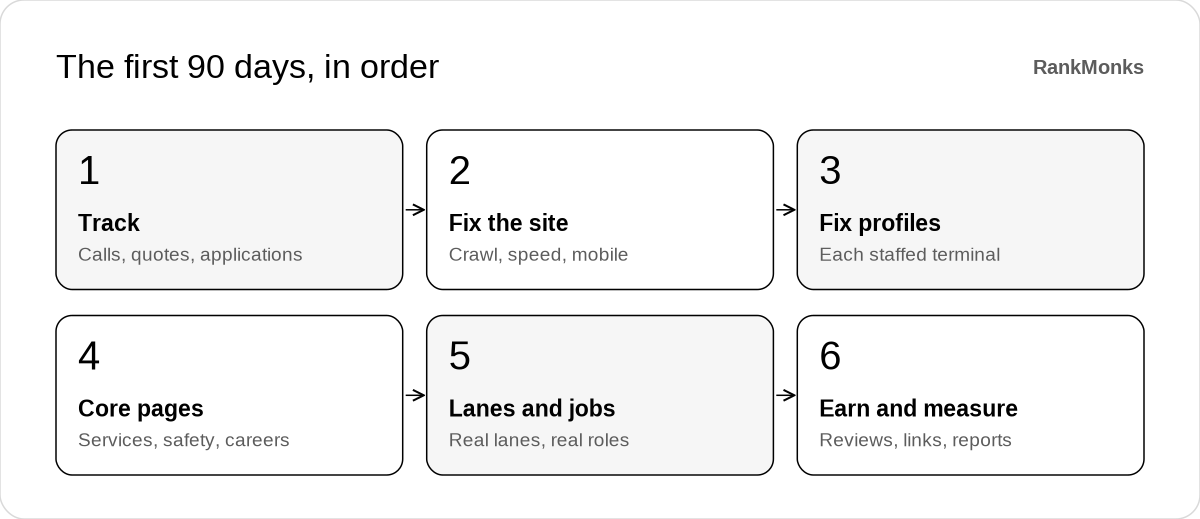
Days 1 to 30: track and fix
Finish the tracking setup, then run a technical SEO audit. On carrier sites, the most common problems are pages Google cannot index, slow mobile pages, job details locked in PDFs or third-party portals, duplicate templated pages and broken redirects from old site versions.
In the same month, fix each Google Business Profile. Confirm which locations are real and staffed, set the right categories, correct hours and pins, and remove or merge duplicates. Our guide on how US trucking companies win on local maps with SEO covers this in detail.
Days 31 to 60: build the core pages
Build or rebuild the pages every carrier needs:
- Service pages, one per equipment type or mode you run.
- A safety and compliance page, with your USDOT number, operating authority where it applies, insurance and safety program.
- Careers pages, one per driver role, with pay structure, home time, equipment, requirements and hiring areas.
- Location pages, one per staffed terminal.
- A quote page with a short form and a staffed phone number.
Use keyword research to confirm the words each audience uses. Drivers search "home weekly" and "regional", not "network optimization". Shippers search "reefer" and "LTL", not "temperature-controlled solutions".
Days 61 to 90: lanes, jobs and reputation
Add lane and region pages for the states, regions and regular lanes you really serve. Each page should say what equipment runs there, what you typically haul, transit expectations and how to get a quote. Link each lane page to the matching service pages, and back.
Add individual job postings for open roles, marked up with JobPosting structured data so they can appear in Google's job results. Google's guidelines ask employers to keep postings accurate and to remove them, or mark them expired, once the job is filled.
Start a review routine with shippers and other customers, point drivers to job review sites for feedback about working for you, and begin earning links from associations, customers, partners and local news.
After 90 days: measure and expand
Report results by page group: service, lane, location and careers. Expand what works, fix what does not, and refresh pages when facts change. Our guide to schema markup covers the structured data worth adding as the site grows.
Who inside the carrier does what?
SEO at a carrier works best when the people who hold the facts each own a small, clear part of the work. The SEO lead plans and writes, but cannot invent lanes, pay rates or safety details.
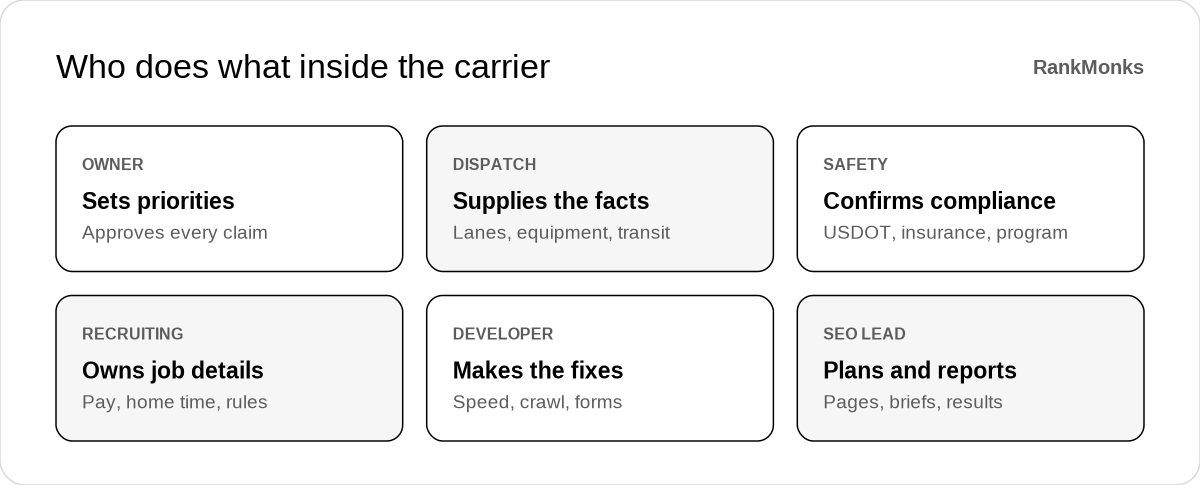
| Role | Supplies | Time needed |
|---|---|---|
| Owner or general manager | Priorities, sign-off on claims and pay statements | An hour or two a month |
| Dispatch or operations | Lanes run, equipment, transit times, regions | A short interview, then updates when lanes change |
| Safety manager | USDOT and authority details, insurance, safety program | A review of the compliance page |
| Recruiter | Pay structures, home time, requirements, hiring areas per role | Updates whenever a role changes |
| Web developer | Technical fixes, forms, page templates | Depends on the audit |
| SEO lead | Plan, page briefs, writing or editing, reporting | Ongoing |
If you have no in-house developer, the SEO lead or agency should be able to make most changes directly or work with your website provider.
What are the most common SEO mistakes carriers make?
The most common mistakes are building pages before fixing the site, creating hundreds of templated lane or city pages, hiding job details where Google cannot read them, and measuring traffic instead of business results.
- Writing blog posts first. Articles do little when service and careers pages are thin or missing.
- Templated city pages. Pages that only swap a city name are low value, and at scale they risk Google's spam policies.
- One careers page for everything. OTR, regional, local and owner-operator roles have different searches and different questions.
- Stale job postings. Filled roles left live frustrate drivers and break Google's job posting guidelines.
- Fake locations. Business Profiles at drop yards or mailboxes can be suspended.
- Stock photos. Real trucks, real terminals and real people build more trust.
- No owner for updates. When lanes, pay or equipment change and the site does not, pages slowly stop matching searches.
How do you check that each step worked?
Check each step against a simple test before moving on. If a step fails its test, fix it before building on top of it.
| Step | How to check it worked |
|---|---|
| Tracking | Submit a test quote, place a test call and start a test application, then confirm each appears in analytics and your CRM or applicant system |
| Technical fixes | Key pages show as indexed in Search Console, and mobile pages load quickly |
| Business Profiles | Searching your company name shows the right details for each terminal |
| Core pages | Search Console shows impressions for service and careers searches within weeks |
| Lane and job pages | Job postings appear in Google's job results, and lane pages start earning impressions |
| Reviews and links | Review count and new referring sites grow month by month |
What warning signs show the implementation is going wrong?
The warning signs are activity without outcomes. If months pass with plenty of reports but no change in quote requests or applications from search, or if pages go live without anyone from operations checking them, the project has drifted.
Watch for reports that list tasks but not results, page counts growing faster than useful content, profiles changed without your knowledge, and nobody able to say which searches each page targets.
What should you ask whoever implements your SEO?
Ask questions that keep the work tied to facts and to outcomes, whether you are briefing an agency or an in-house lead.
- What will be live and measurable at 30, 60 and 90 days?
- Which searches does each new page target, and who checked the facts on it?
- How are filled job postings removed?
- How will we know whether quote requests and applications came from search?
- What do you need from our team each month?
How does implementation differ for AEO, GEO and AI visibility?
The same foundations carry over, but each discipline adds its own steps. AEO adds question research and answer-first page structure, covered in how to implement AEO properly for US trucking companies. GEO adds work on third-party sources and consistent facts across the web, covered in how to implement GEO properly for US trucking companies.
If your company also runs into Canada or has Canadian terminals, how to implement SEO properly for Canadian trucking companies covers the extra steps there, such as French-language pages for Quebec. And if you are still building the internal case for the work, start with why SEO is important for US trucking companies.
How does RankMonks approach SEO implementation for US trucking companies?
RankMonks follows the order in this guide. We listen first, reading your site, profiles, search data and what AI tools say about you. Then you get a written audit covering SEO, AEO and GEO, with problems ranked by what they cost you, so the fixes that matter most ship first.
Work ships in small, steady releases, either as short tickets for your developer or as changes we make ourselves. The person who plans the work does it, and we ask your dispatch, safety and recruiting teams for the facts rather than guessing. Each month you get a plain-language report covering rankings, quote requests, applications and AI citations, with what we did and what comes next.
Frequently asked questions
How long does it take to implement SEO for a trucking company?
The first 90 days cover tracking, fixes, core pages and the first lane and job pages. Rankings usually take three to six months to move after content and authority work begins. SEO then continues as ongoing upkeep, because lanes, jobs and competitors keep changing.
Can a trucking company implement SEO without a developer?
Many carriers can, if their website platform lets them edit pages, titles and forms directly. Technical fixes such as site speed, redirects and structured data may need a developer or an agency that can make the changes. The audit will show how much technical work is involved.
Should job postings go on our own site or on job boards?
Post on your own site first, with JobPosting markup, so your careers pages can appear in Google's job results. Job boards can still help reach more drivers. Your own pages give you a channel you control and a place to send drivers who find you elsewhere.
What should we do with old pages when we rebuild the site?
Keep pages that bring traffic or links, and redirect the rest to the closest matching new page. Removing pages without redirects loses whatever rankings and links they had. A crawl of the old site before launch shows which pages need redirects.
SEO works for carriers when it is implemented in order, built on real facts and measured by real results. That is how our SEO service runs. If you want a plan for your company, start a conversation.
Written by RankMonks.