
SEO8 min read
How to Implement SEO Properly for Canadian Trucking Companies
Published · RankMonks
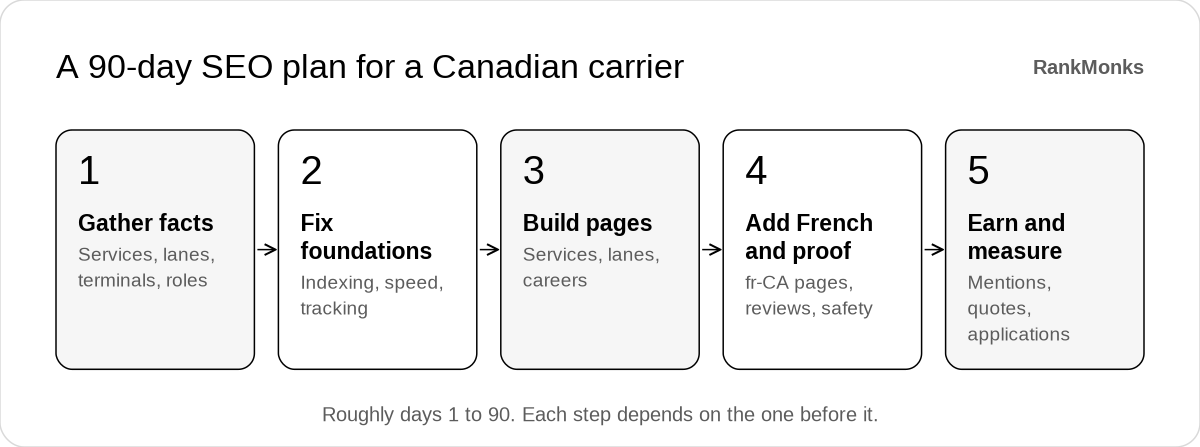
Implementing SEO properly for a Canadian trucking company means doing the work in the right order: gather the facts, fix the technical foundations, build the pages shippers and drivers search for, add French and proof, then earn links and measure. Most SEO projects that fail at carriers did reasonable things in the wrong order, such as publishing blog posts on a site Google could not index properly.
This guide sets out a 90-day plan, who inside the company does what, the mistakes that waste months and how to check each step. It sits under our complete guide to SEO for Canadian trucking companies, which explains the strategy behind each step.
Key takeaways
- Gather your facts before you touch the site: services, equipment, lanes, terminals, driver roles and credentials.
- Fix indexing, speed, forms and tracking first, because everything else depends on them.
- Build one page per service, lane, terminal and driver role, then add French versions where you serve Quebec.
- SEO at a carrier needs input from dispatch, safety and recruiting, not only from whoever runs the website.
- Check each step against Search Console and your quote and application counts before moving on.
What should you do before you touch the website?
Before you change anything, write down what the carrier actually does and whom it wants to reach. SEO pages are only as good as the facts in them, and those facts usually live in dispatch, safety and recruiting, not in marketing.
Gather:
- Services and equipment. Every trailer type you run and the freight you haul, including dangerous goods under TDG rules if you handle them.
- Lanes. The routes you run most, the ones you want to grow and the border crossings you use.
- Terminals. Every location, which ones are staffed, their hours and what is run from each.
- Driver roles. AZ or Class 1, long haul, regional, local, team and owner-operator, with pay structure and home time for each.
- Credentials. Your NSC number or provincial safety certificate, CVOR status in Ontario, insurance, and FAST, PIP or C-TPAT membership if you hold it.
- Access. Who controls the domain, the website, Google Search Console, analytics and each Business Profile.
If nobody can log in to Search Console or a Business Profile, sort that out first. You cannot measure or fix what you cannot reach.
What should you fix in the first 30 days?
In the first 30 days, fix the technical foundations and set up tracking, so that every page you build later can be found and measured. Start with a technical SEO audit and work through it in order of impact.
- Indexing. Check in Search Console which pages are indexed. Remove or redirect old, duplicate and test pages. If you run both a .ca and a .com, choose one main version and redirect the other to it.
- Mobile speed. Compress truck and yard photos and remove unused scripts. Drivers often browse on a phone with a weak signal.
- Forms. Test the quote form and the job application on a phone, end to end, and make sure each notification reaches someone who acts on it.
- Tracking. Record quote requests, calls and applications as conversions in analytics.
- Business Profiles. Claim and verify a profile for each staffed terminal and correct the basics. The details are in how Canadian trucking companies win on local maps with SEO.
What should you build in days 31 to 60?
In days 31 to 60, build the pages that match how shippers and drivers search. Each page should serve one clear need and say specific, verifiable things about it.
- Service and equipment pages. One each for dry van, reefer, flatbed, LTL or whatever you run, stating the equipment, regions, freight types and handling requirements.
- Lane pages. Start with the lanes you run most often and want more of. Describe the route, the crossings, the equipment on that lane and transit you can actually meet.
- Terminal pages. One per staffed location, with gate directions for trucks, hours, dispatch phone and the jobs based there. Link each from its Business Profile.
- Careers pages. One per role, with pay structure, home time, lanes, equipment and requirements. Add JobPosting structured data so jobs can appear in Google's job results, and update or remove postings as soon as roles are filled.
- Safety and compliance page. Your credentials, insurance and cross-border programs, stated plainly.
Plan the URLs and menus before writing, as our guide to site architecture explains, and link related pages together. A lane page should link the equipment it uses and the quote form.
What should you do in days 61 to 90?
In days 61 to 90, add French pages if you serve Quebec, put structured proof on the site, start a review routine and begin earning links.
- French pages. Translate the service, terminal and careers pages that matter to Quebec customers and drivers, have a fluent French speaker who knows the industry review them, and link the versions with hreflang for en-CA and fr-CA. Quebec's Charter of the French Language generally requires French for commercial content aimed at Quebec, so check the current requirements.
- Structured data. Add Organization markup for the company and LocalBusiness markup for each terminal page. Our guide to schema markup covers the details.
- Reviews. Ask shippers and other customers for a Google review after a successful delivery, with a short message and a direct link. Do not ask your own drivers or staff: Google's policies treat reviews from current or former employees as a conflict of interest. Point drivers to job review sites such as Indeed or Glassdoor instead. Reply to every review.
- Links. Update your listing with the Canadian Trucking Alliance or your provincial association, ask partners who list carriers to include you, and pitch one genuinely newsworthy story to the trade press.
- Internal links. Connect services, lanes, terminals and careers so every page is a click or two from the quote form or the application. See internal linking.
Who should do what inside the carrier?
SEO at a carrier works best when each piece of knowledge comes from the person who holds it. Whoever builds the website cannot write an accurate lane page without dispatch.
| Role | What they contribute |
|---|---|
| Owner or general manager | Priorities: which freight and which hires matter most |
| Dispatch or sales | Lanes, equipment, transit times and the questions shippers ask |
| Safety and compliance | Credentials, insurance, TDG and cross-border programs |
| Recruiter | Driver roles, pay structure, home time and the questions drivers ask |
| French-speaking staff | Review of French pages and Quebec terminology |
| Web developer or agency | Technical fixes, page builds, structured data and tracking |
Give each person a short list of questions rather than asking them to "write some content". A dispatcher can answer "which lanes do shippers ask about most?" in a minute.
What mistakes should you avoid?
The most common mistakes are copying pages across cities, machine-translating French and building content before the foundations work.
- City-swap pages. Twenty pages that differ only by city name add nothing and can be treated as doorway pages. Build pages for real lanes and real terminals.
- Unreviewed machine translation. It reads badly to exactly the people you want to reach.
- One careers page for every role. An AZ local driver and a long-haul team driver want different information.
- Fake locations. Profiles for cities where you have no staffed site risk suspension.
- Claims you cannot back up. "Safest carrier in Canada" helps nobody. Specific credentials and facts do.
- Blogging first. Articles on a site with indexing problems or no tracking waste the effort.
How do you check each step worked?
Check each step against something you can see before moving to the next. SEO done blind tends to drift.
| Step | How to check it |
|---|---|
| Indexing fixes | Search Console shows the right pages indexed and errors falling |
| Speed | Core Web Vitals in Search Console improve on mobile |
| Tracking | A test quote request and a test application appear in analytics |
| New pages | Each page gains impressions for its target searches within weeks of being indexed |
| Business Profiles | Profile performance shows calls, direction requests and website clicks |
| French pages | Search Console shows French queries with impressions in Quebec |
| Reviews and links | Review count and new referring domains grow month by month |
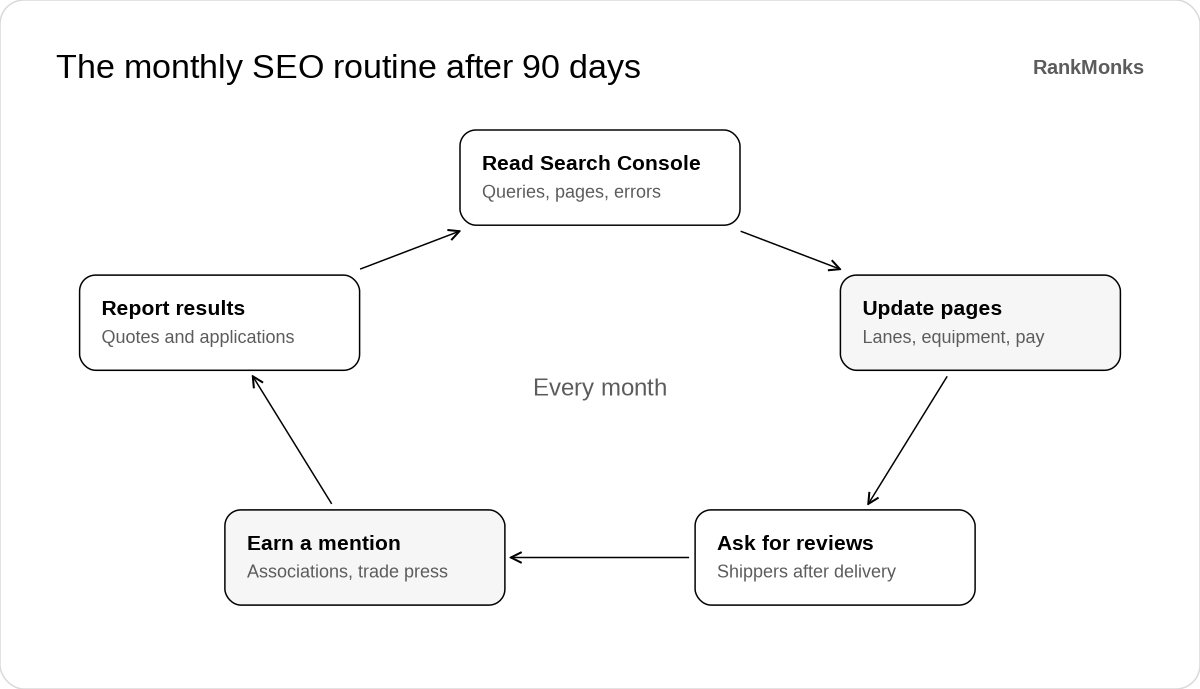
After 90 days, settle into a monthly routine.
What should you ask an agency that offers to implement this?
Ask how they would sequence the work, who does it and how you will see progress.
- What would you fix in the first month, and why in that order?
- How will you get facts from our dispatch, safety and recruiting teams?
- How do you handle French pages and hreflang?
- Which of our locations should have Business Profiles?
- How will we see quote requests and applications in your reports?
- Who owns the accounts and the work if we part ways?
The same sequencing applies to answer engines and AI tools, covered in how to implement AEO properly for Canadian trucking companies and how to implement GEO properly for Canadian trucking companies. If you also run a US operation, see how to implement SEO properly for US trucking companies. Once the foundations are in, how good SEO boosts AI visibility for Canadian trucking companies shows what the same work does for AI answers.
How does RankMonks approach SEO implementation for Canadian trucking companies?
RankMonks follows the same order. We listen first, reading your site, search data, terminal profiles and what search engines and AI models say about you. Then you get a written audit covering SEO, AEO and GEO, with problems ranked by what they cost you.
We build in small, steady releases: technical fixes first, as short tickets your developer can pick up or as changes we make ourselves, then pages, profiles and proof. The person who plans the work does it, and we take on a small number of clients at a time. Each month you get a plain-language report on rankings, traffic, citations and share of AI answers, with what we did and what comes next.
Frequently asked questions
How long does it take to implement SEO for a carrier?
A focused first phase takes around three months: one for foundations, one for core pages and one for French, proof and links. Results follow on their own timeline. Technical fixes can show within weeks, while new pages usually take three to six months to move rankings.
Can we implement SEO in-house?
Yes, if someone owns it and has time each week, and you have access to a developer for technical fixes. Many carriers gather facts and handle reviews in-house and use outside help for technical work and page structure. The full guide to SEO for Canadian trucking companies explains each part.
Do we need a new website to implement SEO?
Usually not. Most carrier sites can be fixed and extended. A rebuild makes sense when the platform cannot be crawled properly, cannot handle separate French pages or makes every change slow and expensive. If you do rebuild, redirect every old URL to its new equivalent.
What should we do first if we only have time for one thing?
Fix your Business Profiles, then the careers or service page closest to your most urgent need. If you are short of drivers, build a detailed careers page for that role. If you are short of freight, build the page for the service or lane you most want to fill. Then work outward.
SEO pays when the right work is done in the right order and checked as it goes. That is how our SEO service runs. If you would like a plan for your carrier, start a conversation.
Written by RankMonks.