
AEO9 min read
How Canadian Trucking Companies Win on Local Maps With AEO
Published · RankMonks
Canadian trucking companies win on local maps with AEO by making every staffed terminal easy for search engines and voice assistants to describe without guessing. When a driver asks "which trucking companies near Brampton are hiring?" or a shipper asks "what time does the Laval terminal open?", the reply usually comes from a business listing and the page behind it. If those are complete and consistent, the reply can name you, correctly.
This guide covers which local questions end in a map answer, which listings assistants read, how to make each terminal listing and page answer-ready, how reviews feed the answers, and how to test them each month. It is part of our guide to AEO for Canadian trucking companies.
Key takeaways
- Local trucking questions, from drivers looking for work and shippers looking for a terminal, often end in a map card or a single spoken reply.
- Assistants draw these answers mainly from business listings, so each staffed terminal needs a complete listing on Google, Apple and Bing.
- List only real locations staffed during their stated hours, because drop yards, trailer lots and virtual offices break the rules and risk suspension.
- Each terminal page should answer the local questions first: address, hours, what is handled there, hiring status and how trucks get in.
- Check the answers monthly, in English and French, by asking the assistants the questions your shippers and drivers ask.
Which local questions end in a map answer?
Local questions end in a map answer when the person wants a place, its hours or its distance. In trucking, they come from two directions: drivers looking for work nearby, and shippers or visitors looking for a specific terminal.
| Question | Who asks | Where it is usually answered | What the answer draws on |
|---|---|---|---|
| "Trucking companies near me hiring" | Drivers | Map results, job results, voice | Listings and careers pages |
| "Entreprise de camionnage près de moi" | French-speaking drivers and shippers | Map results, voice | Listings and French pages |
| "Is the Mississauga terminal open Saturday?" | Shippers, drivers | Listing card, voice reply | Listing hours |
| "LTL terminal in Winnipeg" | Shippers | Map results | Listing category and services |
| "Directions to the Delta yard" | Drivers, visitors | Maps app | Listing address and pin |
| "Cross-dock near Calgary airport" | Shippers | Map results, AI Overview | Listings and terminal pages |
Google says local results depend mainly on relevance, distance and prominence, and a voice assistant usually reads out only the top one or two. Our guide to local SEO covers the ranking side. This article covers making the answer itself right.
Which listings do assistants read?
Assistants read the business listings their own platforms maintain, and some also read directories and your website. In practice, three listings matter most for a Canadian carrier:
- Google Business Profile, which feeds Google Search, Google Maps, Google's assistant and Google's AI features.
- Apple Business Connect, which controls how you appear in Apple Maps and, through it, many of the local answers Siri gives on iPhones.
- Bing Places for Business, which feeds Bing's results and maps, and services that rely on Bing.
Other AI tools that answer local questions draw on a mix of web results, directories and review sites, and they do not always say which. The safest approach is to keep every listing you control identical, then check what each assistant actually says.
How do you make each terminal listing answer-ready?
A terminal listing is answer-ready when an assistant could answer the common local questions from it alone: what the place is, where it is, when it is open, what happens there and whether people trust it.
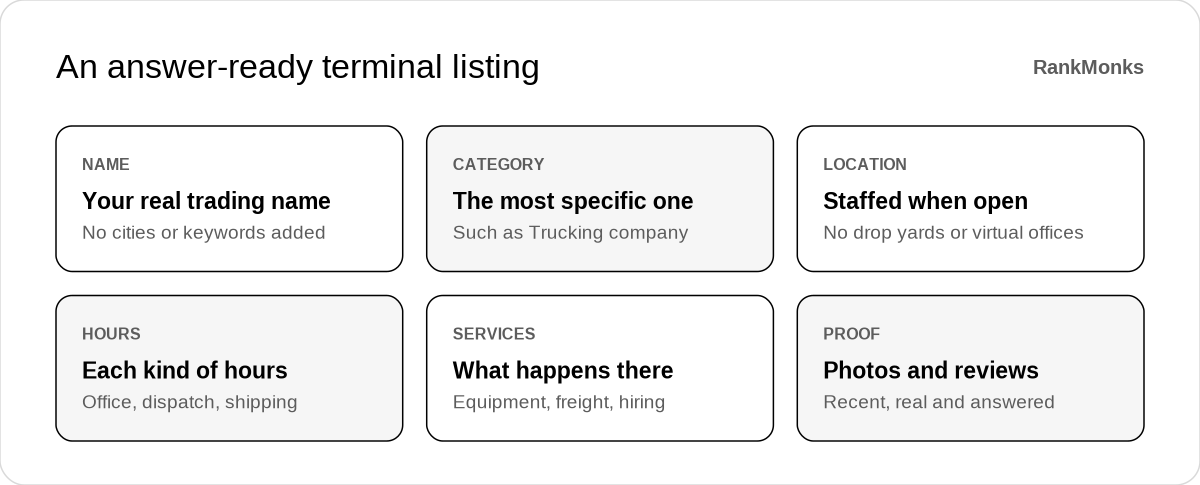
Work through each listing:
- Use your real trading name. Adding "Trucking Jobs Brampton" to the name breaks Google's guidelines and can get the listing suspended.
- Pick the most specific primary category. "Trucking company" is the usual choice. Add secondary categories only for things you do at that site, such as warehousing.
- List only real, staffed locations. Google expects a listed location to be staffed during its stated hours. A drop yard, a trailer lot or a virtual office should not have its own listing.
- Set the hours carefully. Where Google offers extra hours types for your category, use them for dispatch or the shipping dock; otherwise list the main hours and put the rest on the terminal page. Update holiday hours before every statutory holiday, including provincial ones such as Family Day or the Fête nationale in Quebec.
- Name the services. Dry van, reefer, LTL, cross-dock, driver hiring: the words people search with.
- Write a plain description. Say what the terminal handles and who it serves. If it mainly serves French-speaking customers, write the description in French.
- Add real photos. The entrance, the yard, the dock and the trucks, so drivers recognize the place when they arrive.
- Place the pin where trucks enter. If the truck gate is on a different road from the office, say so on the terminal page as well.
- Copy the details to Apple and Bing. Every field should match the Google listing.
What should each terminal page say?
Each terminal page should answer the questions a listing cannot hold, in its first lines, then give the detail. The listing links to the page, and assistants that read the web use both.
A strong terminal page opens with something like: "Our Laval terminal handles LTL and full-truckload freight for Quebec and eastern Ontario. The office is open Monday to Friday, 7 a.m. to 6 p.m., and the dock receives until 4 p.m. We are hiring Class 1 drivers for regional runs."
Below that, include:
- The full address, written exactly as on the listings, with a map and the truck entrance described.
- Each set of hours.
- The services and equipment based at the terminal.
- The lanes it serves, linking to the lane pages.
- Current driver openings, linking to the careers pages.
- Parking and check-in instructions for visiting drivers.
- A French version for terminals in Quebec or serving French-speaking areas, linked with hreflang.
Add LocalBusiness structured data with the same name, address, phone number and hours. Our guide to schema markup shows how.
How do reviews feed local answers?
Reviews feed local answers in two ways: they affect which terminal is shown, and assistants increasingly summarize what reviewers say. A terminal with recent, specific reviews from shippers gives an assistant something accurate to repeat.
- Ask the right people. Ask shippers, consignees and other customers after a smooth pickup or delivery. Do not ask your own drivers or other staff for Google reviews: Google's policies treat reviews from current or former employees as a conflict of interest.
- Send drivers to job review sites. Employer reviews from drivers belong on sites such as Indeed and Glassdoor, which recruits read when they compare carriers.
- Make it easy. Send customers a direct link to the review form.
- Never pay or filter. Do not offer rewards for reviews or ask only the customers you expect to be happy. Both break Google's rules.
- Reply to every review. Thank people specifically, answer complaints calmly and correct factual errors politely.
- Reply in the reviewer's language. A review in French gets a reply in French.
How do you test what the assistants say?
Test local answers by asking the assistants your customers use the questions your customers ask, from the area each terminal serves, once a month. The results show whether your listings are being used and whether they are right.
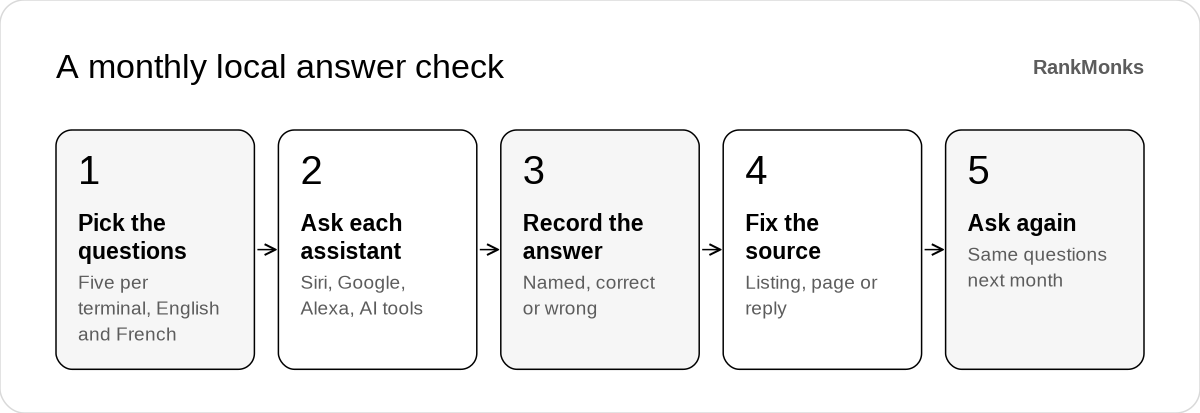
A simple log is enough: the question, the assistant, the language, whether your terminal was named, whether the details were correct and what you changed. When an answer is wrong, find the source. Usually it is a listing that does not match, an old directory entry or a terminal page that contradicts itself. Our guide to fixing wrong AI answers about your brand covers what to do when the error comes from a site you do not control.
What are the warning signs on local maps?
Watch for these signs that your local answers are at risk:
- Two listings for the same terminal, often one created years ago by a former manager.
- A listing for an unstaffed yard or a closed terminal.
- A map pin that sends trucks to the office car park instead of the gate.
- Hours that differ between Google, Apple, Bing and the site.
- Competitors with keywords stuffed into their business names outranking you. You can suggest an edit or report the listing to Google.
- A suspended listing after a change of address or name.
What should you ask an agency about local map answers?
- How will you decide which of our locations qualify for a listing?
- Will you manage Apple Business Connect and Bing Places as well as Google?
- How will you keep regular and holiday hours consistent across every listing?
- Who will write the French descriptions and terminal pages?
- How will you test voice answers, and how often?
- What will you do if a listing is suspended?
How do local map answers fit with SEO and the rest of AEO?
Local map answers rest on local SEO. Our guide to how Canadian trucking companies win on local maps with SEO covers rankings in the map pack, while this article covers what the answer says. The listings work also slots into the 90-day plan in how to implement AEO properly for Canadian trucking companies, and the same consistent facts help AI tools, as explained in how good AEO boosts AI visibility for Canadian trucking companies.
If you also run terminals south of the border, our guide to how US trucking companies win on local maps with AEO covers the American side. Everything connects back to our guide to AEO for Canadian trucking companies.
How does RankMonks approach local map answers for Canadian trucking companies?
RankMonks starts by reading every listing, terminal page and review profile you have, then asking the assistants what they say about each location. The written audit that follows covers SEO, AEO and GEO, with each problem ranked by what it costs you, so a wrong address at your busiest terminal comes before a missing photo at a small one.
Fixes ship in small, steady releases, and each month we report the local answers you won and lost alongside rankings, traffic and share of AI answers. The person who plans the work does it, because we take on a small number of clients at a time. Listing fixes can show within weeks. We do not guarantee map positions or voice answers.
Frequently asked questions
Can a trucking company list a drop yard on Google Maps?
Generally, no. Google expects a listed location to be staffed during its stated hours, so an unstaffed drop yard or trailer lot does not qualify for its own listing. Mention it on the nearest terminal's page instead, with directions for drivers.
Should each terminal have its own listing?
Yes, if each one is a real, staffed location that customers or drivers visit. Each listing should link to its own terminal page, not the home page. Use the same business name on every listing.
Do voice assistants answer local questions in French?
The major assistants, including Siri, Google's assistant and Alexa, can be set to French, so French-speaking drivers and shippers can ask local questions out loud. The answer depends on the listings and pages the assistant can use, so French descriptions and French terminal pages help. Test each assistant in both languages.
How often should we check our local answers?
Monthly is enough for most carriers, plus a check after any change to hours, addresses or terminal services. Ask the same questions in the same languages each time so the results can be compared. Check holiday hours before each statutory holiday.
Local answers are where many driver searches and shipper visits begin. Getting them right is part of our SEO service, and if you want a check of what the assistants say about your terminals today, start a conversation.
Written by RankMonks.