
SEO8 min read
Why SEO Is Important for Canadian Trucking Companies
Published · RankMonks
SEO is important for a Canadian trucking company because the people who decide whether you get a load or a driver usually search before they pick up the phone. A shipper looking for reefer capacity out of Calgary, a broker checking a carrier it has never used and an AZ driver looking for work near Brampton all start in a search box, and the carriers that appear there get the first conversation.
This article makes the business case. It is part of our complete guide to SEO for Canadian trucking companies, which covers the pages, technical work and measurement in full.
Key takeaways
- Shippers, brokers and drivers search before they call, so being absent from search means being absent from the shortlist.
- Relying only on brokers, load boards, referrals and paid job ads leaves a carrier paying for every load and every applicant.
- Canadian search has its own shape: provincial licence names, French in Quebec, and cross-border freight that Americans search for too.
- SEO compounds, because pages, reviews and links keep working after the effort that built them.
- AI assistants increasingly read the pages search engines rank, so SEO now shapes what those tools say about a carrier.
How do shippers find a carrier in Canada now?
Shippers find carriers through a mix of referrals, brokers and search, and search sits somewhere in almost every route. Even a shipper who hears your name from a colleague will usually look you up before calling.
Three kinds of search matter most:
- Capacity searches. "Reefer carrier Calgary", "flatbed trucking Hamilton", "Toronto to Montreal dry van". These come from shippers with a need right now.
- Capability searches. "Cross-border carrier Ontario to Michigan", "dangerous goods trucking Alberta", "heavy haul Saskatchewan". These come from shippers with a requirement that rules most carriers out.
- Checking searches. Your company name with "reviews", "safety" or "jobs". These come from people who already know of you and want reassurance.
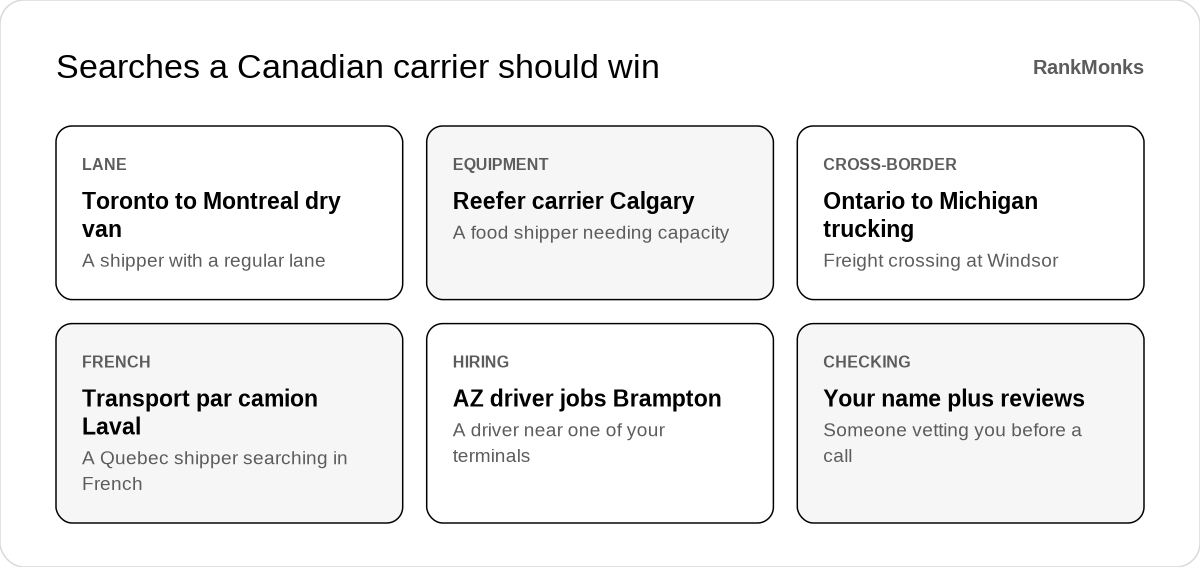
A carrier with one general services page cannot win the first two kinds, because no page matches the search. Matching each search to the right page is a question of search intent, and most carrier sites never ask it. And if the checking search turns up an outdated site, a profile with the wrong hours or a run of unanswered reviews, a warm referral can die right there.
Why does SEO matter for driver recruitment?
SEO matters for recruitment because drivers search for jobs the way shippers search for capacity: by licence class, location and the conditions they care about. Carriers across Canada describe hiring and keeping qualified drivers as a constant challenge, and every application that arrives directly is one you did not pay a job board for.
Drivers search with specific words. In Ontario they look for "AZ driver jobs", and in most other provinces for "Class 1 driver jobs", usually with a city or region and a condition such as "home daily", "home weekends" or "team". Owner-operators search for lease terms and steady lanes. In Quebec, many search in French.
A careers section with one page per role, stating pay structure, home time, equipment, lanes and requirements, can rank for those searches. Marked up with JobPosting structured data, each job can also appear in Google's job results. The detail does a second job: drivers who apply after reading the full picture are more likely to be a fit, and less likely to leave in the first month.
What does a carrier lose by relying only on brokers, load boards and referrals?
A carrier that relies only on brokers, load boards, referrals and paid ads gives up control of its pipeline and pays for each load or applicant. None of these channels is wrong, but each has a limit that SEO does not share.
| Channel | What it gives you | Its limit |
|---|---|---|
| Brokers | Freight without a sales team | The broker sets the rate and owns the shipper relationship |
| Load boards | Loads to fill empty miles | Spot freight, often priced against many other carriers |
| Referrals | Trusted introductions | Limited to people who already know you |
| Paid search ads | Visibility the day you pay | Stops when the budget stops |
| Job boards | Applications on demand | You pay per posting or click, and drivers compare you with every other ad |
| SEO | Direct quote requests and applications | Takes months to build, then keeps working |
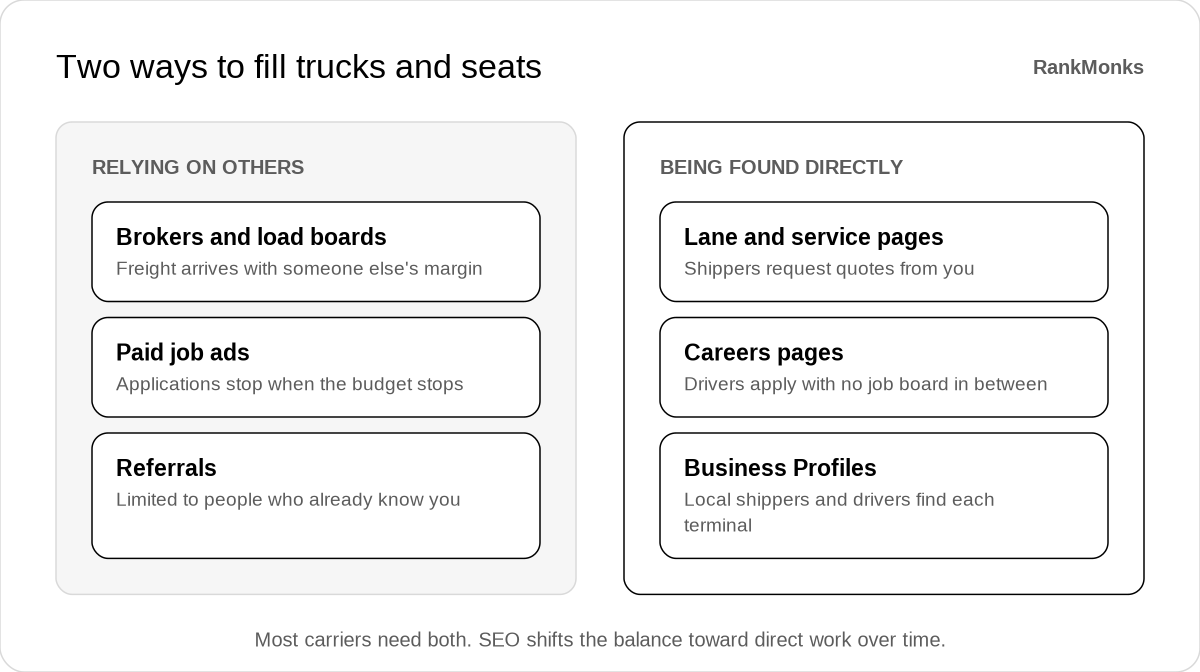
The point is balance, not replacement. A carrier that wins some of its freight and hires directly has a stronger position in every rate conversation, because it does not depend on any one channel.
Why does SEO compound for a carrier?
SEO compounds because the assets it builds keep working. A lane page written this year can bring quote requests for years if you keep it accurate. Reviews accumulate. Links from associations, partners and the trade press stay in place and keep passing authority to the rest of the site.
Paid channels work the other way: the day you stop paying, the visibility stops. That does not make them bad, but it does mean SEO is one of the few marketing costs that tends to become cheaper per result over time.
The compounding applies to trust too. A carrier with a detailed site, a complete profile for each terminal, steady reviews and a clear safety page wins more of the searches it appears for, because shippers and drivers find what they need to say yes without a phone call.
Why are Canadian trucking searches different from US ones?
Canadian trucking searches differ in language, regulation and geography, and a strategy copied from an American playbook misses those differences.
- Language. Quebec shippers and drivers search in French, for terms such as "entreprise de camionnage" or "emplois camionneur classe 1". A carrier serving Quebec needs real French pages to compete there.
- Licences and rules. Drivers search by provincial licence class, not "CDL". Shippers look for provincial safety credentials, such as an NSC number or, in Ontario, a CVOR certificate.
- Cross-border demand. Much Canadian freight moves to and from the United States, so American shippers and brokers search for Canadian carriers in American terms. A cross-border page that explains your crossings, eManifest handling and US authority speaks to them.
- Concentrated markets. Hubs such as the Greater Toronto Area, Montreal, Calgary, Edmonton, Winnipeg and Metro Vancouver are competitive, while many specialist and regional searches have little competition at all. That is an opening for carriers who build specific pages.
If you also run a US operation, the American side of the case is set out in why SEO is important for US trucking companies.
Why does SEO matter more now that buyers ask AI?
SEO matters more now because AI assistants read the web to answer questions, and the pages they read are largely the pages search engines can find and trust. A shipper who asks an assistant for cross-border reefer carriers in southwestern Ontario gets a short list, and carriers with clear, specific, well-ranked pages are more likely to be on it.
Our guide to how good SEO boosts AI visibility for Canadian trucking companies explains which SEO work carries over. The case for working on AI answers directly is made in why GEO is important for Canadian trucking companies, and for direct answers and voice in why AEO is important for Canadian trucking companies. For the bigger picture, see SEO in the AI era.
What warning signs show a carrier is neglecting SEO?
The clearest warning sign is that your own name is the only search you win. If a shipper has to know you already to find you, search is not bringing new work.
Other signs:
- Your services are listed in one paragraph on one page.
- Your careers page says "now hiring" with a phone number and no detail.
- A terminal has no Business Profile, or its profile shows old hours or the wrong address.
- Reviews from shippers go unanswered, or the newest one is a year old.
- You take loads or hire drivers in Quebec but have no French pages.
- Nobody can say which pages brought last quarter's quote requests.
What should you ask before you invest in SEO?
Ask questions that tie the work to freight and hires, whether you do it in-house or hire help.
- Which searches bring shippers and drivers in our regions, and do we appear for them?
- Which pages would we need to build to match those searches?
- How will we count quote requests and applications that come from search?
- What can realistically change in three months, and what will take longer?
- Who owns our Business Profiles, analytics and domain?
When you are ready to plan the work, how to implement SEO properly for Canadian trucking companies sets out the order, and how Canadian trucking companies win on local maps with SEO covers the terminal profiles.
How does RankMonks approach SEO for Canadian trucking companies?
RankMonks starts by reading everything: your site, your search data, your terminal profiles and listings, and what search engines and AI models say about you today. You get a written audit covering SEO, AEO and GEO, with each problem ranked by what it costs you, so you can see where the case for SEO is strongest before committing to more.
We take on a small number of clients at a time, and the person who plans your strategy does the work. Each month you get a plain-language report on rankings, traffic, citations and share of AI answers. We are honest about time: technical fixes can show within weeks, while content and authority work usually takes three to six months to move rankings.
Frequently asked questions
Is SEO worth it for a small Canadian carrier?
Often, yes, particularly for carriers with a specialty, a regional focus or a hiring need. Searches for specific equipment, lanes and local driver jobs have far less competition than broad terms, and a small number of well-made pages can win them. The full guide to SEO for Canadian trucking companies explains where to start.
How is SEO different from paying for Google Ads?
Google Ads buys visibility for as long as you pay, and stops when you stop. SEO earns visibility in the ordinary results and on the map, which takes longer to build but keeps working without a cost per click. Many carriers use both, with ads covering gaps while SEO builds.
Do shippers really search Google for carriers?
Many do, especially for specialized equipment, new lanes and cross-border work, and almost all of them search a carrier's name before trusting it. Even freight that starts with a referral or a broker often passes through a search on the way to a contract.
Does a carrier need SEO if it is always busy?
A busy carrier still benefits, because SEO gives it more choice over which freight and which drivers it takes on. It also protects the business when a large customer leaves or a broker relationship changes. Building the channel while you are busy is easier than building it in a slow quarter.
SEO is one of the few channels a carrier owns outright. Our SEO service is built to make that channel bring freight and drivers. If you want an honest read on where you stand, start a conversation.
Written by RankMonks.