
GEO9 min read
Why GEO Is Important for Canadian Trucking Companies
Published · RankMonks
GEO is important for Canadian trucking companies because the people who hire carriers, and the drivers who choose where to work, have started asking AI tools for names. A logistics manager in Mississauga asks ChatGPT which carriers run temperature-controlled freight to Montreal. A driver in Surrey asks Gemini which companies nearby are hiring Class 1 drivers for local work. The tool answers with two or three names and a reason for each, and the carriers it leaves out never hear about the load or the applicant.
GEO, short for generative engine optimization, is the work of making sure your company is one of those names and that what the tool says about you is true. Our explainer on GEO vs SEO vs AEO sets out how it differs from search. This article explains why it matters now, what a carrier loses without it, and why brokers, load boards and job boards do not cover the gap. For the full picture, including how to measure it, read our guide to GEO for Canadian trucking companies.
Key takeaways
- Shippers, brokers and drivers in Canada increasingly use AI tools to build a shortlist of carriers or employers before they visit any website.
- An AI answer names only a few companies, so being left out costs a carrier the quote request or the application, not just a ranking position.
- AI tools build their answers from your site, your listings and what independent sources say about you, which means the answer can be influenced honestly.
- Bilingual and cross-border carriers have the most to gain, because their customers ask precise questions about French-language service, US authority and border programs.
- GEO compounds: consistent facts and earned mentions keep working long after the work is done.
How are Canadian shippers and drivers using AI tools to find carriers?
They are using AI tools to ask the long, specific questions that a search box never handled well, and they expect a short list of names in return. One question often bundles the equipment, the lane, the border and the language together.
Here are prompts of the kind a Canadian carrier should expect:
- A shipper: "Which reefer carriers in the GTA run to Montreal several times a week and can handle food-grade loads?"
- A cross-border shipper: "I need an asset-based carrier in Ontario with US authority and FAST-approved drivers for Toronto to Chicago. Who should I call?"
- A driver: "AZ driver jobs in Brampton with home time every night and newer trucks."
- A Quebec shipper, in French: "Quelles entreprises de transport à Laval font du transport frigorifique vers l'Ontario?"
Each question draws on facts spread across your services, terminals, certifications, hiring pages and what others say about you. An AI tool that can find and trust those facts can name you. One that cannot will name someone else.
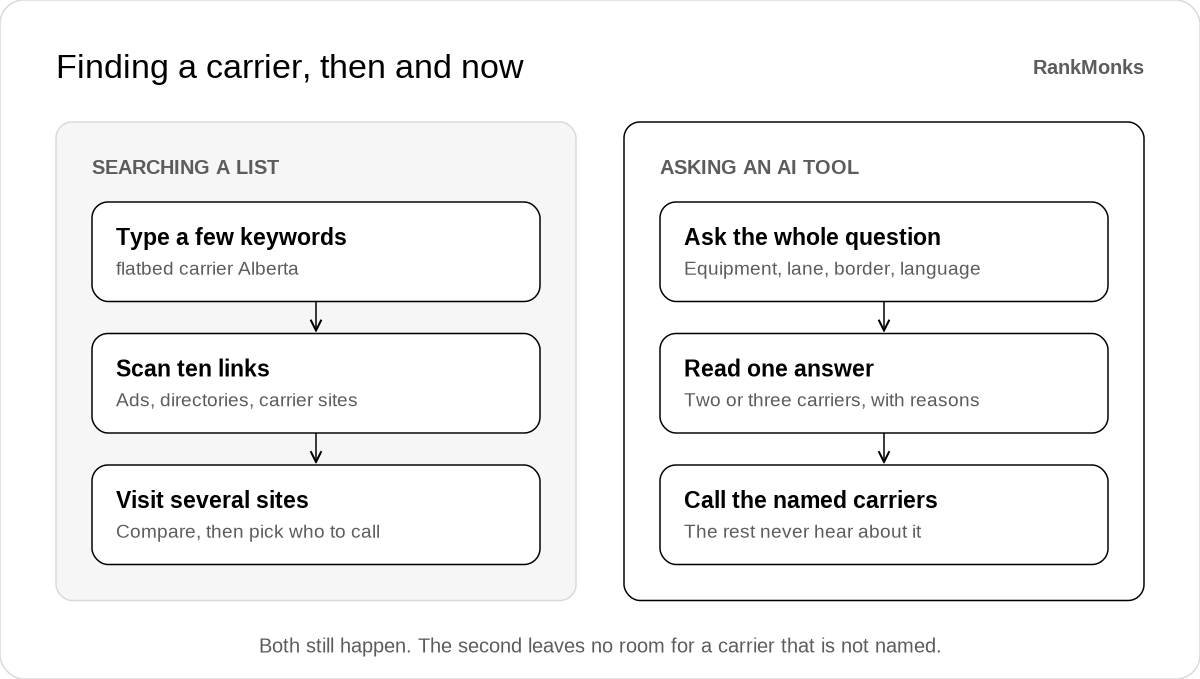
None of this replaces search. Many AI tools search the web while they answer, and they read the pages search engines already find and trust. That is why GEO rests on the foundations covered in why SEO is important for Canadian trucking companies.
What does a carrier lose when AI answers leave it out?
A carrier that AI answers leave out loses the request before it is made. There is no second page to scroll to, so the shipper calls the named carriers and the driver applies to the named employers.
The losses are easy to miss because they never appear in your analytics:
- Quote requests that go to competitors. A shipper who gets three names from an assistant rarely goes looking for a fourth.
- Applicants who apply elsewhere. A driver who never hears your name cannot apply, however good your pay, equipment and home time.
- Wrong descriptions that cost trust. An answer that says you do not cross the border, or that lists a terminal you closed two years ago, can rule you out even when you are named.
- More dependence on intermediaries. If shippers cannot find you directly, more of your freight arrives through brokers, with their margin taken out of the rate.
This follows from the format: ten links spread attention, while a written answer with three names concentrates it. Our GEO guide for Canadian carriers explains how to find out which side of that line you are on today.
Why can't brokers, load boards and job boards cover this for you?
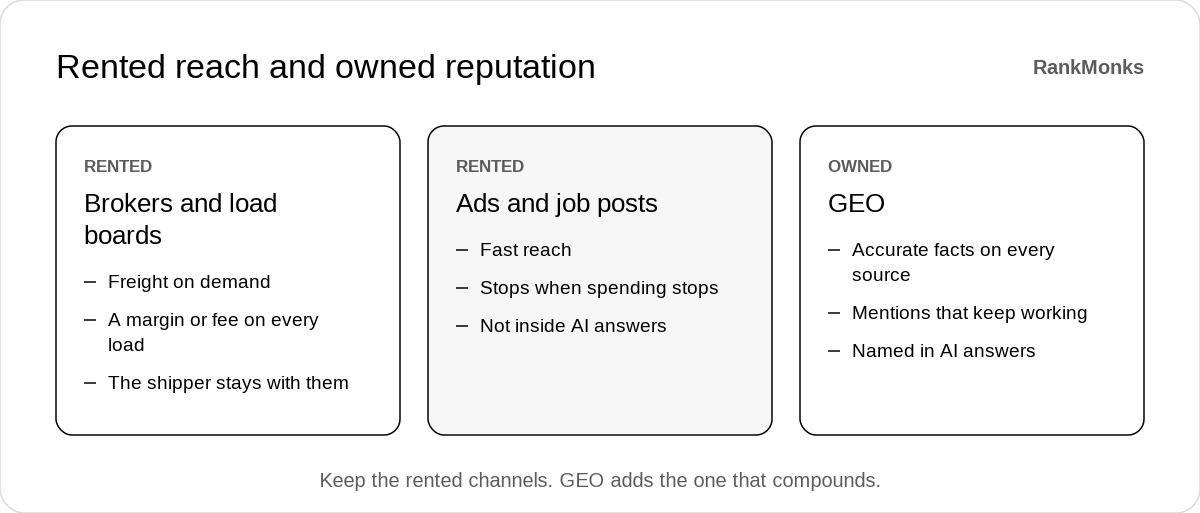
Brokers, load boards and job boards each meet a real need, but none of them puts your name into an AI answer, and some compete with you for it. They are channels you rent. GEO builds a reputation you own.
| Channel | What it does well | What it misses |
|---|---|---|
| Freight brokers | Fill trucks quickly and handle paperwork and credit | They take a margin, and the shipper relationship stays with them |
| Load boards (for example DAT, Truckstop or Loadlink) | Spot freight on demand | Price-driven, and invisible to a shipper asking an AI tool for a carrier |
| Job boards (Job Bank, Indeed and others) | Reach drivers who are actively looking | Your post sits beside every other carrier's on the same page |
| Paid search and social ads | Fast reach you can switch on and off | Stops when spending stops, and does not appear inside AI answers |
| GEO | Gets you named in AI answers, in your words and other people's | Takes months, and needs accurate facts and a real reputation |
Keep these channels. None of them covers the newest place carriers get chosen: the AI answer.
Why does GEO matter more for cross-border and bilingual carriers?
GEO matters more for cross-border and bilingual carriers because their customers ask the most specific questions, and specific questions are where AI tools need precise, published facts. A general carrier can be described in a line. A carrier with US authority, FAST-approved drivers and French-speaking dispatch needs every one of those facts stated somewhere a model can read and confirm.
Cross-border shippers ask about things like:
- whether you hold US operating authority and a USDOT number,
- whether you belong to Partners in Protection (PIP) or C-TPAT,
- whether your drivers hold FAST cards,
- whether you handle ACI and ACE eManifest filing or expect the shipper to arrange it,
- and which crossings you use most, such as the Ambassador Bridge or the Peace Bridge.
If those facts sit only in a PDF, an AI tool may guess, or leave you out.
Language works the same way. A shipper in Quebec who asks in French tends to get an answer built from French-language pages and sources. If your site has no French version, and no French-language directory or trade publication mentions you, your chances of being named are slim. Quebec's Charter of the French Language also sets rules for commercial content aimed at Quebec, so a French version is often a legal question as well as a marketing one. Check the current requirements with an advisor.
If you also run lanes into the US, our article on why GEO is important for US trucking companies covers the questions American shippers and drivers ask.
Why does GEO compound over time?
GEO compounds because the inputs it builds keep working. A trade press article, an association member listing, a run of honest reviews and a consistent set of facts do not switch off at the end of the month.
Paid channels stop when the budget does. GEO is closer to reputation: each accurate mention makes the next answer a little more likely to name you, and each corrected error stops being repeated. Our guide to brand mentions in AI search explains why independent mentions carry so much weight.
Our plan for implementing GEO properly sets out the order of work, and our article on winning local map answers with GEO covers terminals and yards.
What are the warning signs that GEO is being sold badly?
The clearest warning sign is a promise. Nobody controls what a model says, so anyone who guarantees that ChatGPT will recommend your company is guessing or misleading you.
Other signs to watch for:
- Machine translation sold as a French strategy. Unreviewed French copy reads badly to Quebec shippers and can misstate regulated facts.
- Pages written for bots. Hidden text, keyword lists, and a thin page for every town in Canada with only the name changed.
- Fake or incentivized reviews. Canada's Competition Bureau treats misleading reviews as a deceptive marketing concern, and AI tools repeat what reviews say.
- No baseline. Work that starts without recording what AI tools say about you today cannot show what changed.
What should you ask before you invest in GEO?
Ask questions that show whether the work will be measured.
- Which prompts will you track, and will they include shipper, driver, cross-border and French-language questions?
- How will you show me what AI tools say about us today, before any work starts?
- Which third-party sources matter most in our segment, and how will you get us onto them honestly?
- Who reviews French content and regulated claims such as certifications and safety records?
- How will you report progress, and what happens when a number does not move?
The measurement side of those answers is covered in why AI visibility is important for Canadian trucking companies. Our guide on how to choose an SEO agency covers the contract side of the conversation.
How does RankMonks approach GEO for Canadian trucking companies?
RankMonks starts by reading your site, your analytics, your market, and what search engines and AI models say about you today, then writes an audit covering SEO, AEO and GEO, with problems ranked by what they cost you.
For a Canadian carrier, the GEO part of that work usually means:
- a fixed prompt set built from your sales and recruiting conversations, in English and in French where you serve French-speaking customers, agreed with you before tracking starts;
- a baseline across ChatGPT, Claude, Perplexity, Gemini, Grok, Google AI Overviews and AI Mode;
- fixes to your pages and business facts, shipped in small, steady releases;
- and a monthly plain-language report on rankings, traffic, citations and share of AI answers, ending with what to do next.
We take on a small number of clients at a time, and the person who plans your strategy is the person who does the work. We do not guarantee a place in any AI answer, and we tell you up front how long each part is likely to take.
Frequently asked questions
What is GEO for a trucking company?
GEO, or generative engine optimization, is the work of getting a trucking company named and described correctly when people ask AI tools such as ChatGPT, Perplexity or Gemini for a carrier or an employer. It covers the company's own pages, its listings and the independent sources that mention it. The aim is to be on the short list the tool writes, with accurate facts beside your name.
Do Canadian shippers really use AI tools to choose carriers?
Some do, and the habit is spreading, although how much varies by company and by role. The simplest way to find out for your own business is to ask new customers and new drivers how they found you, and to include "an AI tool" as one of the options.
Is GEO only for large carriers?
No. A small fleet with a clear niche, such as reefer freight between Ontario and Quebec, can be easier for an AI tool to describe than a large general carrier. What matters is that the niche is stated plainly and confirmed by other sources.
Does GEO replace SEO for a trucking company?
No. Many AI tools search the web when they answer, and they read pages that search engines can find and trust. GEO builds on SEO, then adds work on the sources and facts that sit beyond your own site.
GEO gives a Canadian carrier a say in the answers that now decide who gets the call. Our SEO service covers GEO alongside search, and if you want to know what AI tools say about your company today, start a conversation.
Written by RankMonks.