
AI Visibility Tracking9 min read
Why AI Visibility Is Important for Canadian Trucking Companies
Published · RankMonks
AI visibility is important for Canadian trucking companies because the first shortlist of carriers is increasingly written by an AI tool, not built from a page of search results. A shipper, broker or driver asks a question, reads an answer with a handful of names in it, and moves on with those names. If your carrier is missing from that answer, or appears with the wrong facts, you lose the load or the driver before anyone calls.
This guide sets out the business case for Canadian carriers: how shippers and drivers use AI tools, what a carrier loses when it is left out, why a wrong answer can be worse than none, how AI answers compare with the channels you already rely on, and why the work compounds. It is part of our guide to AI visibility for Canadian trucking companies.
Key takeaways
- Shippers, brokers and drivers can now get a short list of carriers or employers from an AI tool before they visit any website.
- A carrier left out of those answers loses business silently, because there is no click, no visit and no record of the question.
- A wrong answer about your lanes, terminals, licence requirements or border programs can be more damaging than no answer at all.
- AI answers do not replace load boards, brokers or job boards, but they increasingly decide who gets checked first.
- The sources that shape AI answers build up over time, so carriers that start measuring and fixing early gain an advantage that is hard to copy quickly.
How are shippers and drivers in Canada using AI tools to find carriers?
Shippers and drivers in Canada use AI tools to ask the kind of detailed question that a search box handles badly, and to get a short answer they can act on. The questions mix equipment, lanes, compliance and location in one go.
A few realistic examples:
- A procurement lead in Winnipeg asks for "carriers that run heated vans to northern Ontario in winter".
- A 3PL in Montreal asks for "transporteurs qui font Montréal–New Jersey avec PAPS et dédouanement".
- A broker asks for "Alberta flatbed carriers with oilfield experience and good safety records".
- A driver in Surrey asks which "Class 1 trucking companies run cross-border to Seattle and get you home on weekends".
- A newly licensed driver asks which "companies in the GTA hire AZ drivers fresh out of MELT".
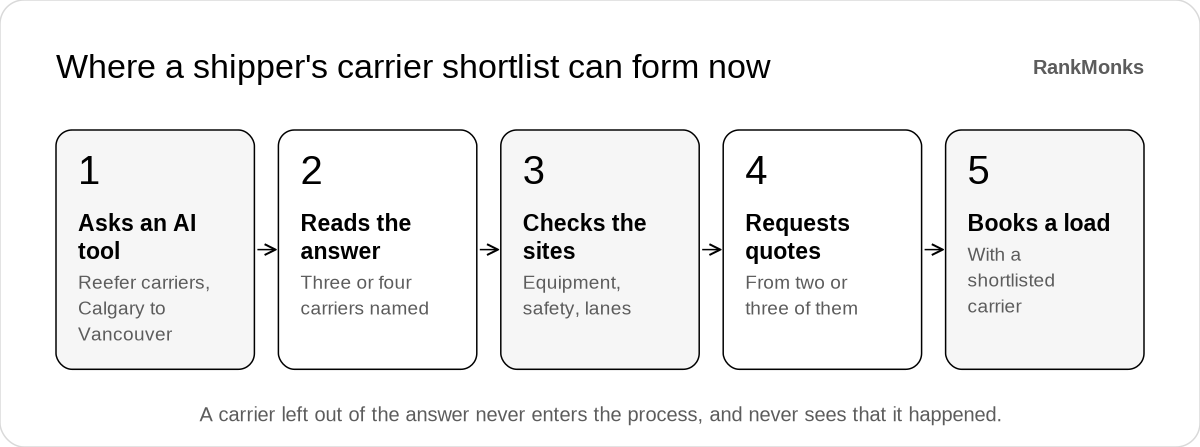
Each of these questions ends in a short list. The person may then check a few websites, call a dispatcher or apply for a job, but the list has already narrowed the field. How common this is varies by person and by company size, and the simplest way to find out for your own market is to ask new customers and new hires how they found you.
What does a carrier lose when AI tools leave it out?
A carrier left out of AI answers loses loads, partners and drivers it never knew were available. The loss is invisible, which is what makes it dangerous.
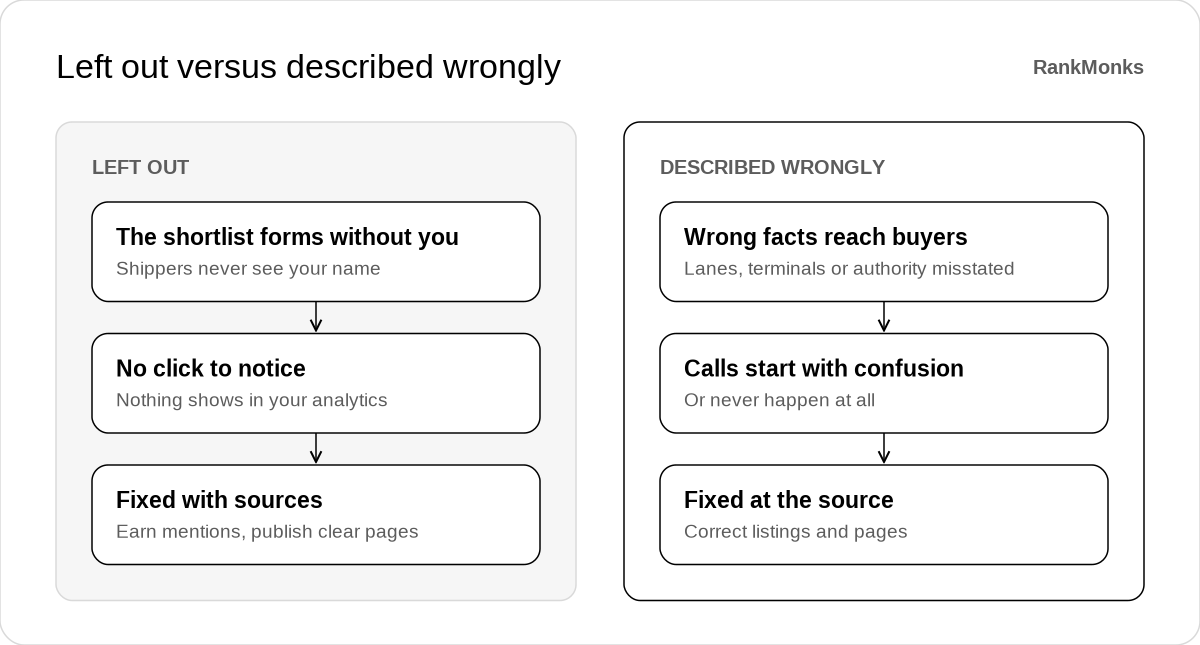
When you drop from page one of Google, you see it: traffic falls, Search Console shows fewer impressions, and calls slow down. When an AI tool stops naming you, nothing changes in your analytics, because the person never clicked anything. They read the answer, called the carriers it named and booked with one of them.
The losses fall in three places:
- Freight. Shippers and 3PLs who would have tendered a lane to you call someone else. On a dedicated or recurring lane, that is not one load but months of them.
- Partnerships. Brokers building a carrier network for a region ask for names and contact the ones they are given.
- Drivers. Recruiting is a constant cost for most carriers. A driver who asks an assistant for employers near home and never hears your name applies elsewhere.
None of this needs an invented statistic to be true. It follows from how the answers work: a few names are given, and the person acts on them.
Why is a wrong AI answer worse than no answer?
A wrong AI answer is often worse than no answer because it reaches the buyer or driver with your name attached, and they act on it. Being left out costs you a chance. Being misdescribed can cost you trust.
Trucking is full of facts that matter and are easy to get wrong:
- Cross-border status. An answer that says you do not run to the US, or that you do when you do not, sends the wrong shippers your way or none at all.
- Border programs. FAST, Partners in Protection and C-TPAT are real selection criteria for some shippers. Claiming one you do not hold, or missing one you do, both cause problems.
- Terminals. An old yard listed as your Brampton terminal sends drivers and visitors to the wrong gate.
- Equipment and freight. Reefers versus dry vans, dangerous goods under the TDG regulations, Super B-trains versus tridem trailers. A buyer needs the right equipment, not a near match.
- Hiring details. The wrong licence class, routes or home-time promise in an answer means applicants arrive with the wrong expectations, or do not apply.
Some errors come from out-of-date listings, some from pages about a similarly named company, and some from the model filling a gap with a plausible guess. Our guide to fixing wrong AI answers about your brand explains how to trace an error to its source.
How does AI visibility compare with load boards, brokers and job boards?
AI visibility does not replace the channels Canadian carriers already use, but it increasingly decides which carriers get checked first. Each channel does a different job.
| Channel | What it does well | Where it falls short | How AI answers change it |
|---|---|---|---|
| Load boards | Fills empty miles quickly | Price-led, spot freight, little loyalty | Shippers may skip the board and ask for named carriers |
| Brokers | Brings freight without a sales team | Margin goes to the broker, limited direct relationships | Brokers themselves ask AI tools to find carriers |
| Referrals | Trusted, high-quality leads | Slow and hard to scale | The person given a referral often checks it with an AI tool |
| Job boards | Reaches active job seekers | Crowded, costly per hire | Drivers ask assistants which employers to apply to |
| Paid search | Immediate presence | Stops when spend stops | AI answers sit above or beside the ads |
The point is not to drop any of these. It is to notice that one more place now decides who is considered, and that you can measure it. A carrier that relies on brokers for most of its freight, for example, has every reason to want shippers to find it directly when they ask.
Why does AI visibility work compound over time?
AI visibility work compounds because the inputs AI tools draw on build up. A clear lane page, an accurate listing, a mention in a trade publication or a member listing with an industry association keeps working after it is published.
AI tools form their view of a carrier from what they can read across the web: your own pages, business profiles, review sites, directories, job boards, association listings and trade press such as Truck News and Today's Trucking. Each accurate, consistent source makes the next answer a little more likely to name you and describe you correctly. Each inconsistent one adds noise. Our guide to brand mentions in AI search explains why mentions on other sites carry so much weight.
Measurement compounds too. A carrier that has tracked the same prompts for a year knows which lanes it owns in AI answers, which ones it is losing and which competitors keep appearing. A carrier starting from zero has none of that history. Our guide on why SEO is important for Canadian trucking companies makes the same case for search rankings, and the two support each other.
What warning signs suggest you are losing ground in AI answers?
The clearest warning sign is new business that mentions competitors you rarely saw before. Others are quieter.
- Shippers say they "found a list" of carriers and you were added late, or by referral.
- Drivers arrive with wrong ideas about your routes, pay structure or home time.
- French-speaking customers in Quebec seem harder to reach than English-speaking ones.
- Your branded searches hold steady while new lane inquiries fall.
- An assistant, asked about you directly, gets your terminals, equipment or cross-border status wrong.
Any one of these can have other causes. Together, they are a reason to run the prompts and look.
What should you ask before you invest in AI visibility tracking?
Ask whether the tracking will cover the questions that actually bring you freight and drivers, in the languages and places you work. Then ask what happens to the results.
- Will the prompts come from our real shipper, broker and driver conversations?
- Will you cover French prompts if we serve Quebec?
- Will you report by province, terminal and lane, not only as one total?
- Will every answer be checked for accuracy, not just counted?
- What will each report tell us to do?
What to track, segment by segment, is covered in our guide to AI visibility for Canadian trucking companies. For a broader look at choosing a provider, see our guide to the best AI visibility agency for small businesses. When you are ready to set things up, our guide to implementing AI visibility tracking properly for Canadian trucking companies walks through it step by step, and our guide to winning local map answers with AI visibility tracking covers terminal-level questions.
If you also operate in the US, the American side of the case is in our guide on why AI visibility is important for US trucking companies.
How does RankMonks approach AI visibility for Canadian trucking companies?
RankMonks starts by listening: we read your site, your search data and what AI tools currently say about you and your competitors. Then we build a fixed prompt set from your sales calls, recruiting conversations and search data, and you correct it so it sounds like your shippers and drivers.
We run those prompts across ChatGPT, Claude, Perplexity, Gemini, Grok, and Google's AI Overviews and AI Mode, take a baseline before anything changes, and track on a schedule. Every month you get a plain-language report on your share of answers, how you are described and what changed, ending with a short list of actions. We are a boutique agency, the person who plans the work does the work, and we do not promise placements that nobody can guarantee.
Frequently asked questions
Is AI visibility only important for large carriers?
No. Small and mid-sized carriers often have more to gain, because they cannot match the advertising budgets of large fleets. An AI answer to a specific lane or equipment question can name a 20-truck carrier that runs that lane well, as long as the facts about it are clear and consistent across the web.
Do drivers really use AI tools to find trucking jobs?
Some do, and the habit is spreading as AI tools are built into phones and search. Drivers ask practical questions about home time, routes, equipment and licence requirements. The best way to know for your own company is to add "how did you hear about us?" to your application form and read the answers.
Can we just ask ChatGPT about our company once and check?
You can, but one answer tells you very little. AI tools vary their answers from run to run, and the questions buyers ask rarely include your name. A fixed set of real buyer and driver questions, run several times on a schedule, gives you a number you can trust.
What should a Canadian carrier fix first?
Fix wrong facts first, especially terminals, cross-border status, border programs and hiring details, because those cost you the most when they are wrong. Then work on the prompts where you are missing and a competitor is named, starting with your most valuable lanes and your hardest-to-fill driver roles.
AI answers are now part of how carriers get chosen, and they can be measured like any other channel. Our AI visibility tracking service runs those measurements every month and turns them into work. If you want to see where your carrier stands, start a conversation.
Written by RankMonks.