
GEO is important for US trucking companies because a growing share of carrier research now ends in an AI answer that names only a few companies. When a shipper asks ChatGPT for reefer carriers out of the Central Valley, or a driver asks Google AI Mode which companies near Atlanta are hiring for regional runs, the carriers in that answer get the calls. The rest are never compared.
GEO, or generative engine optimization, is the work of shaping those answers. This article sets out the business case for a US carrier: how research has changed, what being left out costs, how GEO compares with the channels you already use, and why the work keeps paying once it is done. For the full method, see our guide to GEO for US trucking companies.
Key takeaways
- Shippers, brokers and drivers now ask AI tools full questions with lanes, equipment and timing, and get back a short list of named carriers.
- A carrier missing from that list is not compared at all, which is a bigger loss than ranking lower on a page of results.
- Being described wrongly, such as being called a broker or listed with the wrong trailer types, costs time as well as freight.
- GEO does not replace brokers, load boards, job boards or referrals. It gives a carrier a direct channel that does not stop when spending stops.
- The work compounds, because consistent facts, clear pages, reviews and independent mentions keep feeding answers after they are built.
How has the way shippers and drivers research carriers changed?
Shippers and drivers increasingly ask an AI tool a complete question instead of typing a short phrase and sorting through results themselves. The tool does the sorting and returns a few names.
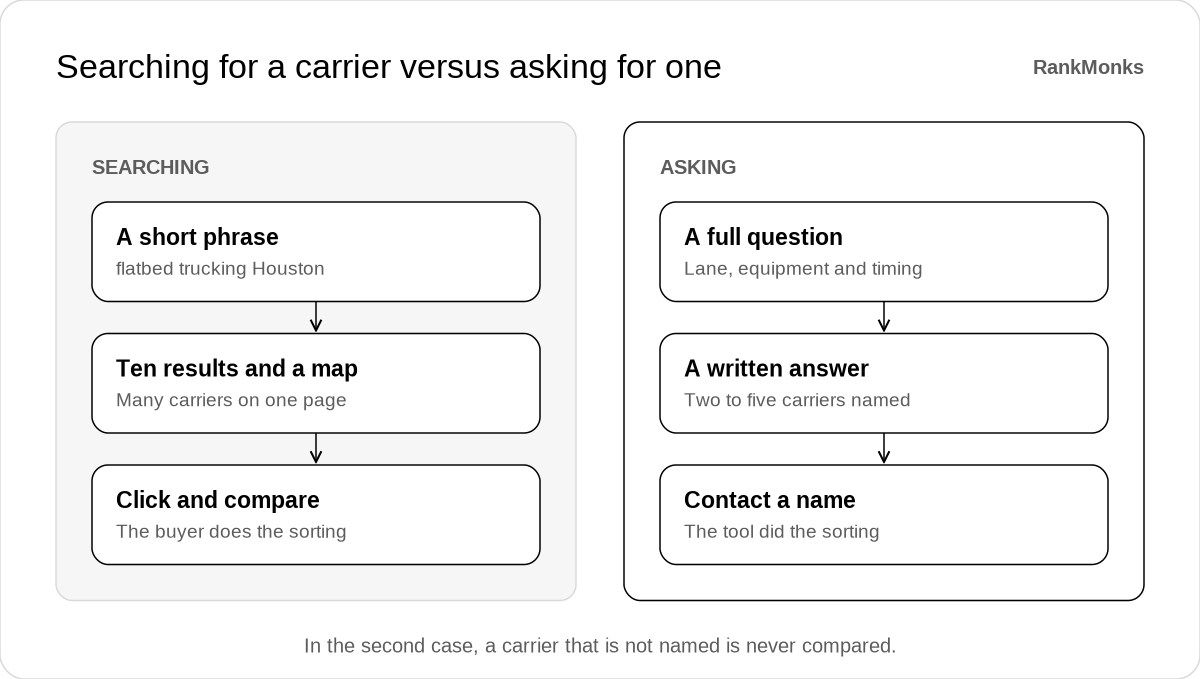
A traditional search for "flatbed trucking Houston" returns ads, a map with three carriers and a page of links. The person clicks around and builds a shortlist. An AI question looks different: "Which flatbed carriers based in Houston can haul pipe to the Permian Basin next week and have tarping experience?" The answer is a paragraph with two to five carriers, often with a sentence on why each fits.
The same shift shows up in hiring. A driver who once scrolled job boards can ask "Which trucking companies near Dallas-Fort Worth offer regional routes with home time every weekend and newer trucks?" and get named companies back.
Three things change for a carrier:
- The shortlist is made for the buyer. Being on page one of search results gave you a chance. Being named in the answer gives you the conversation.
- Details decide inclusion. "Tarping experience", "home every weekend" and "own trucks, not brokered" are the details that decide who gets named. If you do not state them anywhere, tools cannot match you.
- Descriptions travel. Whatever the tool says about you, accurate or not, is what the buyer believes first.
What does a carrier lose when AI tools leave it out?
A carrier left out of AI answers loses the chance to compete for that freight or that driver, without ever knowing the question was asked. There is no ranking report that shows the gap, which is why it often goes unnoticed for a long time.
The losses tend to fall into four groups:
- Direct shipper freight. Shippers who would have called you go to the carriers that were named. Over time, more of your freight arrives through brokers, at a lower rate.
- Driver applicants. For carriers that hire all year, every driver who never hears of you is one more applicant you pay to find on job boards.
- Accuracy. Being named wrongly can be as costly as not being named. A tool that says you run dry van only, when you also run reefer, sends reefer freight elsewhere. One that describes an asset-based carrier as a broker puts off shippers who want their own-truck carrier.
- Position against competitors. When a competitor is named for your lane every time, buyers start to treat it as the default choice for that freight.
None of this needs a statistic to be true. If buyers ask and the answer names three carriers, the fourth is invisible for that question.
How does GEO compare with brokers, load boards, job boards and ads?
GEO complements the channels a carrier already uses. It does not replace them. What it adds is a direct route to shippers and drivers that does not depend on paying for every lead.
| Channel | What it gives a carrier | What it costs or limits | Where GEO fits |
|---|---|---|---|
| Freight brokers | Steady access to loads | A share of the rate, little direct relationship with the shipper | GEO brings shippers who want to deal with a carrier directly |
| Load boards | Spot freight at short notice | Price competition on every load | GEO builds demand that is not won on price alone |
| Referrals | High-trust introductions | Limited to who already knows you | GEO extends that reputation to people who ask AI tools |
| Job boards | A flow of driver applicants | Ongoing spend per posting or applicant | GEO helps drivers find you when they ask for carriers directly |
| Paid search ads | Fast visibility for chosen searches | Stops when the budget stops | GEO work keeps feeding answers after it is done |
Most carriers will keep using every channel in this table. The point is balance. A carrier that depends entirely on brokers and paid channels has no presence of its own when buyers and drivers ask an AI tool.
Why does GEO compound for a carrier?
GEO compounds because each layer of the work keeps feeding AI answers after it is built, and each layer makes the next one more effective. A fixed listing, a clear lane page or a trade press mention does not expire at the end of a campaign.
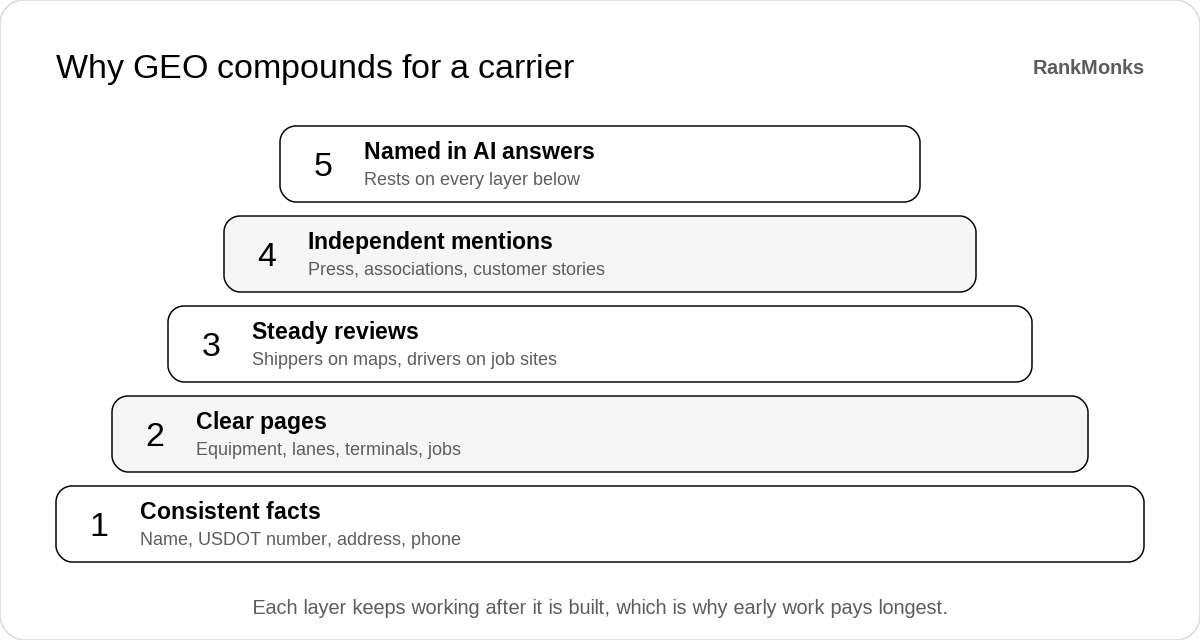
The layers build from the bottom:
- Consistent facts. The same legal name, USDOT number, address and phone on your registration, your site and every listing. Without this, everything above it is weaker.
- Clear pages. Equipment, lanes, terminals and driver jobs stated plainly, so a tool can match you to specific questions.
- Steady reviews. Shippers describing your service on Google and other maps, and drivers describing you as an employer on job review sites, recently.
- Independent mentions. Trade press, state trucking association directories and customer stories that describe you without your involvement.
- Named in answers. The result, which rests on everything beneath it.
A carrier that builds these layers early has a head start that is hard to close, because reviews and mentions take time to accumulate. Our guide to brand mentions in AI search explains why independent sources weigh so heavily.
Which carriers benefit most from GEO?
Carriers with a clear specialty or a constant need for drivers tend to benefit most, because AI questions reward specific, provable facts.
- Specialized carriers. Heavy haul, hazmat, temperature-controlled pharmaceuticals, livestock or oversize loads. Few companies match these questions, so stating your capability clearly goes a long way.
- Regional carriers with defined lanes. A carrier that runs Texas to the Midwest, or the Southeast out of Savannah, can own the questions about those lanes.
- Carriers recruiting all year. Driver questions are frequent and specific, and answers lean on employer reviews on job sites and on terminal details.
- Carriers moving away from broker freight. If the goal is more direct shippers, being named when shippers ask is the most direct route.
Shipper freight is a business-to-business sale, so the principles in our guide to B2B SEO apply here too. A carrier running only long-term dedicated contracts with no hiring needs may see less return. Even then, accurate descriptions protect the reputation those contracts depend on.
How does GEO fit with your other work?
GEO works best alongside the other three disciplines. If you want the same case made for search rankings, read why SEO is important for US trucking companies. For measurement, see why AI visibility is important for US trucking companies.
The full method is in our guide to GEO for US trucking companies. When you are ready to act, how to implement GEO properly for US trucking companies gives a 90-day plan, and how US trucking companies win on local maps with GEO covers terminals. If you also run lanes into Canada, see why GEO is important for Canadian trucking companies, where language and cross-border details change the picture.
What warning signs should you watch for when buying GEO?
Watch for anyone who sells GEO as a trick rather than as work on your facts, pages and reputation.
- Guarantees. No one can promise a place in ChatGPT or Gemini answers.
- Volume for its own sake. Hundreds of near-identical city pages or mass-produced articles add little and can harm the site.
- Fake signals. Bought reviews, planted posts in driver forums or invented customer quotes.
- No baseline. Work that starts without recording what AI tools say about you today cannot show what changed.
- Ignoring SEO. GEO rests on pages that search engines can find. An offer that skips the foundations will struggle.
What should you ask before paying for GEO work?
Ask questions that show whether the work will be measured and whether it fits trucking.
- What do AI tools say about our carrier today, and how did you check?
- Which questions from shippers, brokers and drivers will you track?
- Which sources do those answers rely on for carriers like us?
- What will you change on our site, our listings and our registration details first?
- How will you report progress, and how often?
How does RankMonks approach GEO for US trucking companies?
RankMonks treats GEO as one part of a single practice with SEO and AEO. We start by reading your site, your analytics and your market, and recording what AI models currently say about you. You get a written audit with problems ranked by what they cost you, then the work ships in small, steady releases.
We track an agreed set of prompts across ChatGPT, Claude, Perplexity, Gemini, Grok, Google AI Overviews and AI Mode, and report share of AI answers alongside rankings and enquiries each month. We do not guarantee placement, and we are clear that results take months.
Frequently asked questions
Do shippers really use AI tools to find carriers?
Many buyers now use AI tools for early research alongside search engines and their own networks, though habits vary by company and by role. The simplest way to find out for your freight is to ask new shippers and drivers how they first heard of you, and to include AI tools as an option.
Is GEO only relevant for large carriers?
No. Large carriers tend to win broad questions, but AI questions are usually specific, naming a lane, a trailer type or a home-time pattern. A small carrier that states those details clearly can be named ahead of much larger fleets for the questions it actually fits.
Can GEO help with driver recruiting?
Yes. Drivers ask AI tools about pay structure, home time, routes and company culture, and the answers lean on terminal details, careers pages and employer reviews on job sites such as Indeed and Glassdoor. Clear job pages and honest employer reviews make it more likely you are named for the jobs you actually offer.
Does GEO replace SEO for a trucking company?
No. AI tools that search the web tend to read pages that already rank well, so SEO is the foundation GEO builds on. The two share most of the same work, with GEO adding a focus on outside sources and on measuring the answers directly. Our guide to SEO in the AI era explains the foundation.
GEO matters because the carriers in the answer get the call. Our SEO service covers SEO, AEO and GEO together for carriers. If you want to know what AI tools say about your company today, start a conversation.
Written by RankMonks.