
Digital PR8 min read
Reactive PR: How to Earn Coverage With Expert Comment
Published · RankMonks
Reactive PR is the practice of earning coverage by responding to the news as it happens. You offer a qualified person's comment on a story that is already being written, or you answer a journalist's request for a source, and you do it quickly enough to be useful.
This guide covers where reactive opportunities come from, what to prepare in advance, how fast you need to be, how to write a comment that gets quoted, and how reactive work fits beside planned campaigns.
Key takeaways
- Reactive PR works because journalists on a deadline need a credible expert to explain what a development means, and they need one now.
- Opportunities come from three places: breaking news in your field, dates you can see coming, and requests journalists post for sources.
- Speed is decided before the news breaks, by having an expert bank, approved bios and a fast sign-off route ready.
- A quotable comment takes a position, names who is affected, uses plain words and runs to two or three sentences.
- Reactive PR complements planned campaigns, and part of doing it well is knowing which stories to leave alone.
What is reactive PR?
Reactive PR is a form of digital PR in which you respond to events instead of creating them. The story already exists. Your contribution is an expert who can explain it, challenge it or say what readers should do about it.
It takes two main forms:
- Commenting on the news. A regulator publishes new rules, a budget is announced or a large company in your field makes a move. You send relevant journalists a short comment from a named expert. This is sometimes called newsjacking.
- Answering journalist requests. A reporter is writing a piece and asks publicly for a source with particular knowledge. You reply with exactly what they asked for.
In both cases the journalist is already working on the story. You are helping them finish it, which is why a good comment can earn coverage in outlets that are hard to reach with a planned campaign.
The coverage is usually a quote with the expert's name, job title and company. Sometimes it includes a link and sometimes it does not. Both are worth having, because named expert quotes build the reputation that search engines and AI models read, as our post on brand mentions explains.
Where do reactive opportunities come from?
Reactive opportunities come from breaking news, from predictable events and from requests that journalists post when they need a source. A working programme watches all three.
Breaking news. Follow the publications, regulators and trade bodies in your field, and set alerts for the terms that matter. When something happens that your expert understands better than most, you have a window of a few hours.
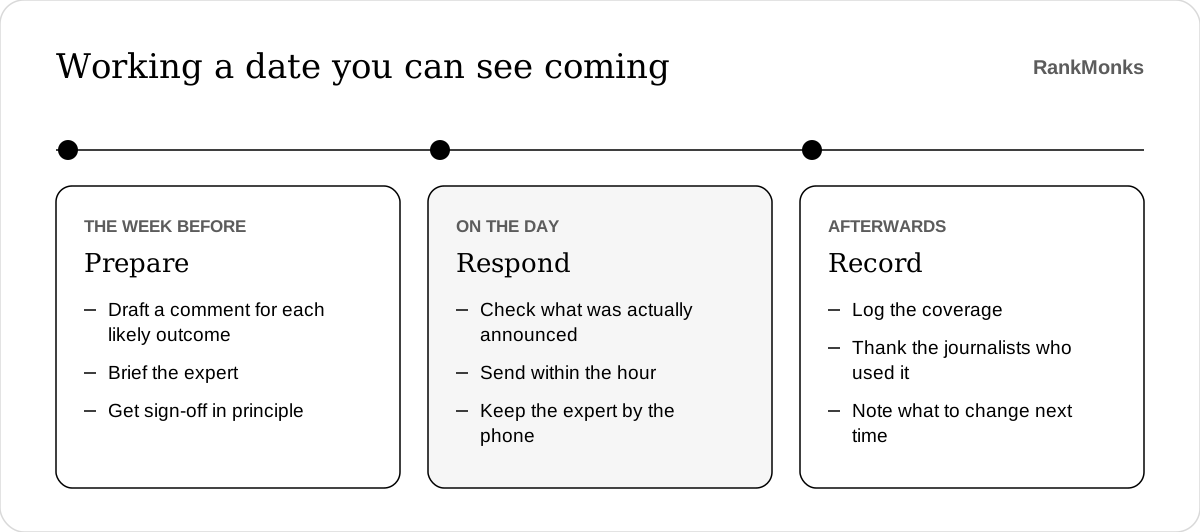
Predictable events. Much of the news is scheduled. Budgets, interest rate decisions, new regulations coming into force, annual results, awareness days and seasonal peaks all arrive on known dates. These are the easiest reactive wins, because you can prepare the comment in advance.
Journalist requests. Reporters ask for sources in several places:
- Journalist request services. These collect requests from reporters and send them to subscribers, usually by email, several times a day. Some are free and some are paid.
- Social media. Many journalists post requests publicly, often with the #journorequest hashtag.
- Direct relationships. A reporter who has used your expert before will come back when the subject comes up again. This is the best source of all, and it is earned by being reliable.
Read each request closely. A reply that ignores what the reporter asked for, or the deadline, is deleted.
How do you prepare for reactive PR?
You prepare for reactive PR by assembling, in advance, everything that would otherwise slow you down on the day. Reactive work looks spontaneous from outside, but almost all of it is preparation.
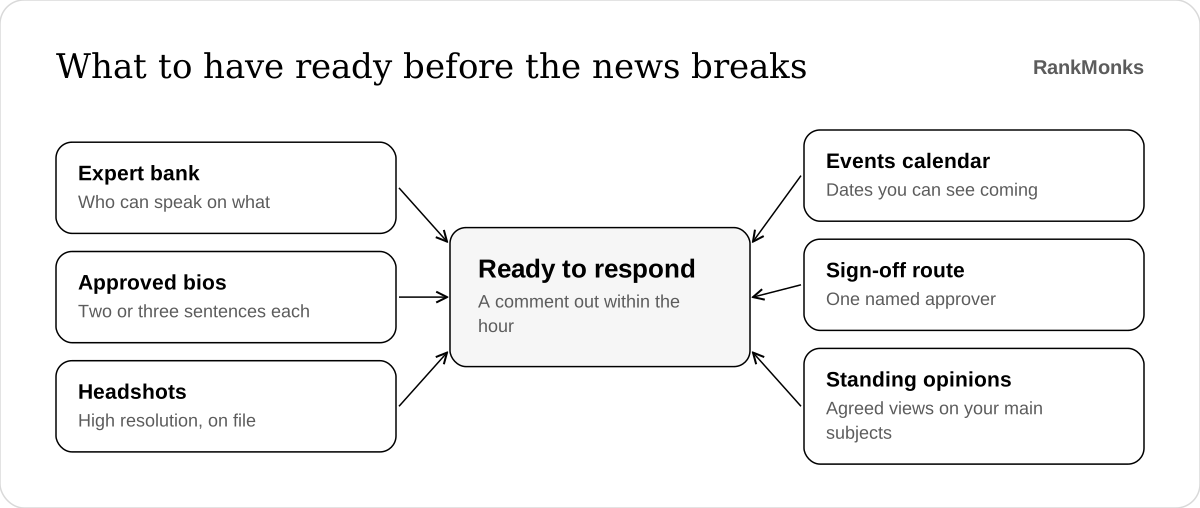
Set these up before you answer a single request:
- Build an expert bank. List the people in your company who can speak, and the subjects each one can speak on with real authority. Include their job titles and qualifications.
- Write and approve the bios. Two or three sentences per expert, signed off once, ready to paste.
- Get headshots on file. High resolution, plain background. Journalists often ask, and a delay can cost the placement.
- Agree standing opinions. For each main subject, agree what your company thinks and what it will not comment on. A comment drafted from an agreed position needs far less review.
- Set a fast sign-off route. Name one person who can approve a comment, and a deputy. If approval needs a committee, you will miss every deadline.
- Keep a calendar of predictable events. Mark the dates that matter in your field for the next twelve months, and who will comment on each.
- Decide who monitors. Someone has to read the requests and watch the news each morning. Make it a named job.
Named people with stated credentials are also the experience and expertise that E-E-A-T describes, so the same experts should be named as authors on your own site.
For example, an accountancy software company knows the date of the next tax announcement months ahead. It drafts three short comments from its head of tax, one for each likely outcome, and has them approved the week before. When the announcement is made, the team picks the comment that fits, adjusts one sentence and sends it within half an hour.
How quickly do you need to respond?
You need to respond within an hour or two for breaking news, and well inside the stated deadline for a journalist request. A reporter writing a news story will use the first good comments that arrive, and stop reading after that.
How fast depends on the kind of story:
| Opportunity | Typical window | What to send |
|---|---|---|
| Breaking news | The first hour or two | A ready comment and the expert's details |
| Predictable event | Minutes after the announcement | A comment drafted in advance, adjusted to the detail |
| Journalist request | Before the stated deadline, the sooner the better | Exactly what was asked for |
Speed never excuses a mistake. Check what was actually announced before you send a prepared comment, because the detail often differs from the forecast.
Put the comment in the body of a short email, followed by the expert's name, job title, company and a one-line bio. Our guide on how to pitch journalists covers the rest of the email.
How do you write a comment that gets quoted?
Write a comment that takes a clear position, says something specific, uses plain words and fits in two or three sentences. Journalists quote people who add something to the story, and they cut comments that only restate it.
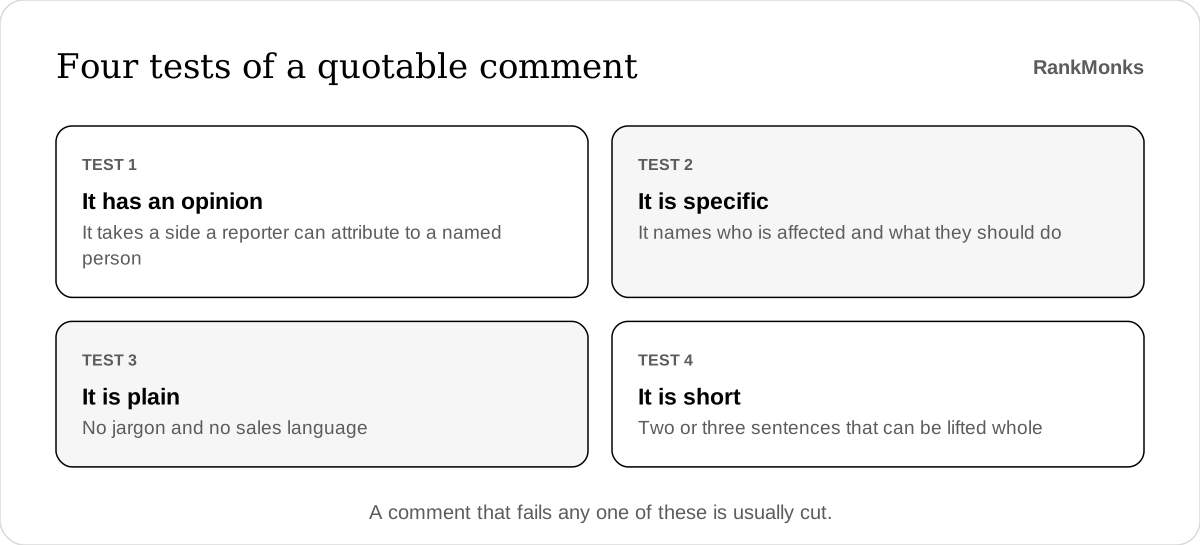
- Give an opinion. A reporter can state the facts themselves. What they need from a source is a judgement they can attribute: this is good, this is a mistake, this will not work as intended.
- Be specific. Say who is affected and what they should do. "Firms with fewer than ten staff should check their contracts this month" is usable. "Businesses should prepare" is not.
- Use plain words. Write the way the expert would explain it to a friend. Remove jargon, and remove every mention of your product.
- Keep it short. Two or three sentences that make sense when lifted out whole. Offer more on request.
Compare two comments on the same invented announcement. The first says the change "represents a significant development for the sector, and businesses will need to consider its implications carefully". The second says the change "helps large employers and hurts small ones, because the new reporting takes about a day a month that a ten-person firm does not have". Only the second gives a reader something they did not already know.
Never invent a quote and attach a name to it. The expert must have said it or approved it, because a journalist may ring to check.
How does reactive PR fit alongside planned campaigns?
Reactive PR fits alongside planned campaigns as the steady, low-cost part of a programme, with planned work supplying the larger stories. Each makes the other easier.
| Planned campaigns | Reactive PR | |
|---|---|---|
| Starting point | Your own story or data | Someone else's news |
| Lead time | Weeks | Hours |
| Main cost | Research and production | Monitoring and expert time |
| Typical result | Links to a research page | A named quote, sometimes with a link |
| Control | You set the timing | The news sets it |
| Main risk | The story does not land | You are too slow, or off topic |
Planned work, such as data-driven PR, gives you findings your experts can cite when they comment. Reactive work builds relationships with the journalists you will later pitch your own stories to.
Knowing when to stay out is part of the job. Leave these alone:
- Tragedies and disasters, unless your expertise is directly needed and the comment is offered without any promotion.
- Subjects outside your expertise. Staying on your own subjects is what builds topical authority.
- Party politics and divisive social issues, unless they bear directly on your field and you have an agreed position.
- Stories about competitors' misfortunes. It reads as opportunism.
Log every comment sent and every quote published, as you would for any other coverage. Our guide to measuring digital PR explains what to record, and our guide to SEO in the AI era explains why expert quotes in trusted publications help decide which brands answer engines name.
Frequently asked questions
What is the difference between reactive PR and proactive PR?
The difference between reactive PR and proactive PR is where the story starts. Proactive, or planned, PR creates a story from your own data or news and takes it to journalists. Reactive PR responds to a story that already exists by offering expert comment on it.
How do you find journalist requests?
You find journalist requests through journalist request services, on social media under hashtags such as #journorequest, and through reporters who already know your experts. Check them each morning, because many requests have deadlines the same day.
Does reactive PR earn links?
Reactive PR earns links some of the time, and named mentions most of the time. Whether a quote carries a link depends on the outlet's own policy. A mention in a trusted publication still builds reputation, and consistent expert comment often leads to linked coverage later. See our guide to link building for how the two fit together.
Who should be the spokesperson for reactive PR?
The spokesperson for reactive PR should be whoever has real, demonstrable expertise in the subject and can respond quickly. That is often a specialist, not the chief executive. Several experts covering different subjects will earn more coverage than one generalist.
Reactive PR rewards the companies that are ready before the news arrives. Getting your experts in front of reporters quickly is part of our digital PR work. If you have people worth quoting, start a conversation.
Written by RankMonks.